
Climbing plants
Mountain clematis
Сlematis montana
Synonyms: Clematis montana var. lilacina Lemoine, Clematis montana Buchanan-Hamilton ex de Candolle, Anemone curta Wall., Clematis anemoniflora D.Don, Clematis insularialpina Hayata, Clematis kuntziana H.Lév. & Vaniot, Clematis montana var. brevipedunculata Kuntze, Clematis montana var. incisa Kuntze, Clematis montana var. montana, Clematis montana var. obtusisepala Kuntze, Clematis montana var. pubescens Kuntze, Clematis montana var. uniflora Kuntze, Clematis punduana Wall, Clematis spooneri var. subglabra S.Y.Hu, Clematis montana var. rubens E.H. Wilson, Clematis montana var. potaninii (Maxim.) Finet & Gagnep
Mountain clematis (Clematis Dill. ex L) – a species of perennial herbaceous or woody plants of the genus Clematis (Clematis) in the Ranunculaceae family. It was named in honor of the well-known Scottish scientist Francis Buchanan-Hamilton. It was first described in 1817 (1818) in the book by the French and Swiss botanist Augustin Pyramus De Candolle «Regni Vegetabilis Systema Naturale, sive Ordines, Genera et Species Plantarum Secundum Methodi Naturalis Normas Digestarum et Descriptarum. Paris». In cultivation in Europe since 1831. It is now widely grown in gardens of Europe and North America.
In nature it occurs in Western Asia (Afghanistan), China (Anhui, Fujian, Gansu, Guangxi, Guizhou, Henan, Hubei, Hunan, Jiangxi, Ningxia, Qinghai, Shaanxi, Sichuan, Tibet Autonomous Region, Yunnan), East Asia (Taiwan), Bhutan; India (Himachal Pradesh, Jammu and Kashmir, Meghalaya, Nagaland, Sikkim, Uttar Pradesh), Nepal, Pakistan, Myanmar. It grows in forests, on slopes, along streams. It ascends to elevations of 1000-4000 m above sea level.
It is a woody deciduous climber up to 8 m high. Grows rapidly. Stems climbing, numerous, densely branched, thin, purple. Shoots cylindrical, deeply 4-10-ribbed, later becoming fissured. Climbs by means of long twining leaf petioles.
Root system superficial, roots fleshy, thin, sparsely branched.
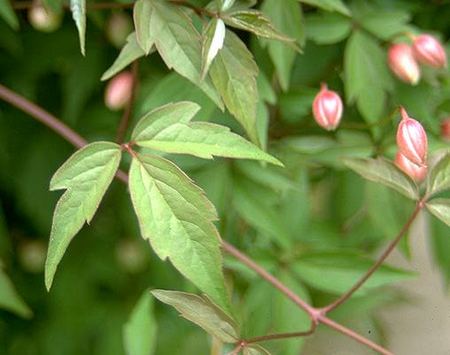
Leaves trifoliate, consisting of shortly petiolulate leaflets 3-10 cm long, rounded or cuneate-acuminate, base cuneate or rounded, with a coarsely serrate-toothed margin, often nearly entire, glabrous or nearly glabrous, with ciliate hairs along the veins, dark green. In autumn the leaves turn yellow.
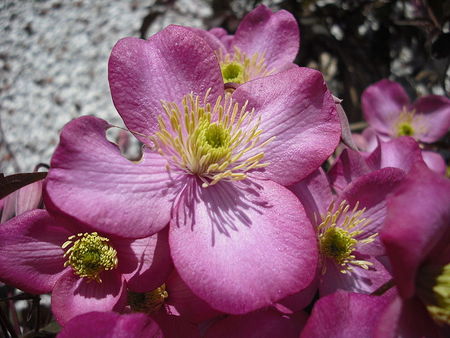
Flowers numerous, solitary, often gathered in axillary clusters of 2-5, up to 5-6 cm in diameter, snow-white, sometimes pink, borne on last year’s shoots, with a strong and pleasant vanilla scent. Sepals 4, broad, obovate to oblong-ovate, (0.7) 1.3-6.5 cm long and (0.3) 1-2.5 (3.5) cm wide, with a rounded apex, more rarely emarginate or shortly acuminate. Peduncles 5-12 (20) cm long. Perianth star-shaped, flat. Perianth segments 4, elliptic or ovate, slightly pubescent outside along the veins, ciliate at the margin, widely spreading. Stamens glabrous, 6-18 mm long. Anthers narrow, oblong, rarely linear, (1.5) 2-3 (4) mm long, with an obtuse apex, rarely acuminate. Ovary glabrous, rarely slightly pubescent. Flowers in May.
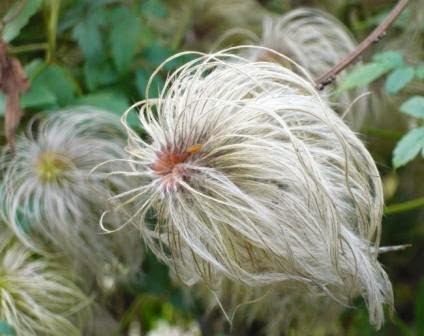
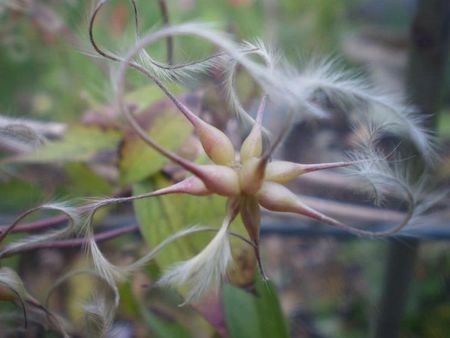
Fruits – glabrous achenes up to 7 mm long and 4-4.5 mm wide. Beak feathery up to 5 cm long. Fruits are gathered in tufted heads. Fruiting in July – August.
Varieties:
- Clematis montana var. Brevifoliola Kuntze
- Clematis montana var. Glabrescens (H.F.Comber) W.T.Wang & M.C.Chang
- Clematis montana var. Sterilis
- Clematis montana var. Wilsonii Spreng.
- Clematis montana var. Longipes
- Clematis montana var. grandiflora Hook.
- Clematis montana var. praecox (Kuntze) Brühl
Hardiness zone: 6b (-20°C). In most of Ukraine it overwinters with shelter and does not flower.
Site: warmth- and light-loving, requiring protection from strong cold winds. Prefers nutrient-rich and moist soil. In the temperate zone it is recommended to plant in sunny or slightly shaded locations. In southern regions it may suffer from overheating, so it can be planted in shade. Prefers light soils or loams, but can grow in any garden soil.
Planting: Planting pit size - 60x60x60 cm. Soil mixture – topsoil mixed with 2-3 buckets of compost or humus, 1 bucket of peat, 1 bucket of sand, 100-150 g superphosphate, 200 g complete mineral fertilizer, preferably 100 g bone meal, 150-200 g lime or chalk, 200 g ash. When planting in light soils it is recommended to add more peat. If the soil is wet, clayey or compact, a 10-15 cm layer of crushed stone should be laid for drainage. In southern regions planting is carried out in late September – early October, in the temperate zone – in September, in northern regions – in spring (late April or early May) or early autumn. In containers it can be planted throughout the growing season. For group plantings the distance between plants should be at least 1 m. For autumn planting the planting material should have developed vegetative buds; for spring planting - at least one shoot. Seedlings should have a minimum of 3 roots less than 10 cm long.
Care: In early spring clematis can be watered with lime milk (200 g lime per 10 l water per sq.m). During dry hot periods water the plant infrequently but deeply, avoiding directing the stream to the center of the bush. Clematis are fed at least four times per season after watering with a complete mineral fertilizer with microelements at a rate of 20-40 g per 10 l of water or with diluted fermented cow manure (1:10). Alternate mineral and organic feedings. In summer once a month plants are watered with a weak solution of boric acid (1-2 g) and potassium permanganate (2-3 g per 10 l of water), and bushes are sprayed with urea (0.5 tablespoon per 10 l of water). In spring after feeding and watering it is recommended to mulch the soil with peat or humus (northern regions) and sawdust (southern). To protect from overheating, annuals can be planted near clematis. Bushes need support. For winter the bushes are removed from the support and covered with dry leaves or conifer boughs.
Pruning: Because it flowers on last year’s shoots, the shoots are slightly shortened before winter.
Propagation: propagated by seeds, cuttings, layering. Seeds are sown in March-April; before sowing they require stratification for 3-3.5 months at 15-16°C. Seeds are sown when they have just begun to germinate. Non-dried seeds, when sown in April, give first shoots already after 1.5 months. Seedlings are grown in a greenhouse for the first year. When treated with rooting stimulants up to 90% of cuttings root.
Diseases: gray mold, powdery mildew, rust, wilt.
Pests: nematodes, spider mite, beet aphid, scale insects, bugs, snails and slugs, rodents (field vole, brown rat).
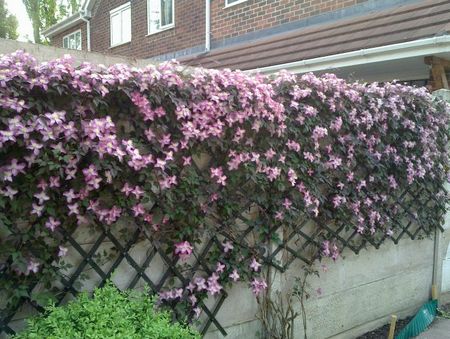
Uses: In southern regions used for decorating tall supports, arbors, pergolas, arches, house walls, fences, trees.