
Deciduous shrubs
Narrow-leaved lavender
Lavandula angustifolia Mill.
Synonym: True lavender, spike lavender, Lavandula officinalis Chaix ex Vill., Lavandula pyrenaica DC., Lavandula spica L., Lavandula vera DC., Lavandula spicata Linnaeus, L. vera de Candolle., Lavandula delphinensis Jord. ex Billot, Lavandula fragrans Salisb., Lavandula minor Garsault nom. invalid., Lavandula officinalis Chaix, Lavandula officinalis f. albiflora Rehder, Lavandula officinalis var. delphinensis (Jord. ex Billot) Rouy, Lavandula spica L., Lavandula spica var. angustifolia (Ging.) Briq., Lavandula spica var. delphinensis (Jord. ex Billot) Nyman, Lavandula vera var. angustifolia Ging., Lavandula vera var. ligustica De Not., Lavandula vulgaris Lam.
Narrow-leaved lavender (Lavandula angustifolia Mill.) – a species of herbaceous plants of the genus Lavandula (Lavandula) of the family Lamiaceae. The species was first described in 1768 by the English botanist Philip Miller in the book «The Gardener’s Dictionary». The species was named for its narrow leaf shape, but was previously known as Lavandula officinalis due to its medicinal properties. In cultivation since the 1500s.
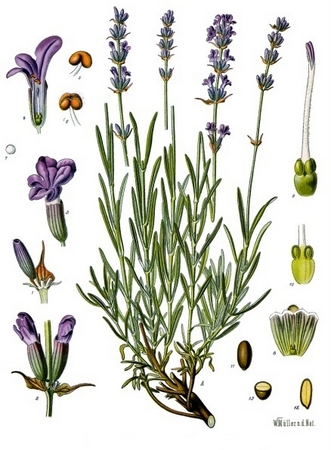
Illustration from the book Franz Eugen Köhler «Köhler’s Medizinal-Pflanzen», 1887
The plant is native to the western Mediterranean – mainly the Pyrenees and other mountains in the northern part of Spain. It is also found in Italy, Andorra and France. Naturalized across much of Europe, North Africa and northern Europe.
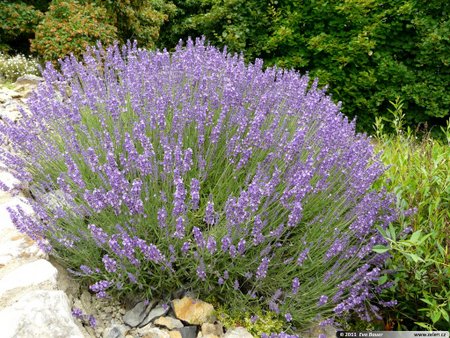
It is a perennial evergreen, strongly branched subshrub 30-60 (100) cm in height. The crown is globular. All parts of the plant have a strong aroma. Lower branches become woody, are highly branched, ascending, and bear numerous young woolly-pubescent whitish-gray shoots. Flowering shoots are 4-angled, the upper internode long, up to 45 cm in length. The bark is brown. Plants live up to 20 years.
The root system is a woody taproot, branched in the upper part.
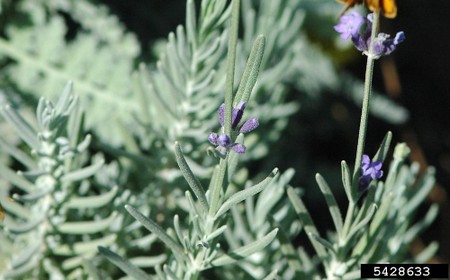
Leaves sessile, arranged oppositely, oblong-linear in shape, with an obtuse apex, 2-6 cm long and 0.3-0.6 cm wide, margins entire and revolute. When unfolding the leaves are woolly-pubescent and grayish-green, later becoming glabrous and green.
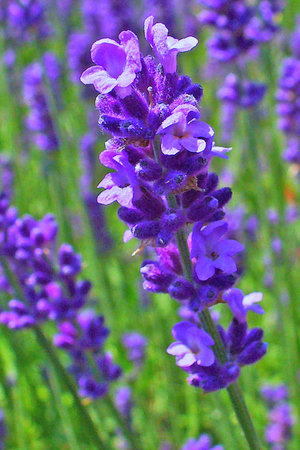
Flowers – false whorls of 6-10, gathered in loose or dense terminal spike-like inflorescences 4-8 cm long, below which there is usually one or several more such whorls. The corolla is indistinctly bilabiate, bluish-violet, up to 1 cm long, pubescent, with large lobes. The calyx is tubular, 0.4-0.7 cm long, with 13 veins, often with purple-coloured teeth, densely pubescent. Flowers from July to September, for 25-30 days.
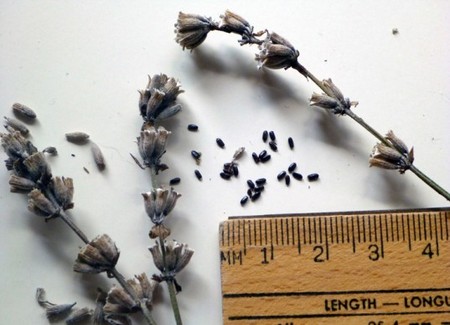
Fruit – 4 nutlets enclosed in a slightly detached calyx. Weight of 1000 seeds 0.8-1 g.
Hybrids:
- Lavandula × chaytoriae Upson & S. Andrews
- Lavandula × intermedia Emeric ex Loisel. (L. Angustifolia х L. Latifolia)
- Lavandula × heterophylla Poir.
Subspecies:
- Lavandula angustifolia subsp. Angustifolia
- Lavandula angustifolia subsp. pyrenaica
Cultivars: AGM award - 'Alba', 'Beechwood Blue', 'Hidcote', 'Imperial Gem', 'Miss Katherine', 'Nana Alba', 'Richard Gray', 'Sawyers', 'Sussex'; dwarf cultivars - Compacta, Folgate, Dwarf Blue, Dwarf White, Hidcote Pink, Hidcote Superior, Munstead, Nana Atropurpurea, Nana Rosea, Sarah, Summerland Surpreme, Lady Lavender; semi-dwarf cultivars - Bowles Early, Hidcote Variety, Loddon Blue, Martha Roderick, Jean Davis, Twickle Purple, Pink Perfume; tall cultivars - Alba, Blackhouse Purple, Biostos, Bridestowe, Graves, Gray Lady, Gwendolyn Anley, Hidcote Giant, Irene Doyle, Mailette, Middachten.
Hardiness zone: zone 5-8 (-25°C).
Location: prefers sites raised above ground level and open areas in full sun. Does not tolerate severe frosts well. Drought-tolerant. Required sum of active temperatures 3600°. Tolerates urban conditions well.
Propagation: Propagated by seed, division, cuttings and layering. Cuttings are taken in spring from 1- or 2-year-old shoots up to 10 cm long. Spacing for cuttings in a cold frame - 5×5 or 6×4 cm. They are planted out in early autumn. Seeds are sown outdoors for wintering in October or for seedlings in February-March. Seeds for seedlings require stratification: sow seeds into soil to a depth of 0.5 cm, moisten with a sprayer. Cover with glass and store in a refrigerator at +5 to +7°C for 1-3 months, after which the sowings are transferred to room conditions, providing appropriate moisture and ventilation. At +18 to +20°C seedlings emerge in 14-21 days. When at the 2-3 pairs of true leaves stage the plants are pricked out. After the end of spring frosts seedlings can be planted outdoors. When grown from seed plants flower in the 2nd-3rd year after sowing. To propagate by division: in autumn cut the plant back to a height of 8-10 cm above soil level, heaping soil around it and carefully filling the spaces between stems with soil. In spring add more soil around the bushes. During the summer the plant produces abundant shoots which root well. In autumn the bush is dug up and divided. To obtain layers: in spring bend down 2 or 3 shoots, lay them in a 3-5 cm deep trench, pin them down, cover with soil and water. During the summer keep the soil near these layers slightly moist. The following spring the shoot can be cut off and transplanted.
Soil: an undemanding plant. Prefers dry calcareous or poor, well-drained, non-acidic soil; grows poorly on heavy and clay soils. Does not like waterlogging.
Planting: planting mix – lime, compost, humus and sand in small amounts. Recommended spacing between plants – 30-40 cm. For establishing plantations the recommended planting scheme is 120-140 x 35-40 cm. Planting density — 20,000 plants per 1 ha.
Care: practically requires no care. Recommended to water when the soil dries out, weed and loosen the soil, and remove faded flower stems. Nitrogen fertilizers can be applied. When young it needs winter protection with boughs or pine needles.
Pruning: in spring cut shoots by 1/3 of their length (10-15 cm). Do not cut back to woody stems, as young shoots will not develop. If productivity declines the plant can be rejuvenated by cutting the bush to a height of 4-5 cm above the soil surface (this procedure is carried out at 10-12 years of age).
Diseases: gray mold.
Pests: spittlebugs (Philaenus spumarius).
Companions: roses, aromatic plants, plants with yellow flowers, fragrant Santolina.
Uses: used in formal and informal designs. Suitable for creating low hedges in urban landscaping and gravel gardens, for stabilizing embankments and slopes. Looks good in the front and middle rows of mixed borders, in rockeries, and in aromatic gardens. Can be grown as a potted and container plant. A good nectar plant that attracts large numbers of bees and butterflies. Planted along paths and near entrances because lavender releases a pleasant aroma when touched. Also planted near vegetable gardens to repel pest insects. All parts of the plant contain essential lavender oil, which is widely used in aromatherapy, in the production of perfumery and cosmetic products and in liqueur and spirits production. Flowers and oil are used in culinary applications. Widely used in medicine. Lavender flowers are used to repel mosquitoes and midges and to protect fur and woolen items from moths. Lavender honey is considered medicinal.