
Deciduous shrubs
Lavender
Lavandula
Synonym: lavender, леванда, лавенда, цветная трава, Isinia Rech. f., Stoechas Mill.
Lavender (Lavandula L.) – a genus of herbaceous plants in the family Lamiaceae. The genus name derives from the Latin "lava" ("to wash"), indicating that the Romans added this plant to their baths, or from the Latin "livere", meaning "bluish".
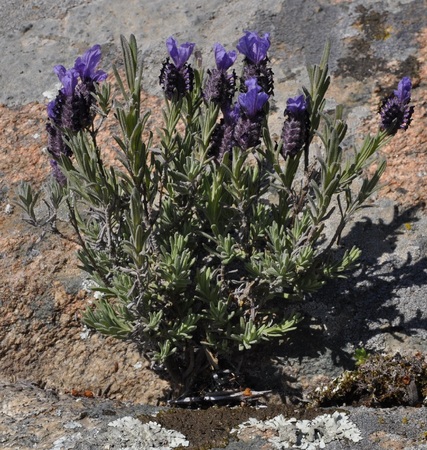
Lavandula stoechas
Members of the genus are found on the Canary Islands, in northern and eastern Africa, southern Europe, in Arabia and India. Cultivated forms are grown worldwide.
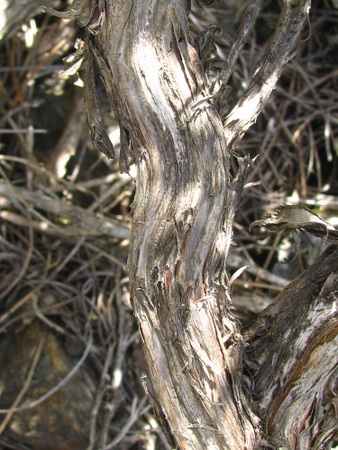
Middle part of the stem. Lavandula angustifolia
These are herbs, subshrubs and shrubs. The root is a taproot, woody. Stems are erect or sprawling, branched, and four-angled.
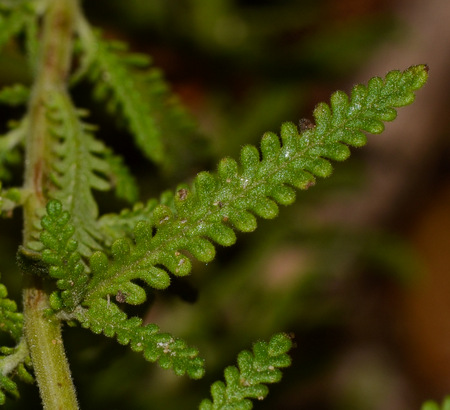
Lavandula dentata
Leaves are opposite, linear-lanceolate in shape, simple, with entire or toothed margins, less often pinnate; sessile, blunt, hairy, with revolute margins.
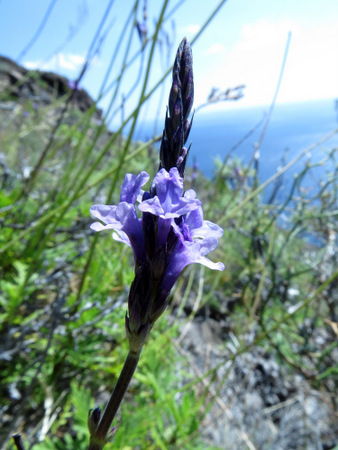
Lavandula canariensis
Flowers are small, blue or purple (hybrids may be other colors), grouped in false whorls of 6-10 that form loose or moderately dense cylindrical, spike-like inflorescences at the tips of thin, long, upright flower stalks. Often several widely spaced whorls are located beneath this spike. The calyx is cylindrical or urn-shaped, indistinctly bilabiate, 5-toothed, with 13-15 veins. The corolla is weakly bilabiate, pubescent outside and tubular at the base. The corolla tube is cylindrical, narrow and long. The upper lip consists of 2 rounded, almost flat lobes; the lower lip is 3-lobed, the lobes rounded and flat. There are 4 stamens; they do not exceed the length of the corolla tube. Flowering is prolonged, in the second half of summer and early autumn.
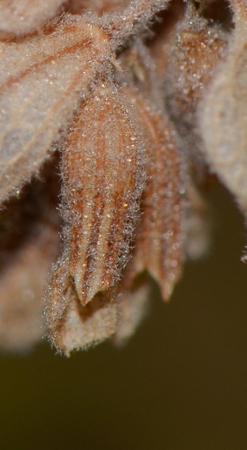
Lavandula dentata
The fruit is a schizocarp, a dry ellipsoid nutlet of dark brown color. It consists of 4 shiny and smooth parts.
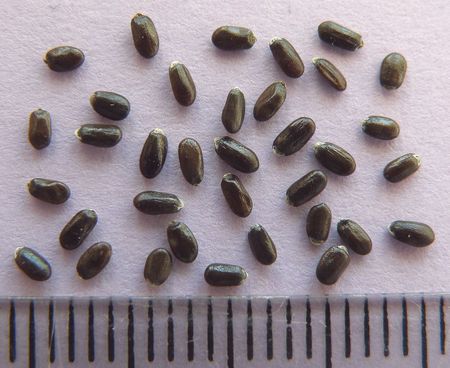
Lavandula angustifolia
Classification: Lavandula stoechas, Lavandula pedunculata and Lavandula dentata were known already in the times of the Roman Empire. In the Middle Ages European species were separated into two groups or genera Stoechas (L. stoechas, L. pedunculata, L. dentata) and Lavandula (L. spica and L. latifolia), until Linnaeus combined them in his "Species Plantarum" (1753) and included three more species in the genus – L. multifida, L. spica and L. dentata. (L. pedunculata was included in L. stoechas). In 1790 the species L. pinnata and L. carnosa were distinguished, but the latter was transferred to the genus Anisochilus. In 1826 the Swiss botanist F.C.J. Gingins de la Sarraz recognized 12 species in 3 subgenera. By 1848 18 species were known. The first modern classification was proposed by Dorothy Chaytor in 1937 at Kew. She recognized 28 species in 6 sections – Stoechas, Spica, Subnudae, Pterostoechas, Chaetostachys and Dentatae. All major and commercial species were placed in Stoechas (Lavandula stoechas, L. dentata, L. viridis and L. pedunculata); Spica included 3 (L. officinalis (L. angustifolia), L. latifolia and L. lanata). She believed that all garden cultivars were hybrids between L. angustifolia and L. latifolia. More recently Upson and Andrews recognized 3 subgenera, which are now considered the most accurate.
Some botanists use the terms: "French lavender", "English lavender", "Dutch lavender" and "Spanish lavender". These are not entirely precise. "English lavender" is generally used for Lavandula angustifolia. The name "French lavender" may be used to refer to L. stoechas or L. dentata. "Spanish lavender" is used for L. stoechas, L. dentata or L. lanata. "Dutch lavender" refers to L. intermedia.
Subgenera: Includes 3 subgenera:
The subgenus Lavandula mainly comprises woody shrubs with entire leaves. It contains the main species grown as ornamentals and for oil production. They occur in the Mediterranean region, northeastern Africa and western Arabia.
The subgenus Fabricia consists of shrubs and herbs and has a wide distribution from the Atlantic to India. It includes some ornamental plants.
The subgenus Sabaudia includes 2 species that occur in the southwestern Arabian Peninsula and Eritrea. Sometimes these species are placed in a separate genus Sabaudia.
Species: 25-45 species are recognized. In cultivation only 2 species are widely used - L. latifolia and L. officinalis.
- Lavandula angustifolia Mill. — Narrow-leaved lavender
- Lavandula antineae Maire
- Lavandula aristibracteata A.G.Mill.
- Lavandula atriplicifolia Benth.
- Lavandula bipinnata (Roth) Kuntze
- Lavandula bramwellii Upson & S.Andrews
- Lavandula buchii Webb & Berthel. — Buch's lavender
- Lavandula canariensis Mill. — Canary lavender
- Lavandula citriodora A.G.Mill.
- Lavandula coronopifolia Poir.
- Lavandula dentata L. — Toothed lavender
- Lavandula dhofarensis A.G.Mill.
- Lavandula erythraeae (Chiov.) Cufod.
- Lavandula galgalloensis A.G.Mill.
- Lavandula gibsonii J.Graham
- Lavandula hasikensis A.G.Mill.
- Lavandula lanata Boiss. — Woolly lavender
- Lavandula latifolia Medik. — Broad-leaved lavender
- Lavandula macra Baker
- Lavandula mairei Humbert
- Lavandula maroccana Murb.
- Lavandula minutolii Bolle
- Lavandula multifida L. — Many-lobed lavender
- Lavandula nimmoi Benth.
- Lavandula pedunculata (Mill.) Cav. — Pedunculate lavender
- Lavandula pinnata L.f. — Pinnate lavender
- Lavandula pubescens Decne.
- Lavandula qishnensis Upson & S.Andrews
- Lavandula rejdalii Upson & Jury
- Lavandula rotundifolia Benth.
- Lavandula saharica Upson & Jury
- Lavandula samhanensis Upson & S.Andrews
- Lavandula setifera T.Anderson
- Lavandula somaliensis Chaytor — Somali lavender
- Lavandula stoechas L. — Stoechas lavender
- Lavandula sublepidota Rech.f.
- Lavandula subnuda Benth.
- Lavandula tenuisecta Coss. ex Ball
- Lavandula viridis L'Her.
Hybrids:
- Lavandula allardii
- Lavandula cadevallii Sennen
- Lavandula chaytorae
- Lavandula christiana
- Lavandula ginginsii
- Lavandula heterophylla
- Lavandula intermedia Emeric ex Loisel. — Hybrid lavender, or Dutch lavender
Hardiness zone: zone 5-8 (-25°C).
Location: prefers sites raised above ground level and open areas in full sun. Does not tolerate severe frosts well. Drought-tolerant. Required sum of active temperatures 3600°. Performs well in urban conditions.
Propagation: Propagated by seed, division, cuttings and layering. Cuttings are taken from 1- or 2-year-old shoots up to 10 cm long in spring. Spacing for cuttings in a cold frame is 5×5 or 6×4 cm. Early autumn they are planted into open ground. Seeds are sown outdoors in October for winter sowing or sown for seedlings in February-March. Seeds for seedlings require stratification: sow seeds in soil to a depth of 0.5 cm, moisten with a sprayer. Cover with glass and store in a refrigerator at +5+7°C for 1-3 months, after which the sowings are transferred to room conditions with adequate moisture and ventilation. At +18+20°C seedlings appear in 14-21 days. At the 2-3 pair true leaf stage plants are pricked out. After the last spring frosts, seedlings can be planted out. With seed propagation plants flower in 2-3 years after sowing. For division propagation in autumn the plant should be cut back to 8-10 cm above ground level, mounded with soil, carefully filling the space between stems with soil. In spring add more soil to the clumps. During summer the plant produces abundant shoots that root well. In autumn the clump is dug up and divided. For layering, in spring bend 2 or 3 shoots, lay them in a 3-5 cm deep trench, pin them down, cover with soil and water. During summer keep the soil near these layers slightly moist. The following spring the shoot can be cut and transplanted.
Soil: an undemanding plant. Prefers dry calcareous or poor, well-drained, non-acidic soil; grows poorly on heavy clay soils. Does not like waterlogging.
Planting: the most optimal time for planting is early spring or autumn (from September until frosts). Planting mix – lime, compost, humus and sand in proportion 3:2:1. You can add Kemira-universal fertilizer at 20 g per hole when planting. Recommended spacing between plants – 30-40 cm. Planting depth 25-30 cm. For plantation establishment recommended planting scheme is 120-140 x 35-40 cm. Planting density — 20,000 plants per 1 ha.
Care: practically requires little care. Recommended to water when the soil dries out, weed and loosen soil, and remove faded flower stems. Nitrogen fertilization can be applied. In youth it needs winter protection with conifer branches or pine needles.
Pruning: in spring cut shoots by 1/3 of their length (10-15 cm). Do not cut into woody stems, as young shoots will not form. If productivity declines, rejuvenation can be performed by cutting the shrub at 4-5 cm above soil level (this is done at age 10-12 years). After frost damage remove the frozen parts and the plant usually recovers fairly quickly.
Diseases: gray mold.
Pests: froghoppers (Philaenus spumarius). Stoechas and dentata lavenders may be affected by the rosemary beetle (Chrysolina americana).
Companions: roses, aromatic plants, plants with yellow flowers, fragrant santolina.
Uses: used in formal and informal designs. Suitable for creating low hedges in urban landscaping and gravel gardens, for stabilizing embankments and slopes. Looks good in the front and middle rows of mixed borders, in rock gardens, and in aromatic gardens. Can be grown as a pot or container plant. A good nectar source, attracting many bees and butterflies. Planted along paths and near entrances because lavender releases a pleasant aroma when touched. Also planted near vegetable gardens to repel insect pests. All parts of the plant contain essential lavender oil, which is widely used in aromatherapy, perfumery and liqueur-vodka production. Flowers and oil are used in cooking. Widely used