
Conifers
Western larch
Larix occidentalis Nutt
Synonyms: Pinus nuttallii Parl.
Western larch (Larix gmelinii (Rupr.) Kuzen.) – a species of coniferous plant of the genus Larix (Larix) in the family Pinaceae (Juniperus). It was first described by the English botanist Thomas Nuttall in 1849 in «The North American Sylva 3: 143». It was introduced to Western Europe in 1881.
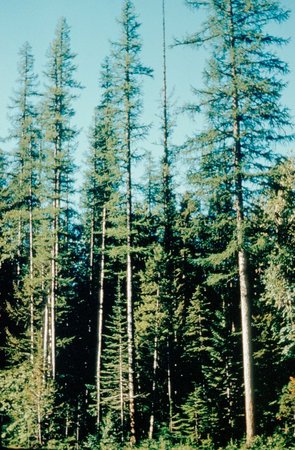
W. H. Hodge
Occurs on mountain shaded slopes and river valleys in the USA (Idaho, Montana, Washington and Oregon) and Canada (British Columbia). In the mountains it rises to altitudes of 600-2100 (2300) m above sea level. It grows together with Pseudotsuga menziesii, Pinus monticola, Pinus contorta, Picea engelmannii, Abies grandis, Abies lasiocarpa.
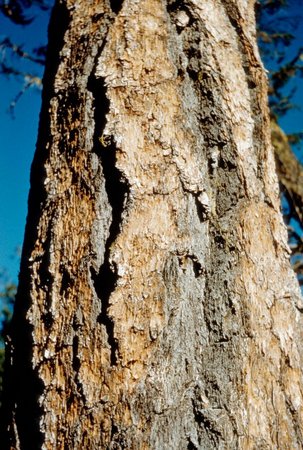
W. H. Hodge
It is a tall coniferous tree up to 50 m high, trunk diameter 90-120 (240) cm. Young trees grow rapidly, reaching 23 m in height at 40 years. Lifespan 300-500 (700) years. Crown narrowly pyramidal, main branches almost horizontal, short, lateral shoots often pendulous. Young shoots orange-brown, initially sparsely hairy, later becoming glabrous. Bark on young trunks scaly, grey-brown, 8-15 cm thick, on old trunks deeply furrowed.
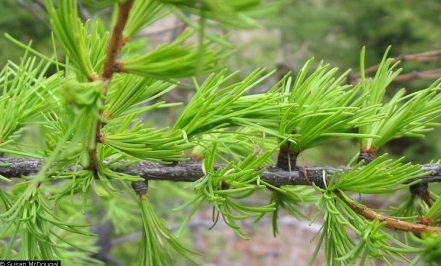
Buds glabrous, brown. Needles deciduous, pale green, blunt, 20-40 mm long and 0.4-0.6 mm wide, straight, stiff, three-sided, on short shoots borne in star-shaped clusters of 14-40, spaced apart, rounded above, keeled below, with 2 stomatal bands on each side, resin canals absent. They appear in May, turn yellow and fall at the end of October.
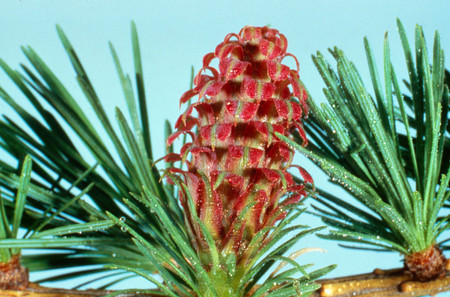
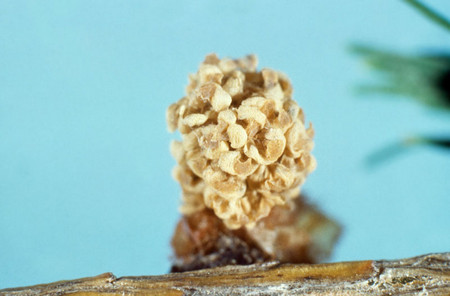
Female catkins purple or green, oblong-ovoid in shape, first appearing at 20-25 years and reaching maximum numbers at 40-50 years.
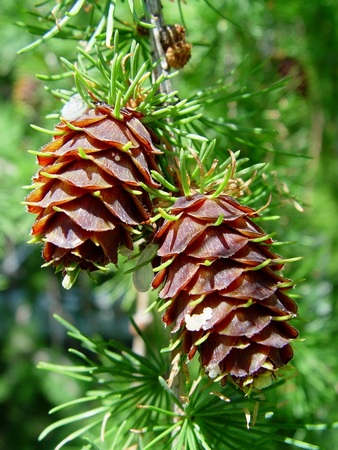
Cones ovoid-elongate, 25-35 (50) mm long and 18-25 mm wide, borne on short pubescent stalks 2.5-4.5 mm long and 3.5-5 mm wide, consisting of 7-12 rows of seed scales which spread widely at maturity. Seed scales are rounded or truncate, often reflexed, faintly pubescent on the outside below the middle; the bract scales have long lanceolate tips that project well beyond the seed scales. Seed body up to 3 mm long, wing up to 6 mm long; they are whitish, with a pale wing, up to 12 mm in length. 1 kg contains 225—340 thousand seeds. 1000 seeds weigh about 4 g. Cones mature in 4-6 months and after ripening the seeds are dispersed within 2 weeks. Opened cones often remain on the branches, becoming grey-black in color.
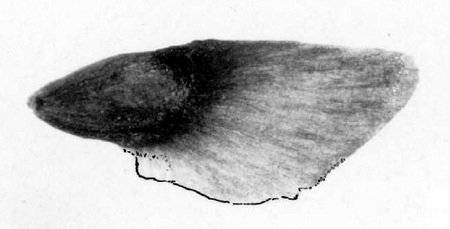
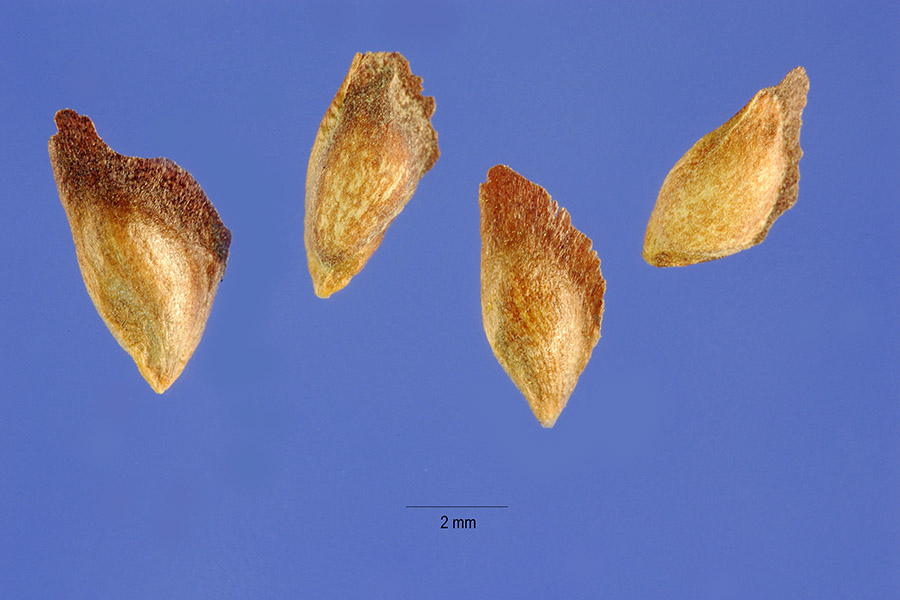
Chromosome number: 2 n =24
Frost hardiness: 2-8 (-50°C)
Location: light-loving, prefers well-drained, rich, deep and moist soils. Does not like dryness.
Planting: planting hole size – 50X50 cm. Planting mix: turf soil and peat in a ratio of 1:1.
Care: requires watering when young. A mature tree should be watered during drought, about 20 L 1-2 times per week.
Pruning: requires sanitary pruning.
Diseases: Schütte fungus, root sponge (root rot), rimmed bracket fungus, the "Judas's ear" fungus.
Pests: adelgids, larch web-roller caterpillars, striped larch sawfly, larch case-bearer caterpillars, bark beetles, wood-borers, longhorn beetles.
Propagation: seed germination is low. Seeds should be kept for 2-3 days in cold water. Row spacing at least 10-12 cm, sowing depth 3-5 mm. After emergence, you can fertilize with nitroammophoska. Watering is essential. Propagated by cuttings, cuttings are 8-10 cm long. The end of the cutting is dipped in 0.8% indoleacetic acid and 10.0% Captan and placed in a room at 24°C.
Uses: planted in parks and avenues. Used for greening large and small towns.