
Conifers
Siberian larch
larix ibirica Ledeb
Synonyms: Larix altaica Fisch. ex Gordon, Larix altaica Fisch. ex Parl., Larix archangelica C.Lawson, Larix decidua var. russica (Endl.) Henkel & W.Hochst., Larix decidua var. sibirica (Ledeb.) Regel, Larix decidua subsp. sibirica (Ledeb.) Domin, Larix europaea var. russica (Endl.) Beissn., Larix europaea var. sibirica (Ledeb.) Loudon, Larix pseudolarix Lodd. ex Gordon. Larix russica (Endl.) Sabine ex Trautv., Larix sukaczewii Dylis, Pinus larix var. intermedia Antoine., Pinus larix var. russica Endl., Pinus pseudolarix Steud., Модрина сибірська, лиственница Ледебура, Лиственница алтайская, лиственница русская.
Siberian larch (Larix sibirica Ledeb.) – a species of coniferous plants of the genus Larix of the family Pinaceae (Juniperus). It was first described by the German scientist, educator and traveler Karl Christian Friedrich (Karl F. von) Ledebour in his work “Flora Altaica” ("Flora altaica. Berolini" 4: 204) in 1833.
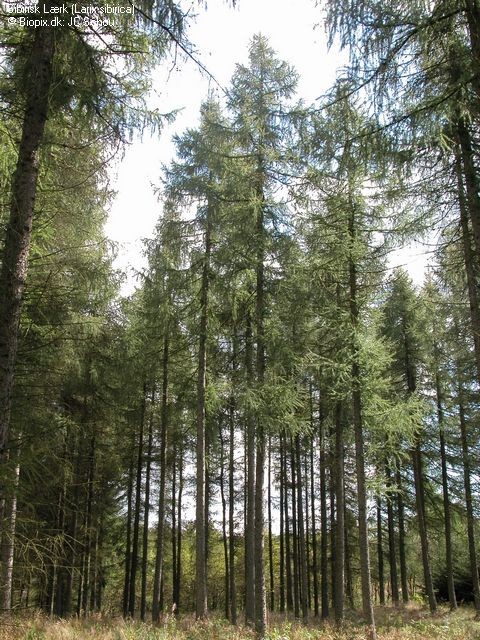
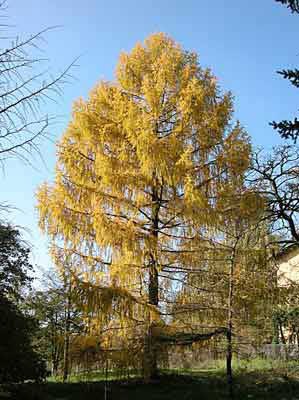
In nature it grows in the northeast of the European part of the former USSR (in Western Siberia (except the southwestern part), southwestern Eastern Siberia, Saur, Tarbagatai), northern Mongolia, northwestern China. In the mountains it rises to altitudes of 2000–2450 m above sea level. It forms pure stands and also grows together with pine, cedar, spruce, fir, birch and other tree species. On the border with the range of Dahurian larch it grows on well-drained southern slopes and in river valleys with warm, well-aerated soils. On burnt areas and clearings it grows as a pioneer.
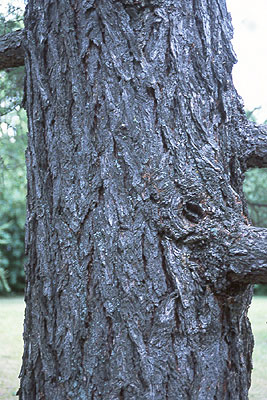
It is a deciduous coniferous tree 30–40 m in height, trunk diameter reaching 80–100 (180) cm. Grows rapidly, very fast in youth. Lives 300–400 (900) years. Crown initially pyramidal, later becoming oval-rounded and spreading. Branches depart from the trunk at right angles and then curve upward. Bark on old trees is thick (up to 25 cm), covered with longitudinal cracks, deeply furrowed, externally light brown, internally reddish-brown; on young trees it is straw-colored, smooth. Trunk straight. Wood with a reddish-brown heartwood and a narrow white sapwood, strong, resistant to decay, well preserved in water and wet environments. Branches have shoots of two types – elongated (growth or annual) and shortened (perennial). Shortened shoots die after 10–12 years or develop into elongated ones. Young shoots yellowish-green, two-year-old shoots grayish-yellow.
The root system is well developed, which prevents damage from windthrow. On stony soil, very wet soil or with shallow permafrost it forms a root system similar to that of pine. On peat or moss bog soils, adventitious roots may form on the trunk above the root collar.
Terminal buds broadly conical, reddish-brown, with ciliate scales, rarely resinous; lateral buds hemispherical, yellowish-brown. Young stems yellow or reddish, marked with grooves from leaf cushions.
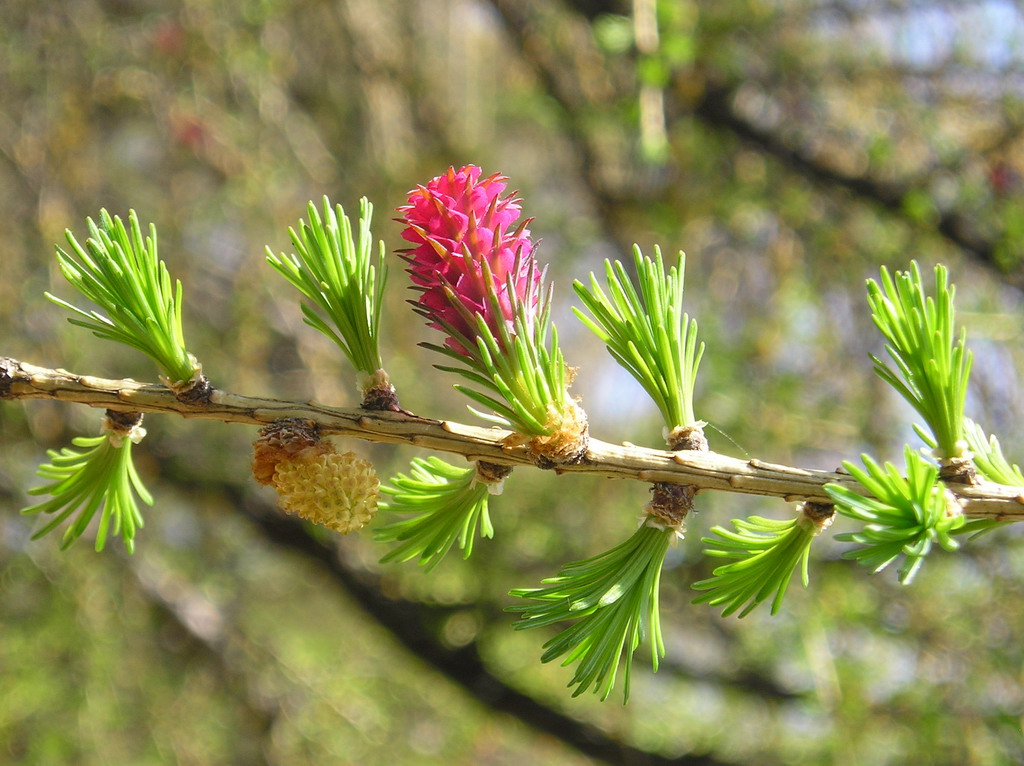
Needles bright green, covered with a glaucous bloom, narrowly linear, soft, blunt, up to 3.5 cm long and 1.6 mm wide, with two stomatal lines on both sides, pleasantly aromatic. On elongated shoots needles are arranged spirally and singly, on shortened shoots in clusters of 30–50. They unfold in May and fall in autumn.
Male catkins (microstrobili) are solitary, spherical or oval, pale yellow, growing at the ends of shortened shoots. Female catkins are broadly ovoid-conical, 10–15 mm long, purple or pink, more rarely pale green or whitish. Male and female catkins are distributed evenly throughout the crown. Pollination occurs in May (in more southern areas in April).
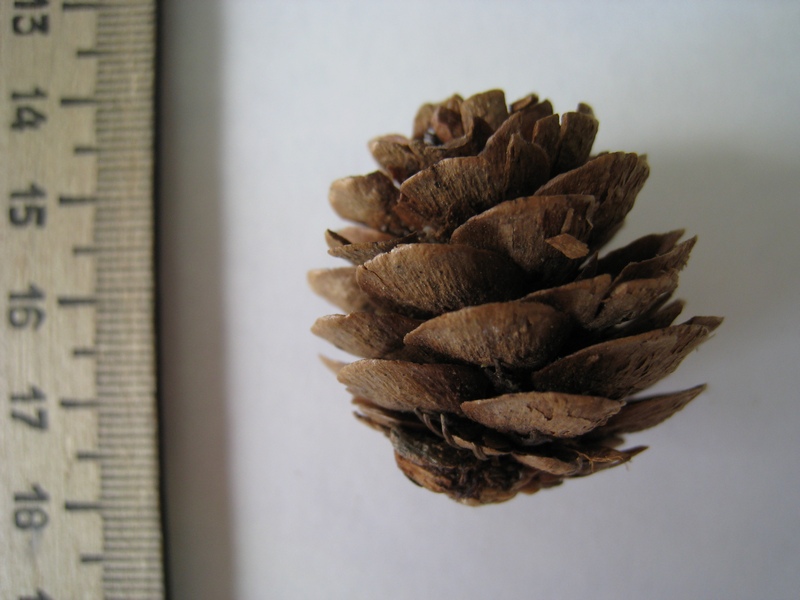
Photo N. Shultz
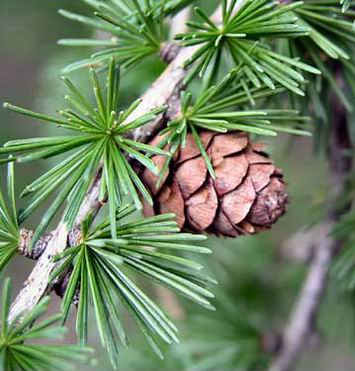
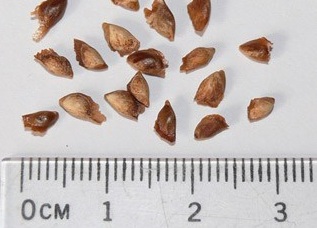
Cones ovoid or oblong-ovoid, at first purple, later light brown or light yellow, 2–4 cm long and 2–3 cm wide, consisting of 22–38 scales arranged in 5–7 rows. Seed scales 13–20 mm long and 10–15 mm wide, rounded or ovoid, margins even, externally covered with dense velvety pubescence of reddish hairs. Covering scales leathery, hidden between the seed scales. Cones remain on the tree after seeds are shed (September–October) and remain for another 2–3 years before falling to the ground intact. Seeds obliquely obovoid, small, 2–5 mm long and 3–4 mm wide, yellowish with dark stripes or spots. Wing 8–17 mm long and 4–6 mm wide, almost straight on one side and hollow-rounded on the other. In 1 kg there are 94–147 thousand seeds, weight of 1000 seeds – 9.5 (5.3–14.1) g. Maximum seed crop appears every 2–3 (4) years. Yield 20–75 kg per 1 ha. Begins to bear fruit at 12–15 years (in plantations at 20–50 years), almost annually.
Hybrids:
- with Larix decidua Mill. – Larix × polonica Racib.
- with Larix gmelinii (Rupr.) Rupr. – Larix × czekanowskii Szafer
Forms: compact (f. compacta), blunt (f. decuminata), pyramidal (f. fastigiata), weeping (f. pendula).
Hardiness: 3–8 (−45°C)
Site: light-loving, winter-hardy. Prefers moderately moist soils, undemanding to fertility. Tolerates urban conditions well. Drought-resistant. Prefers deep, calcareous soils.
Planting: planting pit size – 50×50 cm. Planting mix: sod soil and peat in a 1:1 ratio.
Care: requires watering in youth. An adult tree should be watered during drought, 20 L 1–2 times a week.
Pruning: requires sanitary pruning.
Diseases: Schütte fungus, root sponge, rimmed bracket fungus, the "Judas's ear" fungus.
Pests: chermes, caterpillars of the larch web-spinning leafroller, striped larch sawfly, caterpillars of the larch casebearer, bark beetles, wood-borers, longhorn beetles.
Propagation: seed germination 80–85%. Seedlings have 6–7 cotyledons with single needles. In the first year seedlings are an elongated unbranched shoot; in autumn the needles turn yellow but do not fall. The following year an elongated shoot emerges from the dormant terminal bud, and first-order branches and shortened shoots develop from the axillary buds.
Companions: birch, rowan, maple, linden, spruce, fir, Siberian cedar, juniper, rhododendron.
Uses: soil-improving species. Recommended for forest-reclamation plantings in the Forest-Steppe and Polissya. Can be used for protective shelterbelts, ravine plantings. Also planted along valley bottoms where other species suffer from late frosts. Looks effective as solitary, group and avenue plantings.