
Conifers
Gmelin's Larch
Larix gmelinii
Synonyms: Daurian larch, Amur larch, Abies gmelinii Rupr., Larix amurensis Beissn., Larix dahurica Turcz. ex Trautv., Larix pumila Doktur. & Flerow, Larix dahurica ssp. dahurica Dylis
\r\nGmelin's Larch (Larix gmelinii (Rupr.) Kuzen.) – a species of coniferous plants of the genus Larch (Larix) of the pine family (Juniperus). It was first described by the Russian botanist Franz Ivanovich Ruprecht in 1854 in «Flora Boreali-Uralensis 48.». In cultivation since 1888.
\r\nIt grows at 72°56’ N on the Taymyr in the valley of the Khatanga River between the mouths of the Bludnaya and Popigay rivers and in a prostrate form at 73°04’32" N. It grows in the harshest conditions, reaching the upper tree line in the mountains (dwarf and prostrate form), in low-lying areas – on swampy and peat bogs, in places of shallow permafrost, as well as on stony mountain slopes. On moss bogs it rises to 1400 m above sea level.
\r\n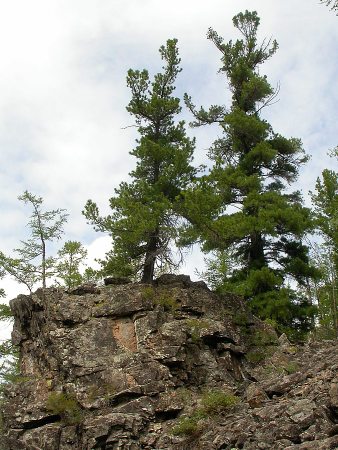
\r\nPhoto V.Ivanov
It is a coniferous tree up to 30 m in height and up to 80 cm in trunk diameter. The crown of young plants is ovate-pyramidal, later becoming ovoid. The trunk is often multi-topped. Bark thick, with deep fissures, reddish or gray-brown. Young shoots light orange-yellow or reddish-brown, sometimes covered with sparse hairs.
\r\n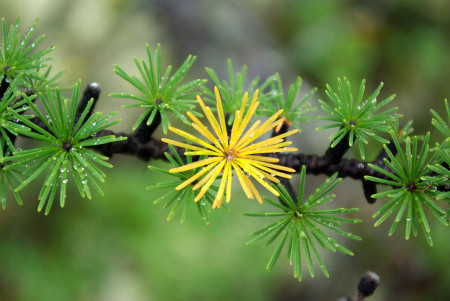
\r\nPhoto V.Solodukhin
Needles soft, light green, deciduous, narrow-linear, 1.5-3 cm in length, growing on short shoots in clusters of 25-40. In summer they become bright green, in autumn – yellow.
\r\n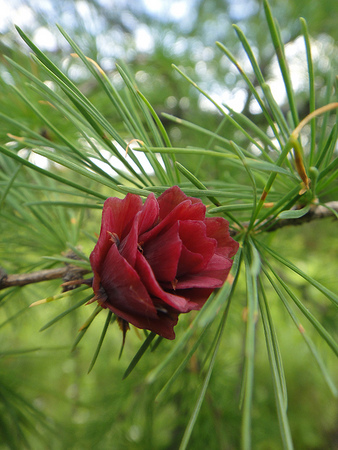
\r\nPhoto E.Bayandina
Cones 15-30 mm long, oval or ovoid in shape. On small cones the scales are arranged 20-25 per cone in 4 rows, on large cones 40-50 scales in 6 rows. Seed scales 1-1.2 cm long, 0.8-1 cm wide. Seeds obliquely obovoid, 0.3-0.4 cm long, ripen in August-September and are shed in dry weather when the seed scales of the cone bend back at an angle of 40—50°.
\r\nVarieties: according to Wikipedia:
\r\n- \r\n
- Larix gmelinii var. gmelinii — occurs across most of the species' range, from the Yenisei to Kamchatka (syn.: Abies gmelinii Rupr, Abies kamtschatica Rupr., Larix amurensis hort. ex Beissn., Larix cajanderi Mayr — Cajander's larch, Larix dahurica Turcz. ex Trautv. — Daurian larch, Larix kamtschatica (Rupr.) Carrière — Kamchatka larch) \r\n
- Larix gmelinii var. japonica (Maxim. ex Regel) Pilg. — occurs on Sakhalin and the Kuril Islands (Larix kurilensis Mayr — Kuril larch, Larix dahurica var. japonica Maxim. ex Regel basionym.) \r\n
- Larix gmelinii var. olgensis (A.Henry) Ostenf. & Syrach — occurs in Primorye, northern part of the Korean Peninsula and in the Chinese provinces of Jilin and Liaoning (syn.: Larix koreana Nakai — Korean larch, Larix olgensis A.Henry basionym — Olga larch). \r\n
- Larix gmelinii var. principis-rupprechtii (Mayr) Pilg. — occurs in the Chinese provinces Hebei, Henan and Shanxi (syn.: Larix principis-rupprechtii Mayr — Ruprecht's larch, Larix dahurica var. principis-rupprechtii (Mayr) Rehder & E.H.Wilson) \r\n
Hardiness: 2-8 (-50°C)
\r\n\r\nLocation: light-loving, not demanding regarding soil fertility, can grow even on the poorest, swampy and waterlogged soils, in areas of permafrost. In maturity can tolerate slight shading. Prefers well-moistened, well-drained loamy or sandy loam soils on gentle slopes and river valleys.
\r\nPlanting: planting hole size – 50X50 cm. Planting mix: topsoil and peat in a 1:1 ratio.
\r\nCare: requires watering in youth. A mature tree needs watering during drought, about 20 L 1-2 times a week.
\r\nPruning: not very suitable for formal shaping, but tolerates pruning well. Small branches can be removed in autumn and spring. The best period is when the shoots have finished active growth but are not yet lignified.
\r\nDiseases: Schutte fungus, root sponge, rimmed bracket fungus, the "Judas's ear" fungus.
\r\nPests: adelgids, caterpillars of the larch web-spinning leafroller, striped larch sawfly, larch case-bearer caterpillars, bark beetles, ambrosia/wood-boring beetles, longhorn beetles.
\r\nPropagation: seed germination is low. Seeds should be kept 2-3 days in cold water. Spacing between rows at least 10-12 cm, sowing depth 3-5 mm. After emergence you can fertilize with nitroammofoska. Watering is mandatory.
\r\nUse: planted in parks and alleys. Used for greening large and small towns. In garden design used to create contrast among conifers or as solitary specimens on lawns. Can be grown in bonsai style.
\r\n