
Deciduous shrubs
Kalmia
Kalmia L.
Kalmia (lat. Kalmia) — a genus of North American evergreen shrubs in the family Ericaceae (Ericaceae). There are eight species, three of which — are popular ornamental flowering garden plants. All species are poisonous.
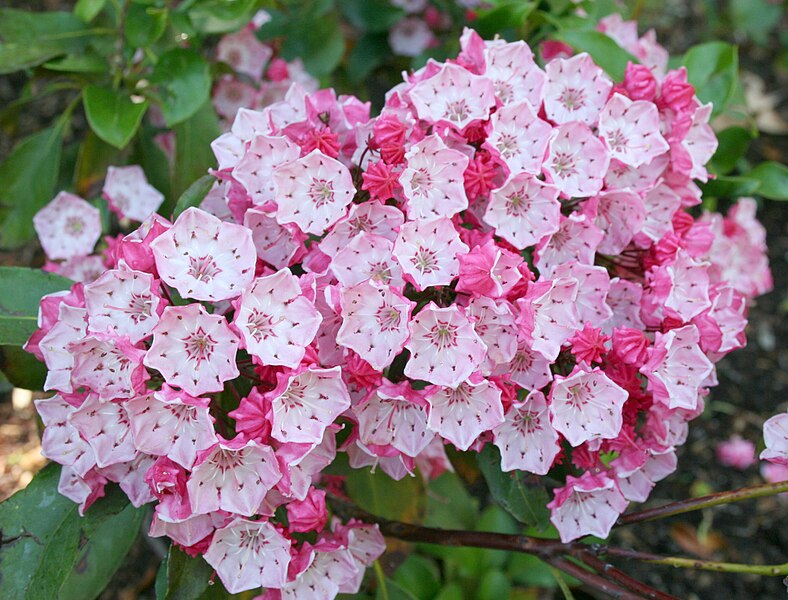
The scientific name of the genus comes from the surname of Pehr Kalm (1716—1779) — a Finnish and Swedish botanist, professor at the Royal Academy of Åbo (Turku), a student of Carl Linnaeus. Kalm participated in an expedition to North America, and later cultivated in Sweden some North American plant species, including Kalmia angustifolia (Kalmia angustifolia).Occasionally in the literature another Russian name of the genus appears — "Калмия"
Plants of this genus are distributed in North America, reaching north to Alaska. They grow in the understorey, at forest edges, and in bogs.
Kalmias — evergreen shrubs ranging in height depending on the species from half a meter to several meters. In spring or early summer the plants produce many flowers — depending on the species they can be small or fairly large; the corolla color may be white, pink or reddish-pink; long stamens are characteristic of all species.

Location: the plants prefer partial shade but tolerate full sun. Kalmias are recommended to be planted in places sheltered from the wind. It is also important to protect them from direct sunlight in winter.
Soil: Kalmias, like rhododendrons, grow best on acidic soils. The soil mix should consist of peat, leaf mold and conifer litter, and sand taken in the ratio 3:2:1:1, with the addition of a complete mineral fertilizer. Kalmias will grow well in fertile, loose, sufficiently moist soils. However, the plants do not tolerate stagnant moisture. They require drainage made of a layer of broken brick and sand 15-20 cm thick.
Planting: the best time to plant Kalmia is spring. Spacing between Kalmias in dense groups is 0.8 m, in loose groups 1-1.5 m. The root collar should be at ground level when planting.
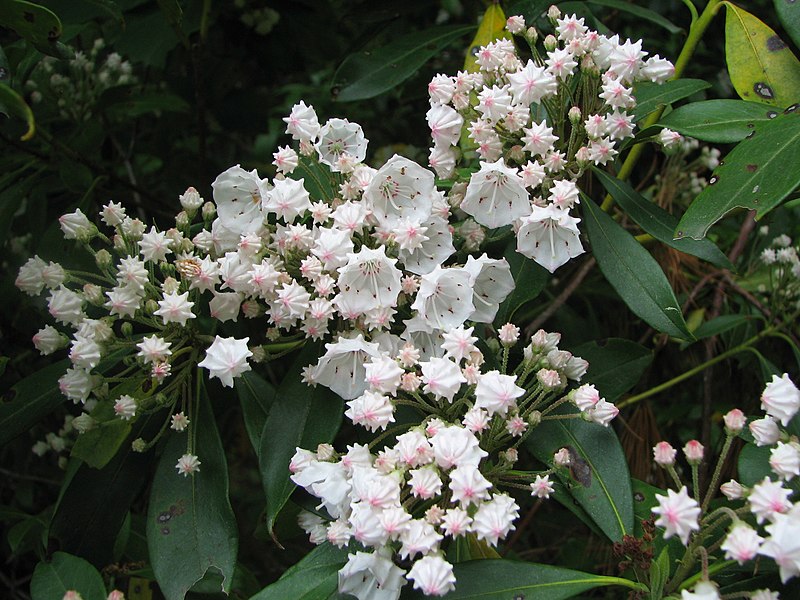
Care: Kalmias can tolerate temporary drought. Two to three times per season from April until mid-June the plants are fed. In early spring it is recommended to remove dead shoots and faded inflorescences. After heavy rains and when the soil becomes heavily compacted, loosen the soil. Do this very carefully because Kalmia roots are shallow. Young plantings should be mulched with peat or wood chips in a layer of 5-8 cm. Kalmias are resistant to diseases and pests.
Propagation: Kalmia seeds ripen in October-November; they can be propagated by layering, root suckers and cuttings. The rooting rate of cuttings is 75%.