
Flowers for the garden
Juno
Juno
The first to separate these bulbous plants into an independent genus was the Austrian botanist L. Trattinnick. He did this in 1821, naming the genus he described after the ancient Italian goddess of the moon and patroness of women — Juno (Juno). The generic independence of these remarkable bulbous plants of the iris family was also supported by the noted specialist in Central Asian flora A.I. Vvedensky. Unfortunately, many Western authors still treat them as irises (subgenus Scorpiris). Such a view is mistaken, since Juno species have no close relationship with irises. This is easy to verify by studying their age phases (ontogenesis). According to G.I. Rodionenko, this genus can be called a fragment of the ancient Gondwanan flora.
To date 57 species of Juno have been described. They occur in Central Asia, Afghanistan, Iran, Asia Minor, in some parts of the Mediterranean and North Africa. Most Juno species are plants of dry desert steppes and mountain slopes with cold winters, a short spring, and a dry hot summer.
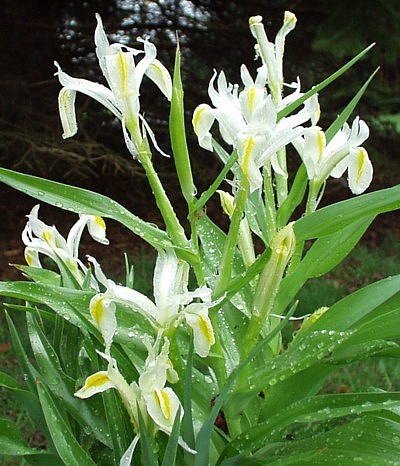
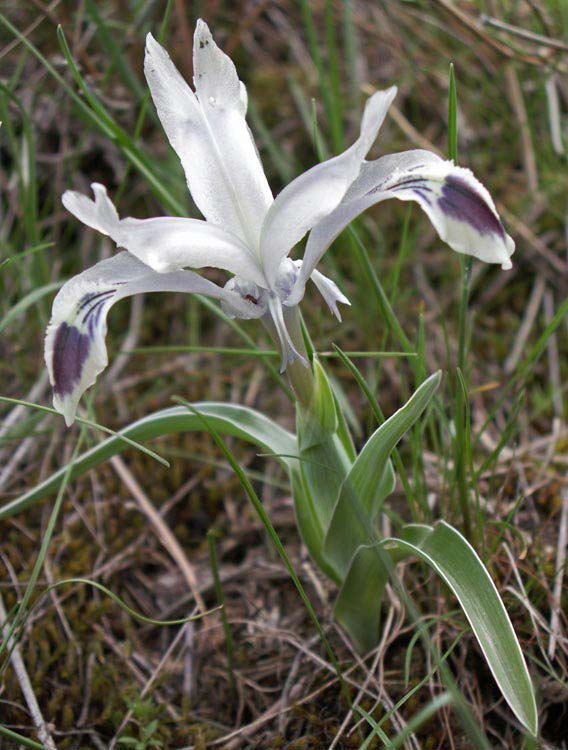
Juno is a perennial bulbous plant 10 – 50 cm tall. The bulb consists of 3 – 5 fleshy non-fused scales and several dry, membranous tunic scales. Roots are cord-like or spindle-shaped, thickened, sometimes threadlike. Roots do not die back during the summer dormancy period. Leaves are narrowly or broadly grooved, more often sickle-shaped and bent back. The flowering stem bears 1 – 2 flowers. Flowers of many species are fragrant, with a six-part perianth-like corolla and a well-expressed tube. The inner segments of the perianth are 2 – 3 times shorter than the outer ones, bent downward or spread to the sides; the outer segments have a claw with or without wings, passing into a blade. Flowers are of various colors, situated in the leaf axils. All Juno species are characterized by an early (from the second decade of April), short (only 2–3 weeks) vegetation period and a long summer dormancy. In Central Asia they flower simultaneously with wild tulips, some species flowering before the leaves appear, at the same time as crocuses. Juno species, despite their uncommon ornamental value, unfortunately still remain little cultivated
Cultivating Juno outdoors is fairly simple, especially in regions where temperature conditions and precipitation patterns are similar to those of their natural habitats. Everything becomes more complicated in regions with cool and humid climates.
Juno bucharica – Juno bucharica (Iris bucharica)
On gravelly slopes in the lower mountain belt and foothills of Central Asia (Western Pamir-Alay).
Bulb up to 2 cm high. Roots spindle-shaped. Stem 15 to 30 cm tall, bearing 4 – 5 flowers. Leaves light green, sickle-curved, narrowed toward the tip, lower leaves 1.5 – 3.5 cm wide. Flowers light or dark yellow, 6—7 cm in diameter; the claw of the outer perianth segments gradually (not winged) widens into an oblong or obovate blade with an emarginate apex, 8—20 mm wide, 10—20 mm long; crest dark yellow, entire, toothed; inner perianth segments almost white, acute, with a more or less elongated, rhombic, often bluntly three-lobed blade. Stigma almost rounded. Flowers in late April, for 14 – 20 days; fruits in late spring — early summer.
Juno caucasica — Juno caucasica (Hoffm.) Klatt
Occurs on dry stony places, among shrubs and early-dormant grasses (also on cultivated plots), in the lower and middle mountain belts of Transcaucasia (the classic locality is the environs of Tbilisi) and northern Iran.
Bulb 1.5—2 cm thick. Roots weakly thickened, mostly cord-like. Stem (5)10—25 cm tall, 2—3 (5)-flowered, with leaves clustered and then internodes inconspicuous, or with leaves spaced and then internodes noticeable. Leaves glaucous-green, sickle-curved, narrowly margined at the edge. Flowers 3—5 cm across, pale yellow, more rarely greenish-yellow, sometimes with a violet tinge; the claw of outer perianth segments is slightly widened in the middle part, 10—12 mm, with an oblong, obtuse blade 1.5—2 times shorter than the claw; outer perianth segments 2.8—3.5 cm long; inner segments 15—20 mm long, claw-like, rhombically widened at the apex. Flowers in early spring; fruits in late spring — early summer.
Juno coerulea – Juno coerulea (B. Fedtsch.) Vved. = Iris coerulea V. Fedtsch
Distributed on stony-clayey slopes of the middle mountain belt of the Western Tien Shan.
Bulb 2—2.5 cm thick. Roots thickened, cord-like. Stem short, 5—7 cm tall, more rarely 1, usually 2—5-flowered, with leaves closely appressed, internodes indistinct by flowering time. Flowers blue, 5—7 cm in diameter; perianth tube about 4 cm long; the claw of the outer perianth segments without winged expansions, with almost parallel margins; crest entire; inner segments 2—2.5 cm long, obovate-lanceolate. Flowers in early to mid-spring; fruits in late spring — early summer. A species valuable for ornamental use.
Site: prefers sunny sites sheltered from strong winds, well-drained soil, does not tolerate waterlogging. Plants remain in one place for up to 4 – 5 years. It is better to plant these species on low rockeries or on relatively low parts of alpine beds where the soil freezes less deeply.
Soil: in nature it grows on clayey-stony soils. Prefers light loams.
Care: Bulbs are planted in mid-September. When dividing, planting, and digging up, handle their fleshy roots carefully, as the renewal buds are located at their base. Plant bulbs at a depth of 5 – 8 cm. Water in autumn and spring as needed; do not water during the dormancy period.
Propagation: by dividing bulbs and sowing seeds in the ground in autumn. Seed viability is retained up to 20 years. Seeds are sown in autumn; seedlings develop slowly and flower in the third to fourth year. For accelerated vegetative propagation, a portion of the basal plate with fleshy roots and buds can be used. Each root with a rudimentary bud produces an independent plant.