
Conifers
Rocky Mountain juniper
Juniperus scopulorum
Synonyms: Juniperus excelsa Pursh, Juniperus occidentalis var. pleiosperma Engelm., Juniperus scopulorum var. columnaris Fassett, Juniperus scopulorum f. columnaris (Fassett) Rehder, Juniperus virginiana var. montana Vasey, Juniperus virginiana var. scopulorum (Sarg.) Lemmon, Juniperus virginiana subsp. scopulorum (Sarg.) A.E.Murray, Sabina scopulorum (Sarg.) Rydb.
Rocky Mountain juniper (Juniperus scopulorum Sarg.) – a species of plants of the genus Juniper (Juniperus) of the cypress family (Cupressaceae). It was first described by Charles Sprague Sargent in 1897 in his work "Garden and Forest" 10: 420, fig. 54. In cultivation since 1836. Introduced to Russia in 1839.
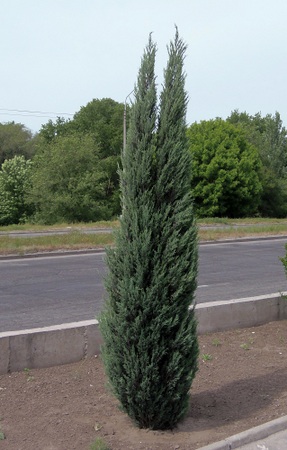
Photo S. Odynets
Native to the western part of North America: Canada (British Columbia, southwestern Alberta), USA from Washington east to North Dakota, south to Arizona, and locally in western Texas, and northern Mexico from Sonora east to Coahuila. In the mountains it rises to elevations of 500-2700 m above sea level (0 m on Vancouver Island and Puget Sound). Found on rocky soils of mountain slopes.
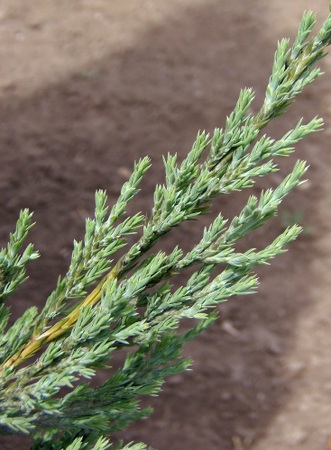
Photo S. Odynets
It is an evergreen coniferous shrub or small tree 1.5-4.5 (6) m tall with a trunk diameter up to 30 (60) cm. The crown begins almost at the base, conical in shape, becoming more rounded with age. Bark reddish-brown, furrowed. Young shoots faintly 4-angled, up to 1.5 mm thick, light or bluish-green in color.
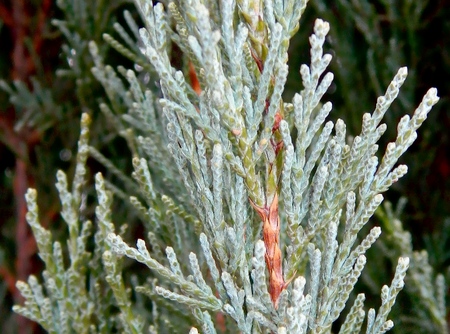
Photo E. Slivakovsky
Leaves mostly scale-like, arranged oppositely, appressed to the shoot, ovate-rhomboid, apex blunt, 1-2 mm long and 0.5-1 mm wide, dark green, more often glaucous-blue or blue-gray. Needle-like leaves may occur at the tips, reaching 12 mm long and up to 2 mm wide.
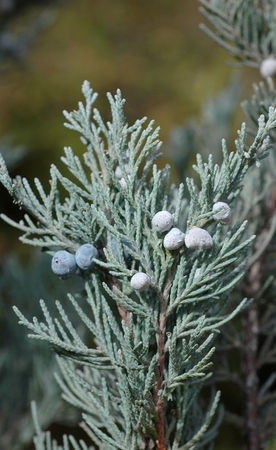
Photo V. Epiktetov
Berry-cones globose, 4-6 mm in diameter, dark blue with a bluish bloom, ripening at the end of the 2nd year. Seeds number 2, rarely 3; they are ridged, reddish-brown, 4-5 mm in diameter.
Forms:
- Juniperus scopulorum var. Arbuscula
- Juniperus scopulorum fo. Columnaris
- Juniperus scopulorum var. Columnaris
- Juniperus scopulorum var. Patens
- Juniperus scopulorum forma horizontalis
- Juniperus scopulorum forma viridifolia
Hybrids:
- Juniperus scopulorum x virginiana
- Juniperus scopulorum x virginiana x horizontalis
Cultivars: 'Blue Angel', 'Blue Arrow' (Juniperus virginiana 'Blue Arrow'), 'Blue Heaven', 'Blue Sabre', 'Blue Trail', 'Cologreen' ('Colorado Green'), 'Dew Drop', 'Erecta Glauca', 'Gray Gleam', 'Greenspire', 'Hilborn’s Silver Globe', 'Medora', 'Moffat Blue' ('Moffettii'), 'Monam' ('Blue Creeper'), 'Monwade' ('Green Ice'), ('Moonglow' (Juniperus virginiana 'Moonglow'), 'Moonglow Variegated', 'Pathfinder', 'Skyrocket', 'Silver King', 'Silver Star', 'Springbank', 'Sutherland', 'Table Top Blue', 'Tolleson’s Blue Weeping', 'Tolleson’s Green Weeping', 'Welchii', 'Wichita Blue', 'Winter Blue'.
Hardiness: 3-9 (-39°C)
Location/site: not demanding to soil, can grow on rocky, gravelly or sandy soils. Poorly tolerates waterlogging at the roots and saline soils. Tolerates urban conditions, air pollution and heat well. Prefers sites protected from strong winds. Demanding of light; in deep shade the crown becomes sparse and loses decorative value.
Planting: recommended spacing between plants 0.5 or 1.2-2 m. Planting depth – 70 cm. Drainage as needed: crushed brick or sand layer 15-20 cm. Soil mixture: topsoil, peat and sand in ratio 1:2:1. Does not like transplantation; preservation of the root ball and abundant watering are necessary.
Care: in spring (April-May) apply nitroammophoska (nitroammofos) 30-40 g/m2. In dry summers it is recommended to water the plant 2-3 times per season and perform evening spraying once a week. Mulch with peat or sawdust layer 5-8 cm. May be subject to snow breakage, so after heavy snowfalls it is recommended to brush off the plant.
Pruning: tolerates heavy pruning and clipping well, maintains shape for a long time.
Diseases: rust (Arcerid (50 g per 10 l of water) spray 4 times at 10-day intervals), Schütte, Biatorella and Nectria canker, alternaria, pear rust fungus.
Pests: aphids (Fitoverm (2 g per 1 l of water) spray 2 times at 10-14 day intervals), leaf-mining moth (Decis (2.5 g per 10 l) spray 2 times at 10-14 day intervals), spider mite (Karate (50 g per 10 l)), scale insects (karbofos (70 g per 10 l of water)), galls, sawfly, shoot moth, pine looper.
Propagation: propagated vegetatively. Cuttings are cut up to 10 cm long from late April to mid-May. Collected with a "heel" which should then be shortened without separating the bark from the cutting. It is recommended to place the cutting for a day in a solution of heteroauxin or another root-forming stimulant. Cuttings are planted in a mix of equal parts peat and sand, sprayed, covered with film and placed in a location protected from direct sunlight.
Uses: used in landscaping of squares and parks, private estates and public institutions. Some cultivars are used in heather gardens, rock gardens and rockeries, for creating hedges and various compositions, greening terraces, balconies, roofs, as a vertical element on lawns, and for decorating the main entrance.