
Conifers
Rigid juniper, or Stiff juniper
Juniperus rigida
Synonyms: можжевельник твердолистный, можжевельник жесткий, Juniperus arborea Budischtschewex Trautv., Juniperus communis Thunb., Juniperus confertavar. pseudorigida Makino, Juniperus rigida f. modesta (Nakai) Y.C.Zhu, Juniperus rigidasubsp. pseudorigida (Makino) Kitam, Juniperus seoulensis Nakai, Juniperus utilisKoidz., Juniperus utilisvar. modestaNakai.
Rocky juniper (Juniperus scopulorum Sarg.) – a species of the genus Juniperus (Juniperus) of the family Cupressaceae (Cupressaceae). It was first described in 1846 by Philipp Franz von Siebold and Joseph Gerhard Zuccarini in their work «Abh. Math.-Phys. Cl. Königl. Bayer. Akad. Wiss. 4(3): 233». Introduced into cultivation in the USA in 1961, in Europe – since 1861.
The range extends to China: Gansu, N Hebei, Heilongjiang, Jilin, Liaoning, Inner Mongolia, Ningxia, Qinghai, Shaanxi, Shanxi; Japan: Hokkaido, Honshu, Kyushu, Nansei-shoto (Ryukyu Islands), Shikoku; North Korea; Russian Far East: Primorye, Sakhalin. It is found on rocks, especially on cliffs, and prefers calciferous rocks. It ascends mountains up to 2200 m above sea level.
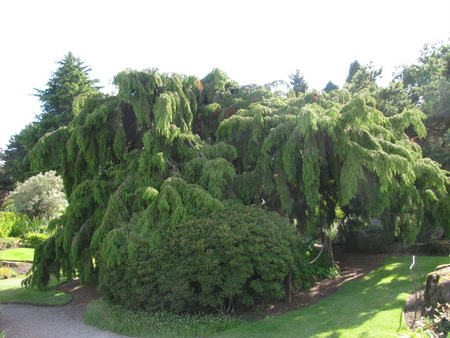
It is a tall dioecious evergreen coniferous tree or shrub up to 8 (15) m in height. Annual growth up to 12 cm. Crown columnar, narrowly pyramidal or oval in shape; female specimens have a more open crown. Growing on sandy dunes or coastal rocks it has a prostrate crown and reaches 30-40 cm in height, with branch lengths up to 2 m. Branches are ascending, three-angled, then become prostrate. Young shoots are pendulous. Bark gray, on old branches reddish-brown, furrowed.
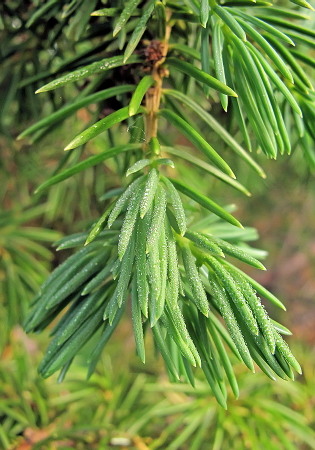
Photo by Yu. Semeykin
Leaves are dense, stiff, yellowish-green, erect, sharply pointed, spiny, narrowly linear, 1.5-3 cm long, arranged in whorls of three needles, with a single stomatal band, concave above with a silvery-blue stripe or speckles, strongly convex below with a robust keel. They brown in winter.
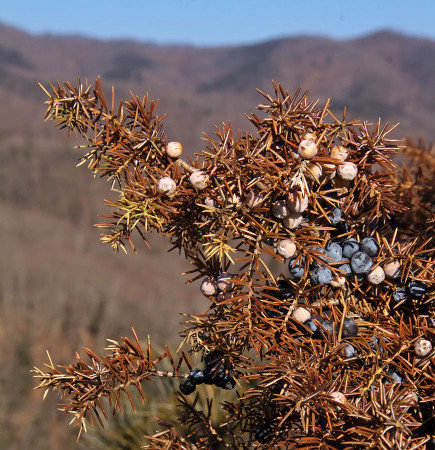
Photo by D. Kochetkov
Microstrobili axillary, ellipsoid or almost spherical, 3-5 mm long. Berry-like cones are round, solitary, axillary, small, with a smooth surface, up to 6 mm in diameter, black-blue in color with a bluish bloom. Formed from 3 scales, the tips of which are clearly visible on the surface of the cone. They ripen in the second year. Seeds 2-3 per cone, they are oblong with a blunt or rounded apex, 3- or 4-angled.
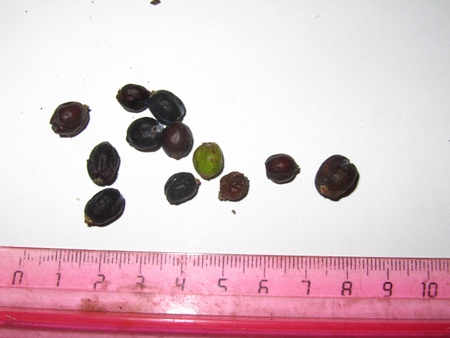
Photo by A. Menshov
Subspecies:
- Juniperusrigidasubsp. conferta (Parl.) Kitam.
- Juniperusrigida subsp. Rigida
- Можжевельник ниппонский (Juniperusrigidassp.nipponica)
Forms: Juniperus rigida 'Pedula'
Hardiness: 4-9 (-29°C)
Location: light-loving, not demanding to soil fertility, can grow even on the poorest soils. Drought-tolerant. In maturity can tolerate slight shading. Prefers rather dry sandy or gravelly soils. Poorly tolerates acidic soil and responds well to liming. Not salt-tolerant.
Planting: recommended spacing between plants 0.5 or 1.2-2 m. Planting depth – 70 cm. Drainage if necessary: crushed brick or sand, layer 15-20 cm. Soil mix: sod soil, peat and sand in the ratio 1:2:1. Does not like transplanting; it is necessary to preserve the root ball and provide abundant watering.
Care: in spring (April-May) apply nitroammophoska 30 - 40 g/m2. In a dry summer it is recommended to water the plant 2-3 times per season and perform evening spraying once a week. Mulch with peat or sawdust to a layer of 5-8 cm. May suffer snow breakage, so after heavy snowfall it is recommended to brush off the plant.
Pruning: tolerates heavy pruning and clipping well, retains shape for a long time.
Diseases: rust (Arcerid (50 g per 10 l of water) spray 4 times at 10-day intervals), shoot blight, Diaporthe and Nectria canker, alternariosis, pear rust fungus.
Pests: aphids (Fitoverm (2 g per 1 l of water) spray 2 times at 10-14 day intervals), leaf-mining moth (Decis (2.5 g per 10 l) spray 2 times at 10-14 day intervals), spider mite (Karate (50 g per 10 l)), scale insects (carbophos (70 g per 10 l of water)), galls, sawfly, shoot moth, pine looper.
Propagation: propagated vegetatively. Rooting of summer cuttings – 100%.
Uses: looks effective in solitary plantings, especially male specimens. Promising for small gardens, rock gardens, parks. Used for bonsai cultivation.