
Conifers
Prostrate juniper
Juniperus procumbens
Synonyms: drooping juniper, Juniperus chinensis var. procumbens Siebold ex Endl., Sabina procumbens (Siebold ex Endl.) Iwata & Kusaka, Juniperus chinensis Linnaeus var. procumbens Endlicher, Syn. Conif. 21. 1847.
Prostrate juniper (Juniperus procumbens (Endl.) Miq.) – a species of plants of the genus Juniper (Juniperus) of the family Cupressaceae. It was first described in 1870 in «Flora Japonica 2: 59, pl. 127, f. 3.» by Friedrich Anton Wilhelm Miquel; authors also include Philipp Franz von Siebold and Joseph Gerhard Zuccarini. Introduced into cultivation in 1843 in the Netherlands.
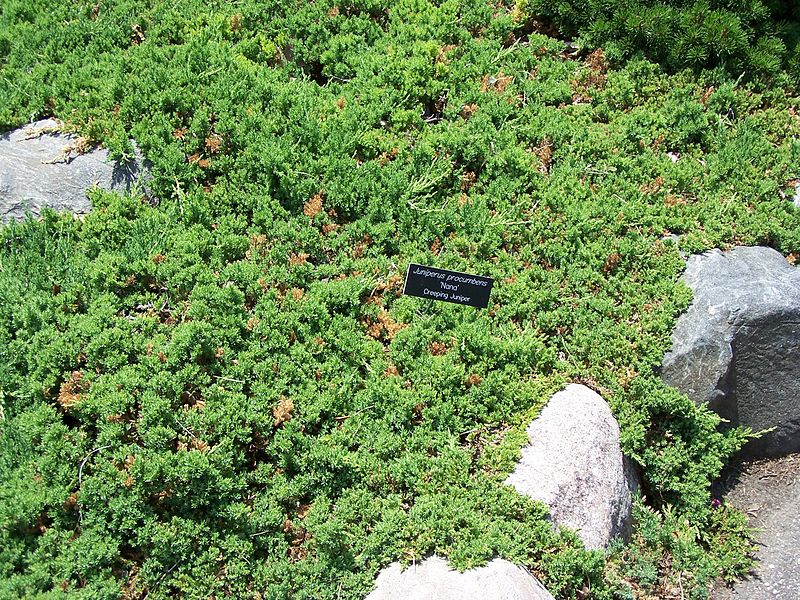
In the wild occurs in Japan (Anhui, Fujian, Jiangsu, Jiangxi, Liaoning, Shandong, Yunnan, Zhejiang, Bonin Islands). Grows on island mountain summits, where it forms creeping carpets on rocks.
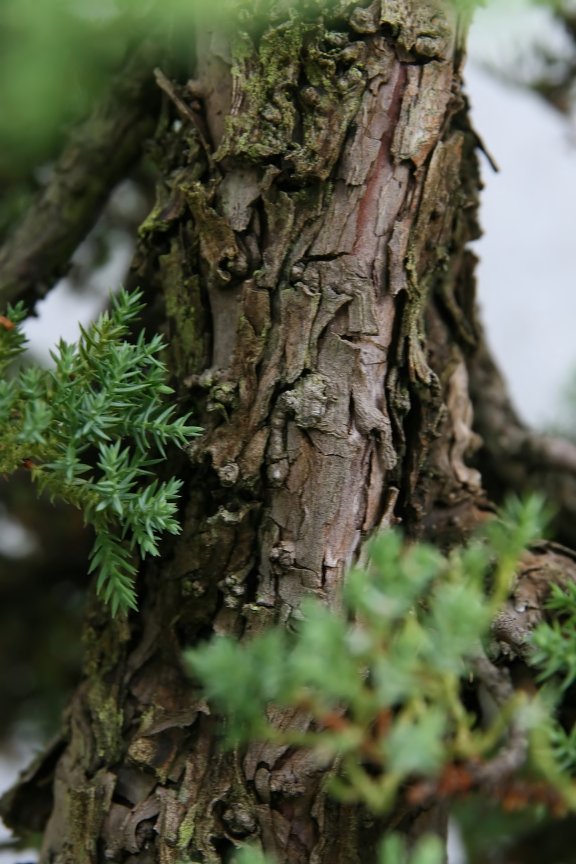
It is a creeping, prostrate shrub up to 70 cm in height, with a diameter up to 2 m. Grows slowly, about 0.5 cm per year. Shoots are creeping, rigid, straight at the tips and slightly ascending, spreading, strongly elongated. Bark maroon-brown, peeling.
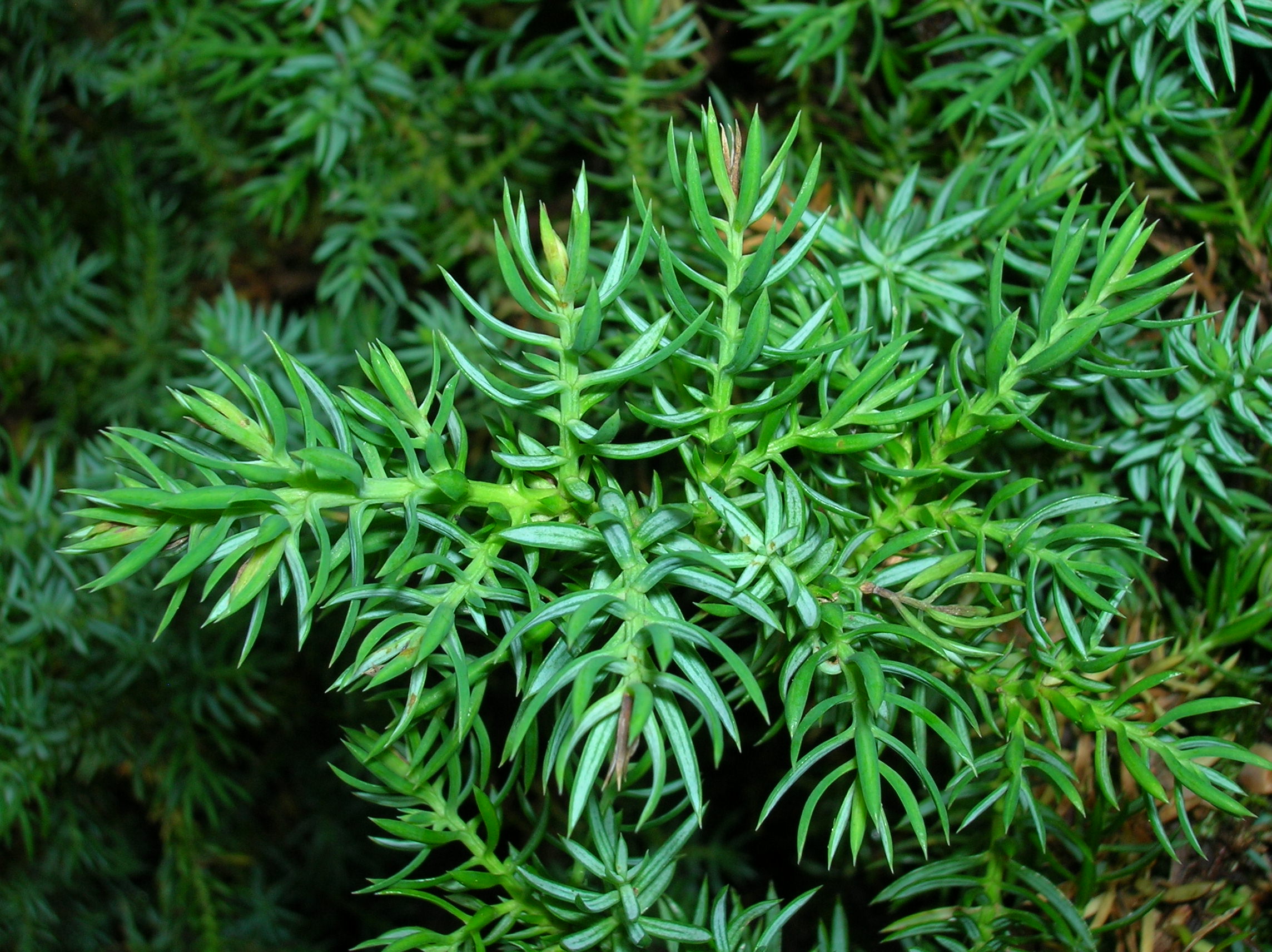
Foliage needle-like, in whorls of three, bluish, oblong-lanceolate in shape, 6-8 mm long, concave above, convex below, with two white spots at the base.
Cones blackish-blue, nearly spherical, 8-9 mm in diameter, with 2-3 seeds inside. Seeds ribbed, up to 4 mm long.
Cultivars: Bonis Isles, Golden, Nana, Santa Rosa, Кishiogima.
Hardiness: 5-9 (-15°C)
Site: drought-tolerant, warmth-loving, practically undemanding regarding soil, resistant to smoke and air pollution.
Planting: recommended spacing between plants 0.5 or 1.2-2 m. Planting depth – 70 cm. Drainage if necessary: crushed brick or sand, layer 15-20 cm. Soil mix: topsoil, peat and sand in the ratio 1:2:1. Transplanting is poorly tolerated, even with a root ball.
Care: in spring (April-May) apply nitroammophoska 30-40 g/m2. In a dry summer it is recommended to water the plant 2-3 times per season and perform evening spraying once a week. Mulch with peat or sawdust to a depth of 5-8 cm.
Pruning: requires only sanitary pruning.
Diseases: rust (Arcerid (50 g per 10 l water) – spray 4 times at 10-day intervals), schutte, biatorrellal and Nectria canker, alternariosis, root canker (Oligotrophus betheli).
Pests: aphids (Fitoverm (2 g per 1 l water) – spray 2 times at 10-14 day intervals), leaf-mining moth (Decis (2.5 g per 10 l) – spray 2 times at 10-14 day intervals), spider mite (Karate (50 g per 10 l)), scale insects (carbophos (70 g per 10 l water)), galls, sawfly, shoot moth, pine looper.
Propagation: propagated by cuttings. Rooting of cuttings is 27% when treated with a 0.01% solution of IMK for 24 h.
Uses: very decorative in rock gardens, as it mimics their form. Looks striking in oriental gardens. Can be grown in bonsai style. Mainly used in Japan, less often in Europe. Can be grown on a stem (standard) and in containers.