
Conifers
Daurian juniper
Juniperus davurica Pall
Synonyms: Juniperus sabina L. var. davurica (Pall.) Farjon (2001), rock heather.
Daurian juniper (Juniperus davurica Pall.) – a species of the genus Juniper (Juniperus) in the family Cupressaceae. It was first described in 1789 in the book by the German and Russian scientist-encyclopedist Peter Simon Pallas «Flora Rossica».
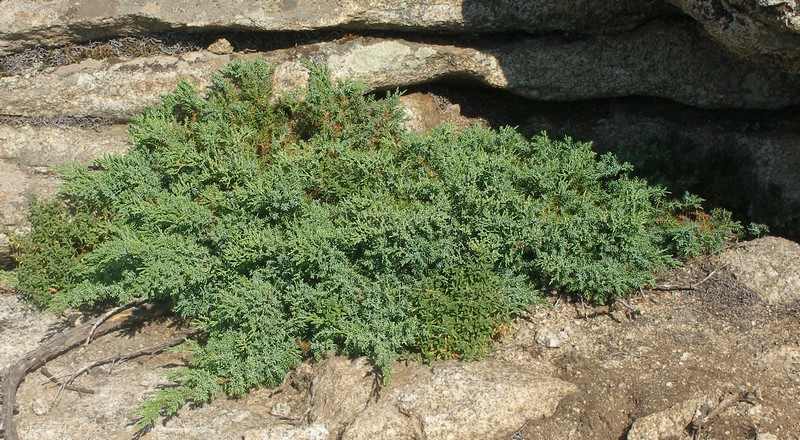
In nature it grows in northern China (Heilongjiang), in Yakutia, in northern Mongolia, and in Russia (in Transbaikal (Dauria), Primorsky and Khabarovsk Krais and in the Amur region). It occurs in small groups, more rarely solitary, on rocky screes of mountain slopes, on cliffs, bare mountain peaks (golets) and screes, as well as in river valleys, sand dunes, and on coastal rocks. It ascends to elevations of 400–1400 m above sea level.
It is an evergreen coniferous shrub with prostrate or ascending shoots. It reaches 0.5 m in height and up to 1 m in diameter. Shoots reach 2–3 m in length, the thickness at the base not more than 2–3 cm (at 100 years reaching 5 cm in diameter), grayish in color, prostrate, four-angled, branches ascending in a comb-like fashion. The crown is cushion-shaped, dense. Bark gray, becoming brownish with age. The main trunk is often hidden in the upper soil layer.
On the shoots the foliage occurs in different forms. Needle-like leaves grow oppositely and decussately on the lower part of the shoot; they are soft, thin, bright green, 0.8 cm long, spreading from the shoot, with sharp tips. Scale-like leaves grow at the tips of the shoots, tightly appressed to them, rhombic in shape, pointed, gray-green in color. In winter the foliage browns.
Megastrobili are ovoid-elongated, 4–5 mm long. Microstrobili 12–18 mm long, with 2–4 pollen sacs.
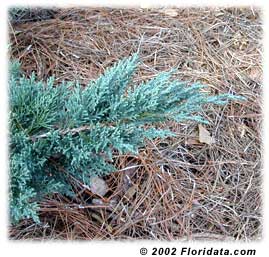
Berry-like cones are brownish-blue or purplish-brown with a glaucous bloom, spherical, 0.5–0.6 cm in diameter. Seeds are ovoid-elongated, slightly flattened, with a sharp apex, arranged 2 or 4 per fruit, often protruding outward.
Varieties: Juniperus davurica subsp. maritima
Cultivars: 'Leningrad', 'Parsonii', 'Expansa', 'Expansa Aureospicata', 'Expansa Variegata'.
Hardiness: 4-9 (-34°C)
Location: does not tolerate drought, prefers moist sandy loam soils, not demanding in terms of fertility, can grow on poor and significantly saline soils. Resistant to urban conditions. Sun-loving, but tolerates light shade.
Planting: recommended spacing between plants 0.5 or 1.2–2 m. Planting depth – 70 cm. Drainage if necessary: crushed brick or sand, layer 15–20 cm. Soil mixture: turf topsoil, peat and sand in the ratio 1:2:1. Transplanting is poorly tolerated, even with a root ball.
Care: in spring (April–May) apply nitroammophoska 30–40 g/m2. In dry summers it is recommended to water the plant 2–3 times per season and perform evening spraying once a week. Mulch with peat or sawdust in a layer of 5–8 cm.
Pruning: tolerates heavy pruning and trimming well, retains its shape for a long time.
Diseases: rust (Arcerid (50 g per 10 L of water) spray 4 times at 10-day intervals), shutte, biatorellaceous and nectriaceous canker, alternariosis, pear rust fungus.
Pests: aphids (Fitoverm (2 g per 1 L of water) spray 2 times at 10–14 day intervals), leaf-miner moth (Decis (2.5 g per 10 L) spray 2 times at 10–14 day intervals), spider mite (Karate (50 g per 10 L)), scale insects (karbofos (70 g per 10 L of water)), galls, sawfly, shoot moth, pine looper.
Propagation: propagated by seeds and cuttings. Winter cuttings root at 72% without treatment.
Uses: used as a groundcover plant, for creating borders, covering slopes and rocks, in rock gardens and home plots. Can be grown in bonsai style.