
Fruit trees
Walnut
Juglans regia
Walnut (lat. Júglans régia) – syn. Greek walnut, Voloshsky walnut, Royal walnut, Redwood. It is a species of trees of the genus Walnut of the Walnut family (Juglandaceae). Its native range is considered to be Central Asia. In the wild it grows in the mountainous areas of Central Asia, the Transcaucasus, the southern part of the Balkan Peninsula, Iran, China, Korea and Japan. In cultivation it is widespread on all continents; the main producers are India, China, the USA, Turkey, Italy, France, Romania, Ukraine, Moldova.
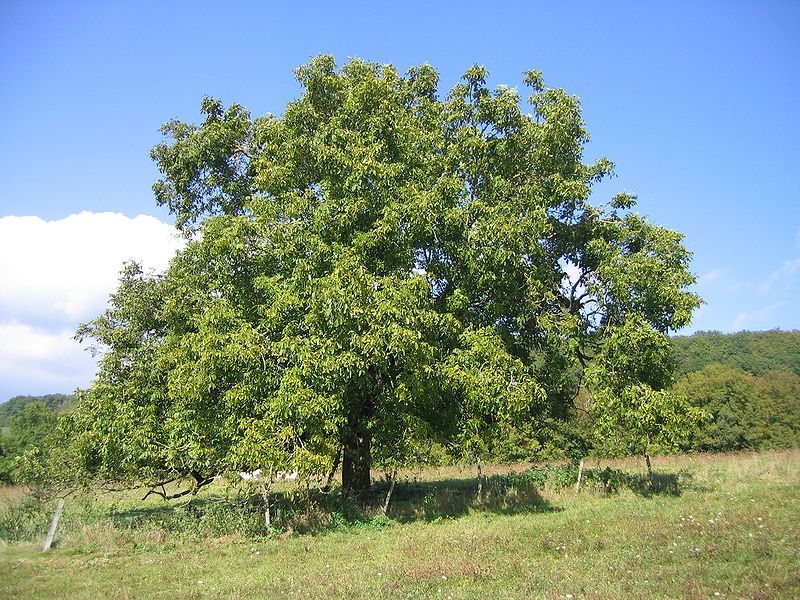
It reaches 30-35 m in height, the trunk from 1 to 1.5 m in diameter. A tree with a comparatively small crown, solitary trees with a broad, pyramidal form.
The root system is powerful, consisting of a main root that grows vertically downward and numerous scaffold and semi-scaffold roots, which also branch into many smaller ones, ending with the finest fibrous absorbing roots up to 1 mm thick.
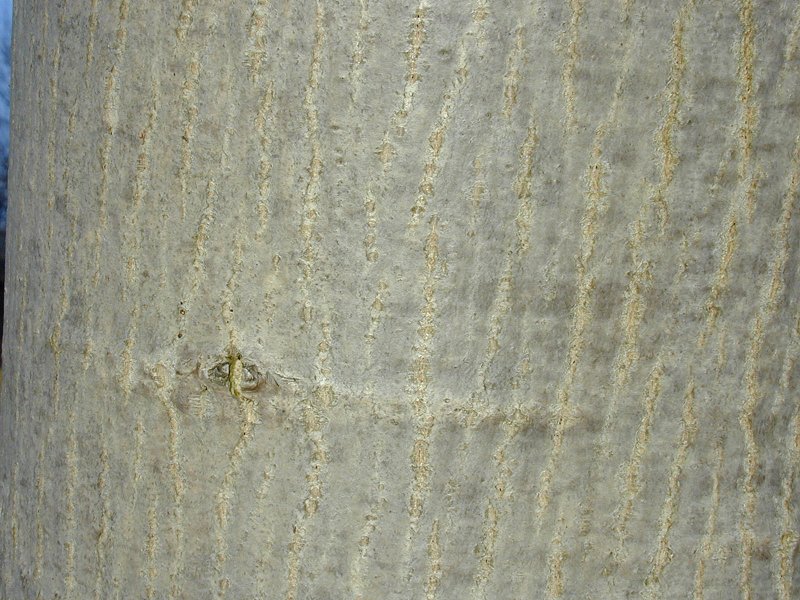
The bark of young trees is shiny, olive-gray, later deeply longitudinally fissured, brownish-gray.
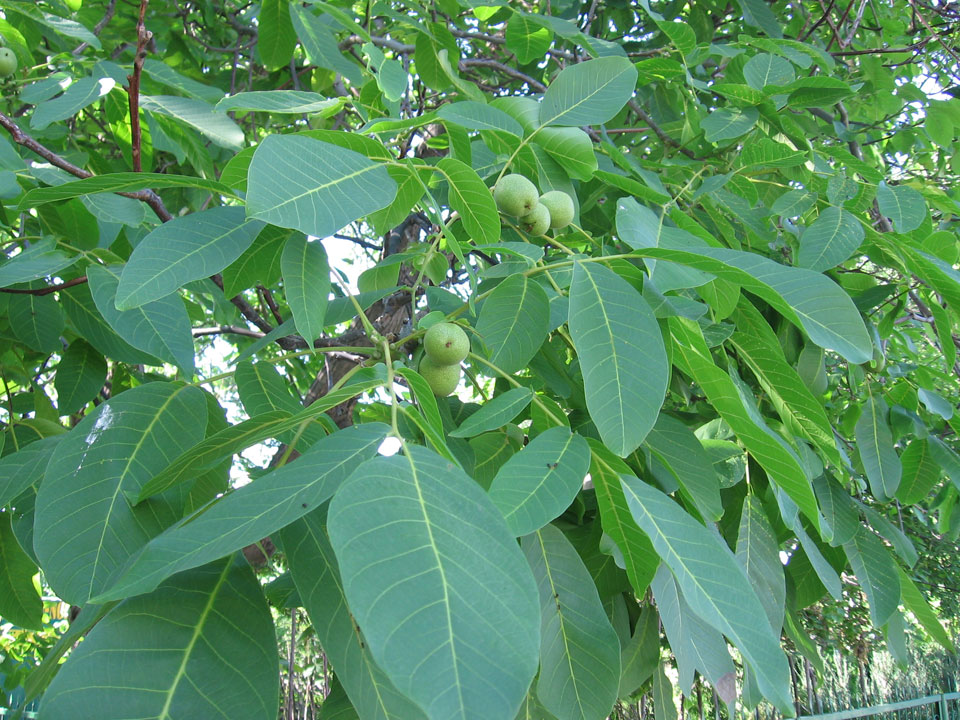
Leaves are pinnate with an odd number of leaflets, up to 40(75) cm long, composed of 5-11 leaflets, the size of which decreases from the tip of the leaf to the base. The terminal unpaired leaflet is larger than the others and on a short petiolule, the remaining ones are sessile. When the leaves are crushed a pleasant smell is noticeable.
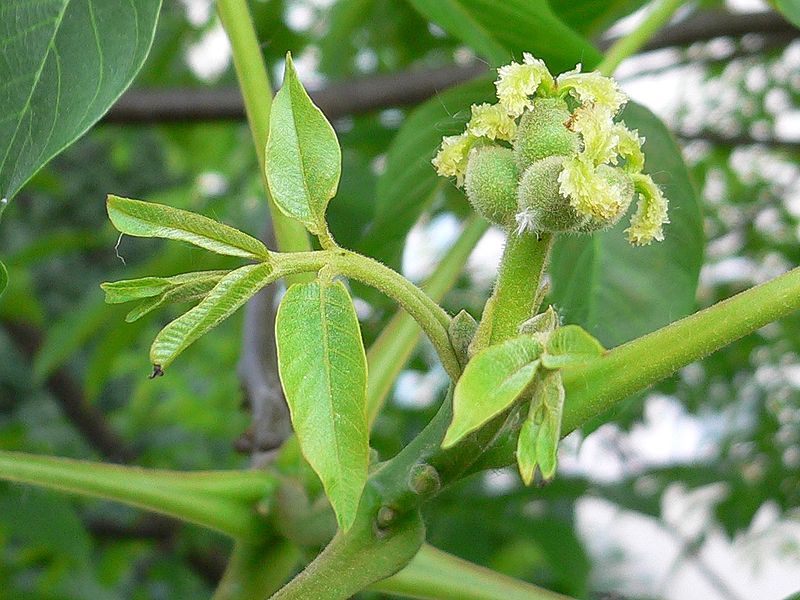
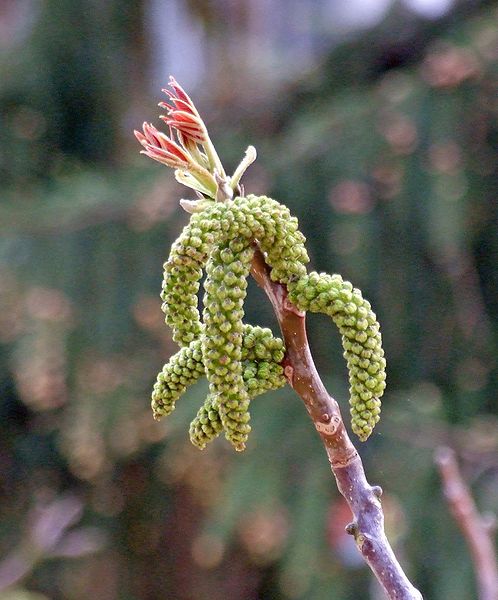
Flowers green, small, monoecious. Staminate flowers are gathered in pendulous catkins. Pistillate flowers grow singly or in groups at the tips of one-year shoots.
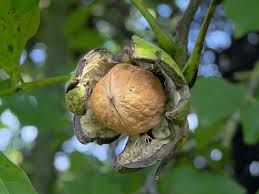
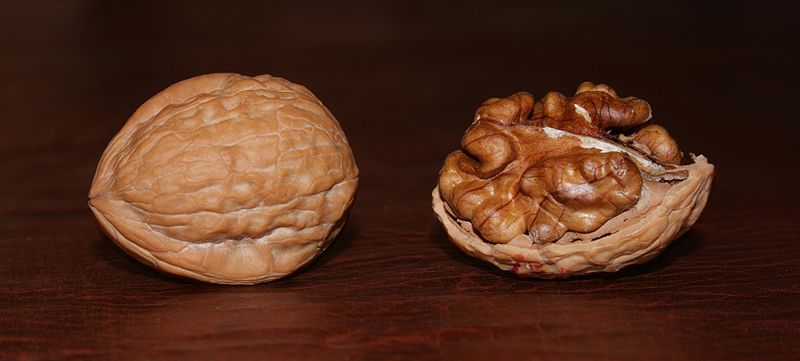
Fruit - a drupe with a fleshy green husk that dries and blackens on the tree. The husk cracks while still on the tree when ripe. The seed is enclosed in a bony, wrinkled shell of two valves joined by a projecting seam. Ripens in September. Fruiting begins at 8-10 years of age and continues for 150-200 years and longer. Yield per tree is 25 kg (maximum 150 kg).
Varieties: It has many forms, of which the following are of decorative interest: by crown shape - weeping (f. htndula), fruiting (f. fertilis); by leaf shape - single-leaf (f. monophylla), variable-leaf (f. heterophylla), laciniate-leaf (f. laciniata), narrow-leaf (f. angustifolia), broad-leaf (f. latifolia), ash-leaf (f. fraxinifolia); by leaf coloration - variegated (f. variegata), striped (f. striata); and less interesting ones - by inflorescence character, flowering time, fruit size and shape, shell hardness. Also noteworthy are its hybrids with other species of the genus: with black walnut - (J. x intermedia Dtpp.), with gray walnut - (J. x intermedia alata Cair.), (S. x silvosteposa N. Vech.) and with Manchurian walnut.
Location: sun/partial shade, thermophilic, tolerates drought well, insufficiently winter-hardy (hardiness zone 6a), suitable for urban conditions, not wind-resistant. Prefers soils from dry to moist; for good development it needs deep, fertile, loose, calcareous and moisture-retentive soil (groundwater not closer than 2-2.5 m).
Planting: digging up seedlings and subsequent planting is recommended in spring (before bud swelling). Autumn planting is carried out only in southern areas until the first half of October. Autumn digging up of seedlings and storing them until spring is not recommended. Planting holes should be 70x70x70 cm. The seedling is backfilled with a specially prepared mixture of top fertile soil and humus (compost) in a 1:1 ratio, 20-40 g of potassium and phosphorus fertilizers and 1 kg of lime. The root collar should be at ground level. Planted trees require abundant watering – at least 2 buckets per planting site and mulching of the soil. At a distance of 30-50 cm from the trunk it is possible to form a mound of a mixture of soil and humus (3:1) to collect water and nourish the root system. After 12-15 days abundant watering is recommended (15-20 l per seedling).
Seeds can be sown in spring and autumn at a depth of 8-10 cm. In the first year seedlings grow slowly, reaching 30-35 cm in height by the end of the growing season.
Grafting is carried out from December to March. The scion must be harvested before frosts. Scions can be stored in substrate at a temperature of +2 to +5 degrees Celsius.
The method of winter and spring budding is also used for propagation.
With seed propagation the walnut begins to bear fruit in 8-12 years after planting in a permanent place; with planting of grafted seedlings – in 3-4 years after planting. There are also early-fruiting forms that bear fruit at 1-2 years of age.
Pruning: formative pruning is performed. The crown is formed bowl-shaped with 3-4 and alternately-leader with 5-6 scaffold branches. The recommended trunk height is from 80 to 120 centimeters for commercial plantations and 1.5-2 meters for planting trees along roads. After completing formative pruning (5-6 years), only rejuvenation pruning is carried out.
Diseases and pests: diseases – brown spot (marssoniosis), cytospora canker, black canker (Sphaeropsis malorum Peck. and S. juglandis Hohn), green (penicillium), black (aspergillus) and pink (trichothecium) molds, gray rot, cladosporiosis, alternaria, fusarium fruit rot, fungal pathogens - Diaporthe eres Nits, Melanconium juglandium Kunze, Nectria cinnabarina (Tode) Fr, Nectria galligena Bres, bacterial crown gall (Agrobacterium tumefaciens Sm. et Towns), bacterial blight (Xanthomonas arboricola pv. juglandis Arsen). Pests – American white butterfly, codling moth, walnut wart mite, walnut leaf-miner moth (tortrix).
Care: it is not recommended to apply nitrogen fertilizers for 2-3 years during the onset of fruiting. The use of phosphorus-potassium fertilizers stimulates fruiting; they should be applied at the root level. Poorly tolerates soil cultivation under the crown. Watering is recommended in the spring-summer period (May-August).
Propagation: propagated by seeds sown in the ground after collection or in spring after stratification. Forms and cultivars are propagated by grafting and by layering of suckers. Suckering ability persists into advanced age.
Uses: the wood is used for various crafts. In addition to its fruit value it has high ornamental qualities: vigorous and fast growth, tolerance to adverse urban conditions, durability. Kernels of the fruits are used fresh or dried, used for making preserves and oil. Unripe fruits are used for making vitamin concentrates. Leaves are used in medicine.