
Fruit trees
Manchurian walnut
Juglans mandshúrica
Synonym: Dumbei walnut, Juglans cathayensis Dode, Juglans cathayensis var. formosana (Hayata) A.M.Lu & R.H.Chang, Juglans collapsa Dode, Juglans draconis Dode, Juglans formosana Hayata, Juglans stenocarpa Maxim., Juglans mandschurica.
Manchurian walnut – a species of deciduous trees or shrubs in the genus Walnut of the family Juglandaceae. In the wild it occurs in the northeastern part of China (Manchuria), on the Korean Peninsula, and also in Russia (southern Khabarovsk Krai and Amur Oblast). It grows in elm-ash and cedar-broadleaf valley forests singly and in groups. Found at elevations of 500-2800 m above sea level. In cultivation since 1857. A hygromesophyte, eutrophic, micro-mesotherm, a stable constituent of the first and second tiers of coniferous-broadleaf valley forests. Lives up to 250 years. Has the shortest growing season among other members of the genus.
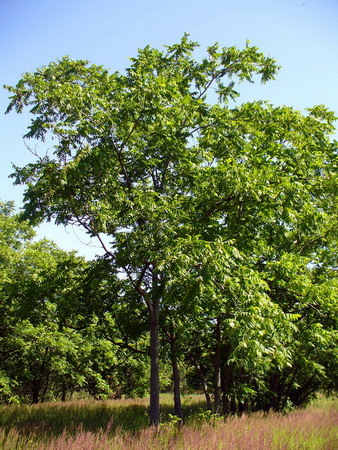
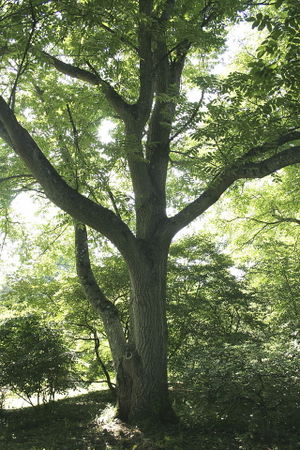
It is a deciduous monoecious tree or shrub 20-25 m in height with a straight trunk. Up to 80-90 years it grows fairly rapidly; later growth slows. Crown high, spreading or broadly rounded, open, resembling the crown of some palm species. Bark dark gray, almost black, with deep longitudinal fissures. Shoots yellowish-brown, pubescent.
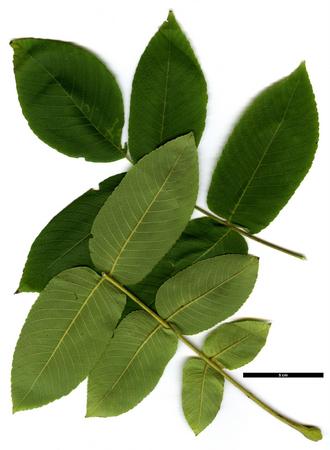
Leaves odd-pinnate, compound, on long petioles, very large (40-90 cm long, more rarely 1-1.25 m), alternate, composed of 7-21 oblong-serrate leaflets 6-17 cm long and 2-7 cm wide. The leaf blade is sparsely finely toothed, with an acute apex; the abaxial (lower) surface of the leaf is pubescent. When crushed, the leaves have a strong characteristic odor. In spring they are grayish-green due to pubescence, in summer bright green, in autumn golden-yellow. Differs from other species by simultaneous leaf fall.
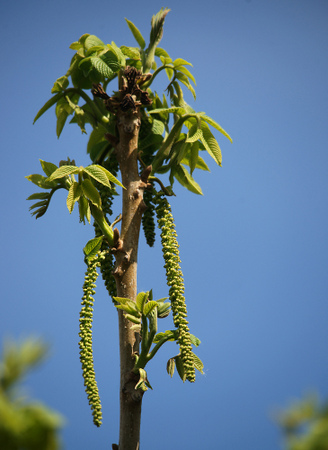
Flowers small, unisexual, opening with leaf emergence. Male flowers are long catkins; female flowers occur 3-10 together at the ends of shoots.

Flowering period: April – May.
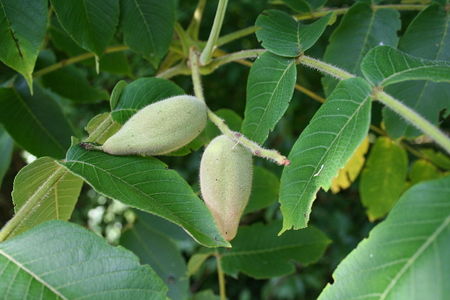
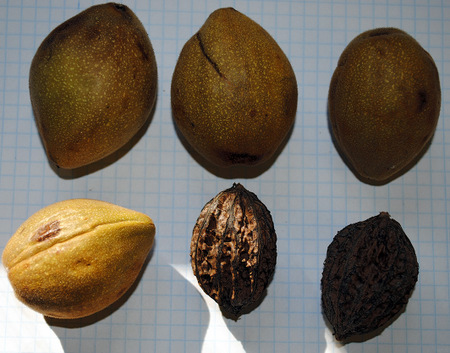
Fruits are drupaceous nuts resembling common walnut fruits but slightly smaller, 2.5-7.5 cm long, borne 3-7 together. The shell is very thick, green or brownish. The kernel is small, edible. Fruits ripen in August – October and fall quickly from the trees. Begins fruiting depending on growing conditions at 4-8 years (in cultivation at 12-15 years).
Chromosome number 2n = 32.
Hardiness zone: zone 2a (-45°C).
Site: Prefers fertile, well-moistened loose, well-drained soil. Sensitive to drought. Light-loving but shade-tolerant. Wind-resistant. Medium tolerance to gases and smoke.
Propagation: Easily propagated by seeds, which retain viability up to 2 years. For winter sowing use freshly collected seeds; in spring sow seeds stratified for 6 months. Germination quality is 98%. Soil germination 75%. Recommended sowing depth 7-8 cm. Cuttings root poorly.
Pests and diseases: little affected.
Conservation status: protected in nature reserves.
Use: Ornamental for its broad rounded crown and large leaves. Used in landscape design in solitary and group plantings in alleys, large gardens and parks, and for urban greening. The hard and attractive wood is used for carving, furniture, and high-quality plywood. The shells are widely used in decorative and applied arts. Also a good honey plant.