
Flowers for the garden
Smooth iris
Iris laevigata Fisch.
Family Cruciferae. one of the most interesting water-loving irises.
First discovered in Transbaikalia and described by the botanist F. B. Fischer in 1837 under the name iris laevigata (I. laevigata). In Japan it is called "kakitsubata". It is called "smooth" because its leaf, unlike the leaf of the marsh iris, does not have a raised central vein.
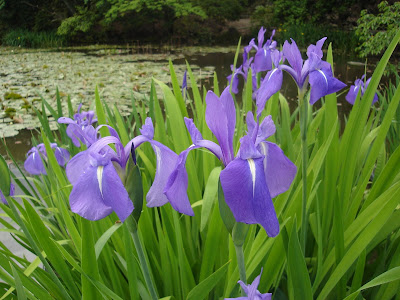
The smooth iris is distinguished by its distinctive violet-blue flowers. It is more moisture-loving than the marsh iris. When planted on the shore, it can during development move into the water body and there grow well at a considerable depth. The preferred habitats of the smooth iris in nature are wet meadows, river and lake shores, and bogs, where it actively forms part of the riparian vegetation.
In the same place, without losing its decorative value, the smooth iris can grow for 5—7 years and more. It does not require winter protection. It is undemanding regarding soils, but of course grows more vigorously and develops more robust foliage in humus-rich soils. In autumn it is advisable to remove the foliage, leaving a clump of basal leaves 10-15 cm high.

Wild forms of this species are propagated by dividing the rhizomes during active root growth, in the second half of August — early September, and by sowing seeds in autumn. Garden forms and cultivars can be propagated only by dividing the rhizomes.