
Flowers for the garden
Ipheion
Ipheion
Ipheion (lat. Ipheion) is a genus of perennial herbaceous, bulbous plants of the family Alliaceae (Alliaceae). The genus includes about 6 species occurring in the subtropics and tropics of the Americas from Mexico to Chile and Argentina.
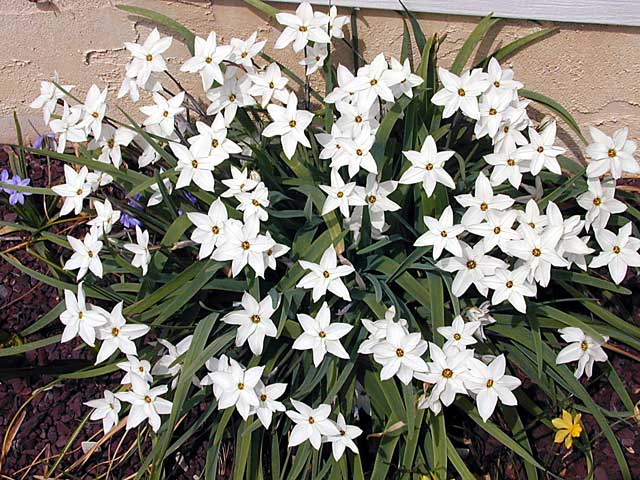
Bulb with a membranous tunic. Flower solitary, erect. Six stamens, they are shorter than the perianth; anthers pendulous. Crushed plants smell of onion or garlic. The plant is little known among domestic gardeners, but deserves wide cultivation, since it is attractive and causes no trouble in growing.
In cultivation:
Ipheion uniflorum — Ipheion uniflorum = Tristagma uniflorum
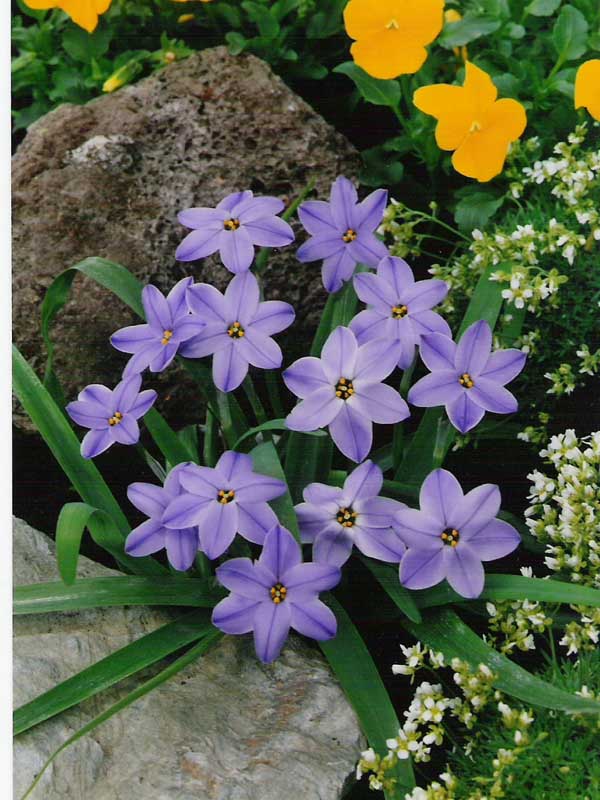
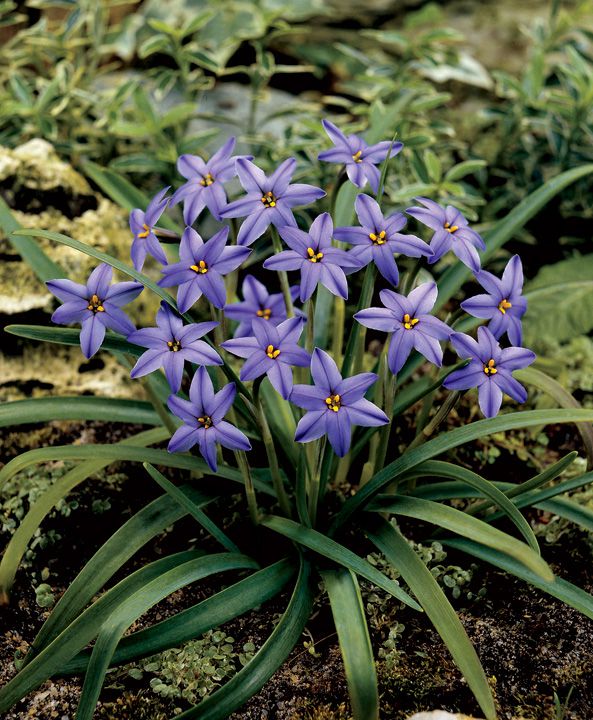
Herbaceous, perennial bulbous plant, bulb small, ovoid; its outer scales continue onto the base of the stems. Several stems, 15—30 cm high. Many leaves, they are broad-linear, almost flat, glaucous, as long as the stems. Flowers simple, resembling six-pointed stars, 2.5 cm in diameter, blue, with a purple stripe down the middle of the petals. Flowers in spring. Very attractive.
Cultivars include: Album — with large white flowers, Wisley Blue — with bluish-lilac flowers, Froyle Mill — with dark blue, Rolf Fiedler — with bright blue flowers.
Location: the plants are undemanding, but require protection from wind. A sunny or lightly shaded site. In the temperate zone and further north, for winter it is advisable to cover with nonwoven fabric (lutrasil, spunbond, etc.).
Soil: prefer a light soil rich in leaf humus with good drainage.
Propagation: in the second half of August—September by dividing clumps of bulbs every 3—4 years. Bulbs are planted in groups at a depth of 5 cm at 8 cm apart. Easily propagated by seed.
Usage: Ipheion is used in group plantings in the foreground, under trees and shrubs. At first the plants gain strength slowly; flowering in the first year after planting may be weak, but as they gradually spread they form large, abundantly flowering patches.