
Deciduous shrubs
Blue holly
Ilex meserveae
Synonyms: blue holly
Blue holly (Ilex meserveae) – varieties of dioecious shrubs from the genus Ilex (Ilex L.) of the family Aquifoliaceae. Hybrids between I. Rugosa and I. Aquifolium or I. Cornuta and I. Rugosa. The author of these hybrids is housewife Kathleen Meserve from New York (USA), who never studied botany. The hybrids were obtained by her on a kitchen windowsill. The first hybrid 'Mesgolg' (Golden Girl) appeared in 1950 and was introduced to trade in 1964 at the Conard-Pyle nursery.
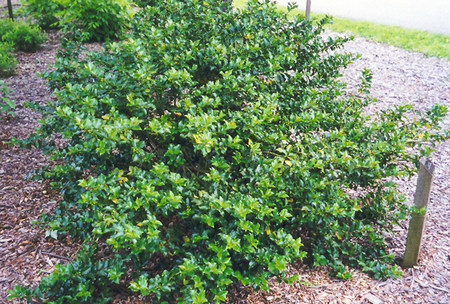
'Blue Girl'
These are evergreen shrubs 1-2 m in height depending on the cultivar. They grow slowly. The crown is compact, pyramidal or rounded. Stems bluish-purple-green. Bark greenish-brown.
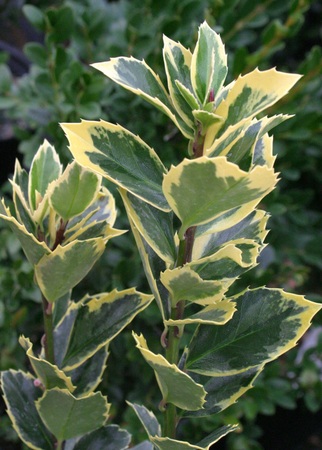
'Honey Maid'
Leaves dark, blue-green in color, glossy, oval or narrowly ovate, with spines along the margins, 4-6 cm long and 2.5-4 cm wide. When unfolding they are bronze-green; in winter they acquire purple tones.
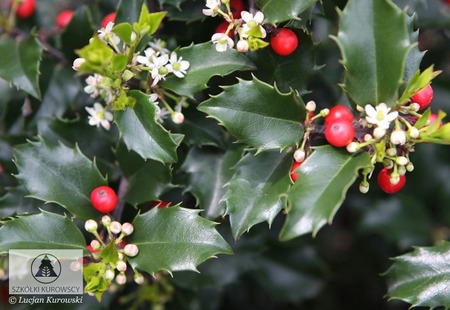
'Blue Girl'
Flowers are dioecious with female and male plants, small, white, inconspicuous, with a light fragrance, appearing from late April to early May. Male flowers are slightly showier than female ones. For pollination it is necessary to have a male and a female plant no more than 1 m apart.
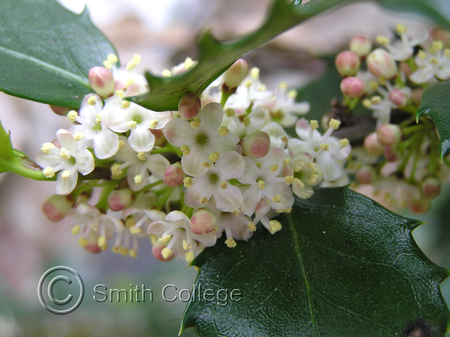
'Blue Prince'
Fruits – bright red, glossy drupes up to 10 mm in diameter, ripen in October and remain on the shrubs until spring.
Fruits are poisonous.
Varieties: hybrids between I. rugosa x I. Aquifolium are called blue - 'Blue Angel', 'Blue Boy', 'Blue Girl' , 'Mesid' (Blue Maid), 'Blue Prince', 'Blue Princess', 'Honey Maid', 'Gretchen', 'Mesan' (Blue Stallion).Hybrids between - I. cornuta x I. Rugosa - 'Mesdob' (China Boy), 'Mesog' (China Girl)
Other hybrids: 'Mesgolg' (Golden Girl) – Meserve's first hybrid; Centennial Girl; 'Hachfee'.
Hardiness zone: 4b-8.
Location: can grow in shady or semi-shady places. Variegated cultivars should be planted in sun. Tolerates urban conditions well. They suffer from bright winter sun.
Soil: prefer light, rich, well-moistened and well-drained woodland soil. Do not tolerate drought well.
Planting: it is recommended to plant young plants; mature plants do not transplant well. In regions with mild winters planting is carried out in winter, in other places – in early spring. For abundant fruiting cross-pollination must be taken into account, so it is recommended to plant 2 or 3 plants.
Pruning: tolerates formative pruning well, which is recommended to carry out in May-June.
Care: young plants need protection from bright winter and early spring sun. In dry and hot summers they require watering.
Pests: leaf-mining fly
Diseases: Phytophthora
Uses: the most frost-hardy holly cultivars. In Western Europe leaves and fruits are used as Christmas decorations – wreaths, garlands. Widely used in group plantings, on forest edges, in the understory, for creating hedges. Formed Meserve hollies are ideally suited for French (formal) style gardens.