
Deciduous shrubs
Common holly
Ilex aquifolium L.
Synonyms: oстролист, падуб обыкновенный, Ilex perado auct. iber., Aquifolium ilex Scop., Ilex balearica Desf., Ilex montserratense Sennen, Ilex perado subsp. iberica (Loes.) S. Andrews
Common holly (Ilex aquifolium L.) – the type species of the genus Ilex (Ilex L.) of the family Aquifoliaceae. The species was first described by Carl Linnaeus in 1753 in Species Plantarum, Tomus I: 125. Cultivated since ancient times.
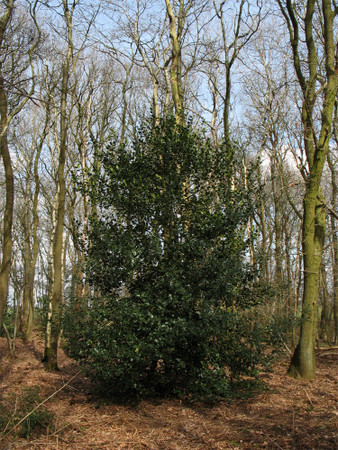
In nature it occurs in Western and Southern Europe, in Northwest Africa, and Southwest Asia. It grows in the understorey of mixed, beech, spruce and fir (Nordmann fir (Abies Nordmanniana)) forests. In Ukraine it is cultivated in Crimea and southern regions; cultivation is possible in the Pre-Carpathians and Transcarpathia; in Kyiv it is damaged by frost down to the root collar.
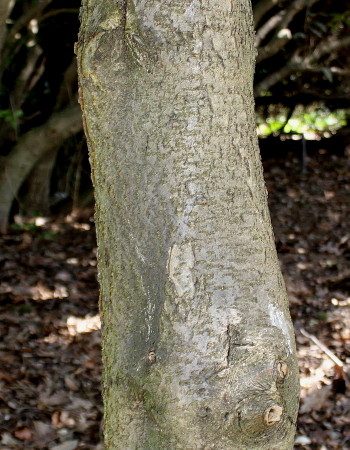
These are evergreen dioecious trees 10-20 (25) m tall, trunk diameter 30-80 cm. In cultivation usually a shrub 3-6 m tall with trunk diameter up to 20 cm. Growth is slow. Lives up to 1000 years. Crown dense, pyramidal or elongated, 3-5 m in diameter. Shoots often prostrate and rooting. Young shoots greenish or gray-green, glabrous, less often shortly and densely pubescent. Bark furrowed, brownish-brown.
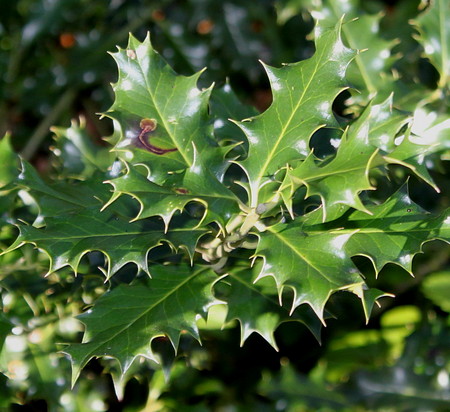
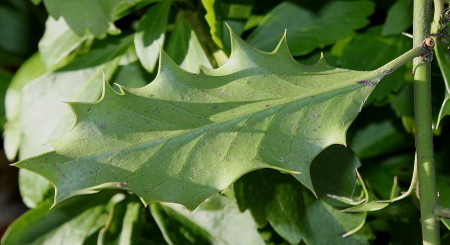
Leaves alternate, 3-9 cm long and 2-5 cm wide, elliptic, obovate or ovate in shape, stiff, leathery, dark green and glossy above, slightly lighter and matte beneath. Leaf blade margins wavy, with 2-9 spiny triangular teeth, often entire on old trees. Lateral veins 4-10 pairs, inconspicuous or distinctly visible on the upper surface, weakly or strongly prominent on the underside. Petioles short.
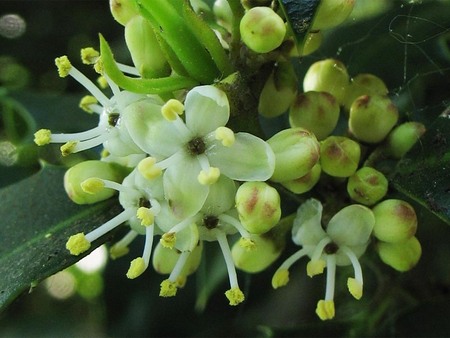 | 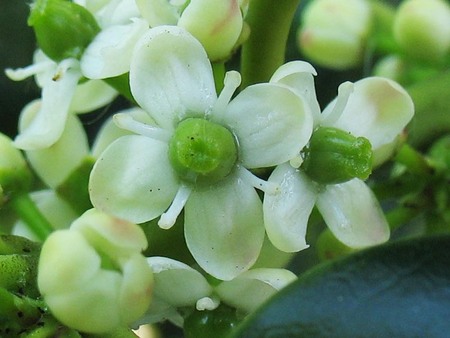 |
| Staminate flowers | Pistillate flowers |
Inflorescences – umbel-like cymes, located in leaf axils, borne on last year's shoots. Staminate flowers in 3-flowered clusters, pistillate flowers solitary, less often 2-3 together. Flowers small, dull-white, yellowish (male) or pinkish-white (female), fragrant, 4-, less often 5-merous. Pedicels short, glabrous, less often short-hairy. Bracts small, oblong. The sex of the plant cannot be determined until flowering begins, which usually occurs at 4-12 years. Flowers in April-May.
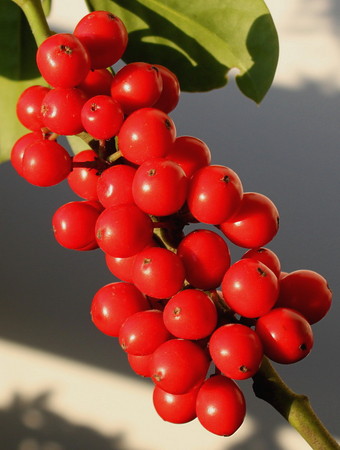
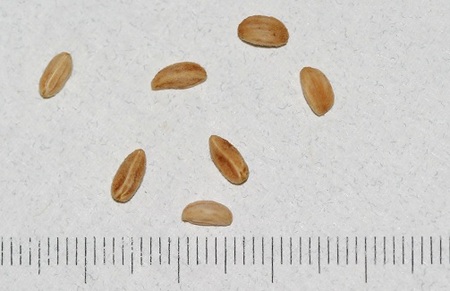
Fruits – red, glossy drupes on short stalks (4-8 mm long), ovoid, globose or elliptic in shape, 7-11 mm long and 5-10 mm wide. Stones 4 or 5, 5-8 mm long, faceted, with longitudinal ribs. Fruiting in July-August. Seeds germinate in 2-3 years.
Poisonous plant.
Hybrids:
- with Ilex perado Aiton – Ilex × altaclerensis (Loudon) Dallim.
- with Ilex rugosa - Ilex × meservea (
Varieties:
- Ilex aquifolium var. algarviensis Chodat
- Ilex aquifolium var. balearica (Desf.) Willk. in Willk. & Lange
- Ilex aquifolium var. barcinonae Pau in Mem. Mus. Ci. Nat. Barcelona
- Ilex aquifolium var. heterophyllum Rchb.
- Ilex aquifolium var. laetevirens Sennen
- Ilex aquifolium var. lusitanica Chodat
- Ilex aquifolium var. senencens Gaudin
- Ilex aquifolium var. altaclerense = Ilex × altaclerensis
- Ilex aquifolium var. chinensis = Ilex centrochinensis
Forms:
- Ilex aquifolium f. bacciflava (Weston) Rehder
- Ilex aquifolium f. ferox (Aiton) C. K. Schneid.
- Ilex aquifolium f. heterophylla (Aiton) Loes.
- Ilex aquifolium f. integrifolia Nolte ex Loes.
- Ilex aquifolium f. pendula (Loudon) Schelle
Cultivars: cultivars awarded the Royal Horticultural Society's Award of Garden Merit (RHS AGM): 'Amber', 'Argentea Marginata', 'Ferox Argentea', 'Golden Queen', 'H-andsworth New Silver', 'J.C. van Tol', 'Madame Briot', 'Myrtifolia Aurea Maculata', 'Pyramidalis','Silver Queen'
Hardiness zone: 5b(18—20°C).
Exposure/position: one of the most shade-tolerant shrubs.
Soil: prefers light, moist, woodland soil, necessarily underlain by lime-containing bedrock. Performs poorly on dry and heavy soils. Does not tolerate drought.
Planting: it is recommended to plant young plants, mature plants transplant poorly. In regions with mild winters planting is done in winter, elsewhere in early spring. For abundant fruiting cross-pollination should be considered, so planting 2 or 3 plants is recommended.
Pruning: tolerates pruning and shaping well; trimming is recommended in May-June.
Care: young plants need protection from bright winter and early spring sun. In dry and hot summers watering is required.
Pests: leaf-mining fly
Diseases: Phytophthora
Uses: used in garden landscapes in solitary and group plantings, for creating hedges and clipped hedges, topiary. In Western Europe used as a Christmas decoration. Widely used in traditional medicine.