
Flowers for the garden
Iberis or candytuft
Iberis
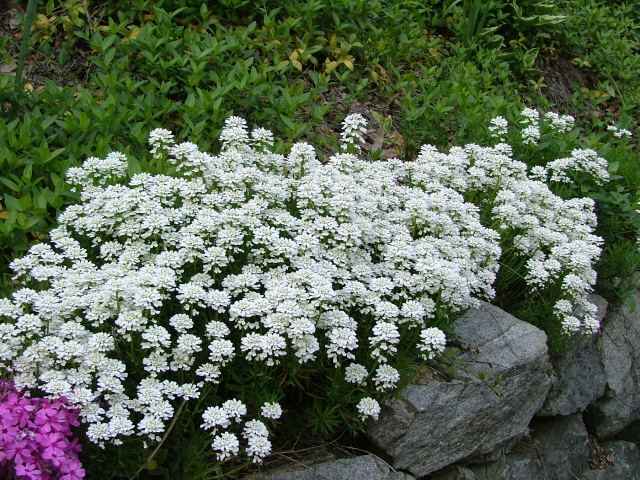
Iberis or candytuft (lat.Iberis) is a genus of annual and perennial subshrubby herbaceous plants of the cabbage family (Brassicaceae). The genus includes about 40 species distributed in the Mediterranean and Central Europe.
The name comes from the ancient name of Spain (Iberia) and indicates the plant's natural range of distribution.
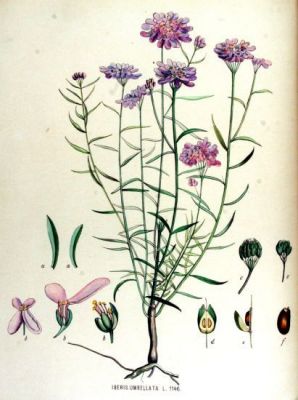
Annual and perennial herbaceous plants, sometimes subshrubs, 10 to 40 cm tall. Leaves entire or pinnately divided. Flowers small, white, pink or lilac, gathered in umbel‑like racemes. Flowers very abundantly (April) May–June, with possible repeat flowering in late summer or early autumn. Fruit — a silique (pod).
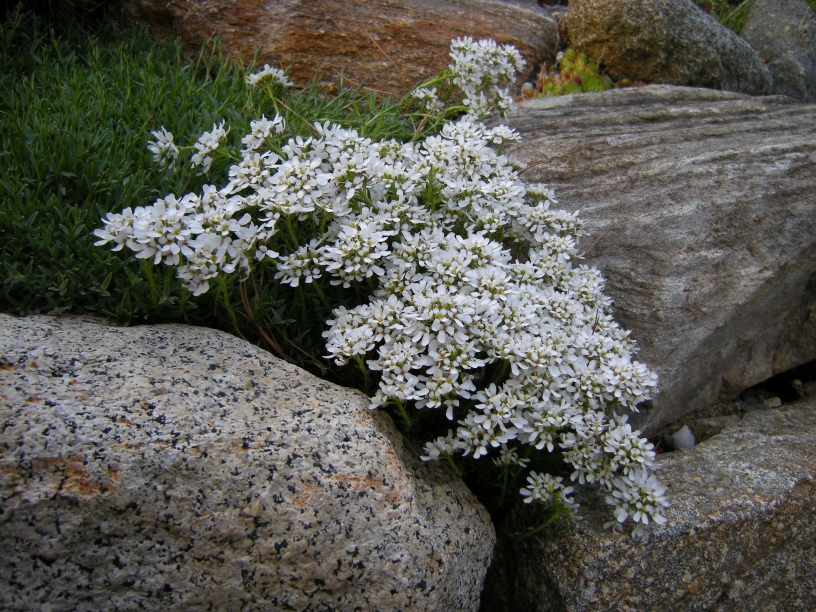
Attracts many bees and butterflies. It is a good honey plant. It is grown in mass plantings along the front edge of borders or to edge paths.
In cultivation:
Evergreen candytuft — Iberis sempervirens
A perennial subshrub up to 40 cm tall. Leaves evergreen, oblong, entire, dark green, glossy, up to 7 cm long. Flowers white up to 1.5 cm in diameter, gathered in umbel‑like inflorescences up to 5 cm across. Blooms in late May - early June, abundantly, for about 20–25 days, sometimes again in late summer. During flowering the inflorescences almost completely cover the leaves. Sets fruit. Decorative throughout the season. In cultivation since 1679. Well suited for alpine rockeries and rock gardens.
Gibraltar candytuft — Iberis gibraltarica
A semi‑evergreen low‑growing shrub, up to 25 cm tall and 40 cm wide, with numerous small pink flowers. Blooms in spring. Requires a sunny position and well‑drained soil. In the conditions of the northern part of Ukraine – short‑lived perennial, usually biennial, but regenerates by self‑seeding. Known cultivars include 'Candy Tuff’ and 'Gibralter Candytuft’. 'Gibralter Candytuft’ - has beautiful lilac flowers that become white with age, densely covering the low compact bush; a very decorative cultivar.
Location: require a well‑lit warm site, can tolerate some shading.
Soil: undemanding, however they achieve greatest ornamental effect on light loams.
Care: limited to cutting back the vegetative growth by half after flowering.
Propagation: by seeds and by dividing the clump. Seedlings flower in the second year. They can grow in one place for up to 5–6 years.
Zone: 6-9