
Climbing plants
Long-petioled hydrangea
Hydrangea petiolaris
Synonyms: Calyptranthe petiolaris (Siebold & Zucc.) Nakai, Гортензия черешчатая, Гортензия черешковая, Гортензия лазящая, Hydrangea anomala ssp. petiolaris (Siebold & Zucc.) McClintock, petiolaris Siebold & Zucc.
Long-petioled hydrangea – a species of woody climbing shrubs of the genus Hydrangea (Hydrangea) in the family Hydrangeaceae (Hydrangeaceae). Native to Japan, where it grows in dense and sparse coniferous or stone-birch forests; it is also found on the Korean Peninsula, in Taiwan, on the island of Sakhalin, in the Far East and eastern Siberia. In cultivation since 1865. Mesophyte, mesotroph, liana-saprophyte, understorey associate.
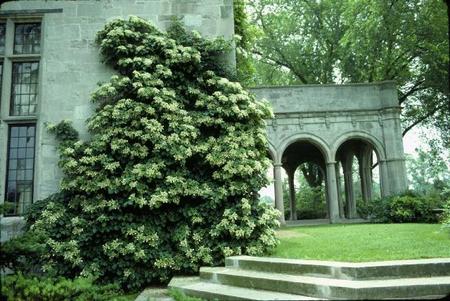
The species is closely related to another species - Hydrangea anomala, from which it differs by smaller size and smaller inflorescences.
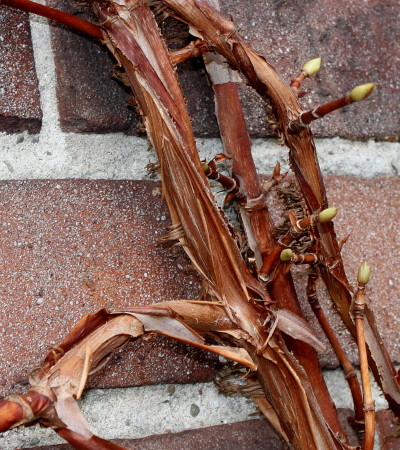
It is a deciduous woody climber or liana-like shrub, 12 (15) - 18 (25) m in height and occupying up to 20 m in width. Climbs supports by means of numerous aerial roots, usually on the shaded side of a tree. In the absence of a support it can creep along the ground and root. Along a low fence it forms a low shrub up to 2 m tall. In the first years it grows slowly, later faster – it can grow up to 1 m in length per season. Trunk up to 6 cm in diameter. Shoots are twining or climbing, in cultivation erect, light green, later brown, rough, peeling. Shoot growth is observed in the period from May to June.
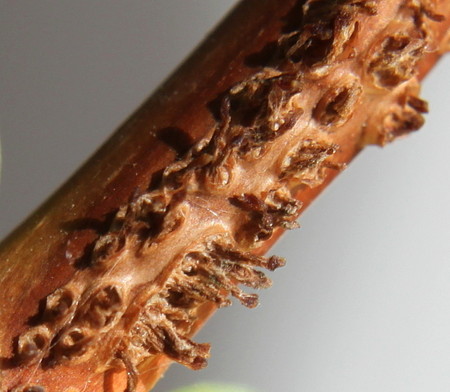
Shoot with aerial roots
Leaves alternate, arranged opposite, distributed along the entire length of the stem, petiolate, simple. Leaf blade oval, elliptic or ovate, not divided, apex acute, drawn out, margins finely or sharply toothed, with a notched, shallowly cordate or rounded base, 5-11 cm long, richly green, glossy, glabrous above, below with tufts of hairs in the vein axils. Petioles 4-8 cm long. In autumn the leaves acquire a coppery tint.
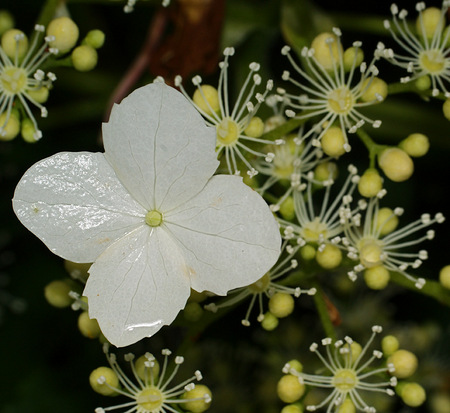
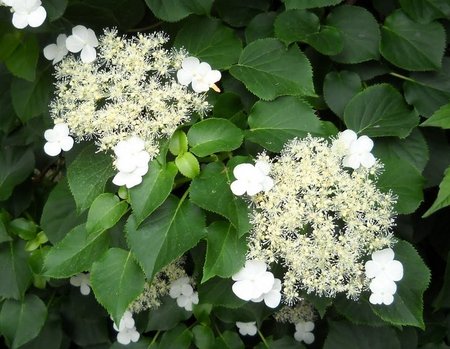
Flowers – loose corymbs of white, white-pink or white-green color, 15-25 cm in diameter, airy, lacy, graceful, with a light fragrance. Sterile flowers are 6-12 in number, peripheral, 2.5-4.5 cm in diameter, on long pedicels. Fertile flowers are small, numerous, whitish, with petals fused at the apex. Stamens very long, 15-20 in number, anthers nearly globular. Perianth actinomorphic. Petals 4-5 in number. Ovary inferior. Blooms in June-July.
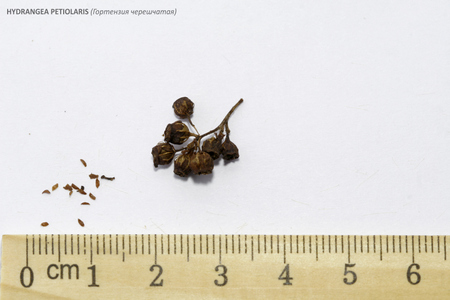
Fruits – globular capsules with a truncate apex, 3-5 mm in diameter, brownish-green. Seeds numerous, small, flat, winged. Fruits ripen in October.
Cultivars: Miranda, Moonlight magic, Melbourne
Hardiness zone: 4 (-28°C). In cold winters shoots may freeze, but recover quickly.
Location: grows well in moderately moist, shady sites, but flowers abundantly only in full sun. Tolerant of urban conditions. Requires a location sheltered from strong winds.
Soil: prefers light, humus-rich, moderately moist, acidic or neutral, well-drained soil. Sensitive to calcareous and heavy soils.
Planting: optimal planting age – 2-3 years. Planting is best done in spring or autumn. Size of the planting hole on light cultivated soils - 40x40x50 cm, on loamy cultivated soils - 50x50x60 cm, on heavy clay soils - 60x60x70 cm. It is recommended to place drainage such as gravel or broken brick at the bottom of the hole in a layer of 5-10 cm. Over the drainage, place fertile soil in a layer of 10-15 cm. Spread the roots over the entire area of the hole and position the root collar at ground level. Water consumption after planting per plant on sandy loam soil 20-25 L, medium-loamy 15-20 L, heavy loamy 10-15 L. In dry and windy weather it is recommended to spray the plant immediately after planting.
Care: for vertical greening it needs a good and reliable support, as well as constant tying of shoots. Watering per plant: 15-20 L on heavy loamy soils, 26-25 L on medium-loamy soils, 30-40 L on sandy soils. Feed 2-4 times during the growing season with liquid mineral fertilizer such as nitrophoska, ammonitrophoska, garden mix at a rate of 10-20 g per bucket of water per 1 sq. m. In autumn the soil can be fertilized with wood ash (100-200 g per 1 sq. m.). Since the plant tends to excessive vigorous growth, it is recommended to avoid too much fertilizer. It is also possible to spray during dry periods for 10-15 minutes 3-4 times a week.
Pruning: when using climbing hydrangea to cover a large vertical area, prune to stimulate vertical branching. To ensure maximum coverage of a fence or wall it is necessary to cut back vigorous shoots. At the same time perform guiding tying of the stems to cover the wall as much as possible and cut off shoots growing from them to stimulate the growth of lateral shoots. To enhance growth and obtain large inflorescences it is necessary to cut back the liana hard in early spring, leaving only some branches with 2-6 buds. Winter pruning and thinning also stimulate the growth of young shoots. When used as a groundcover plant only sanitary pruning is performed.
Propagation: propagated by seeds, which are sown in autumn immediately after collection in specially prepared boxes and lightly covered with soil. Easily propagated vegetatively – rooting of green and semi-woody cuttings under glass, division of the bush, suckers, layering. Rooting rate of cuttings 100% without treatment. Green cuttings are prepared in July, 8-12 cm long with one internode. For rooting in a greenhouse water 2-3 times a day. In addition, it is necessary to loosen the soil and shade the cuttings. With the appearance of the first two leaves ventilation of the greenhouse can be carried out. Faster rooting occurs under conditions of artificial fog.
Pests: aphids (pelargonium, greenhouse, pea), greenhouse thrips, spittlebug (froghopper), spider mite, green tree bug, berry bug, meadow bug, shiny tan leaf beetle, nettle leaf weevil, owlet moths (larvae of noctuid moths), golden chafer, hairy fungus beetle, marsh cranefly, earwig, gall nematode.
Diseases: tracheomycotic wilting, white sclerotial rot, gray mold, common (European) canker, tubercular bark necrosis, powdery mildew, Phyllosticta, Septoria, ring and Ascochyta leaf spot,
Uses: Used to decorate gazebos, pergolas, trellises, fences, house walls, terraces, balconies, trellises, arches, tree trunks. A good nectar source.