
Flowering shrubs
Panicle hydrangea "Kyushu"
Hydrangea paniculata “Kyushu”
Panicle hydrangea Kyushu (Hydrangea paniculata Kyushu) – a cultivar of panicle hydrangea. It was discovered in 1926 on the island of Kyushu (Japan) by the British botanist, dendrologist and plant collector Collingwood Ingram. The cultivar received the Royal Horticultural Society's Award of Garden Merit (AGM) in 1993.
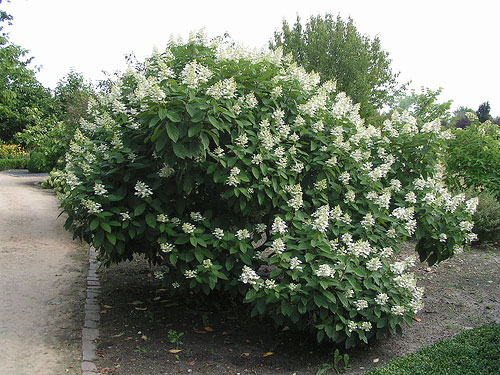
It is a deciduous shrub up to 3 m in height and diameter. It grows quickly, with annual increases in height and width up to 25 cm. The crown is spreading, fan-shaped. Shoots are erect, stiff, reddish-brown. Bark is brown and peeling. The root system is shallow, well-branched, with many fine roots.
Leaves are opposite, less commonly in whorls of 3, ovate or elliptic in shape, 12-15 cm long and 4-7 cm wide, leathery, dark green, slightly glossy on the upper side, glossy beneath, with pubescent veins and an evenly serrated margin. In autumn they take on yellow hues, not particularly notable.
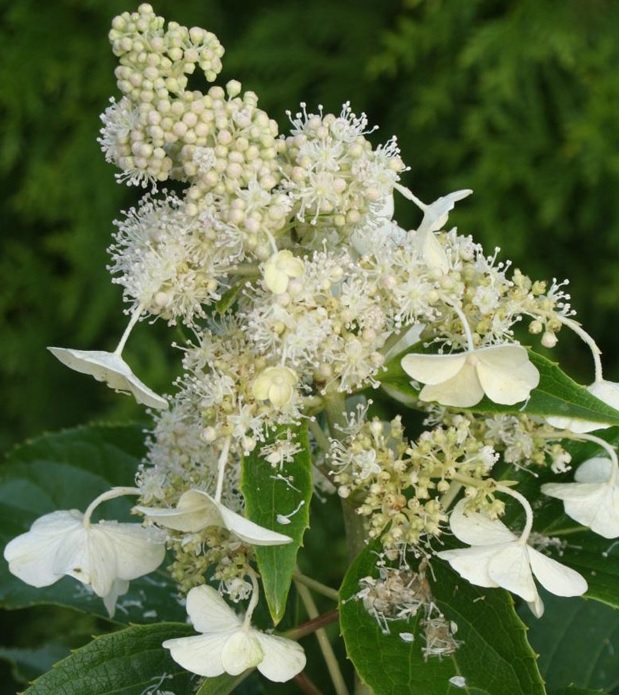
Blooms abundantly from mid-June to October. Flowers are gathered in long, lacy, broadly pyramidal and densely hairy panicles up to 25 cm long, with a pleasant fragrance. Fertile flowers are small, white, with early-falling petals. Sterile flowers are larger, up to 2.5 cm in diameter, with 4 white petals that later become pink. Begins flowering and fruiting at 4-5 years.
Fruits – capsules up to 3 mm in diameter, splitting at the top, ripen at the end of October. Seeds numerous, small.
Hardiness zone: 4 (-29°C).
Location: warm-loving; for planting it is best to choose sheltered locations. Needs protection from strong and cold winds. Does not tolerate drought and prefers moist sites. It is not recommended to plant near fruit trees. Tolerates urban conditions well.
Soil: grows well on fertile, slightly acidic to acidic soils, does not tolerate calcareous soils. Prefers moist, well-drained soils but without waterlogging.
Planting: the optimal planting age is 2-3 years. Planting is best done in spring or autumn. Planting hole size on light cultivated soils - 40x40x50 cm, on loamy cultivated soils - 50x50x60 cm, on heavy clay soils - 60x60x70 cm. It is recommended to place drainage such as gravel or broken brick at the bottom of the hole in a layer of 5-10 cm. Over the drainage, add fertile soil in a layer of 10-15 cm. Spread the roots over the entire area of the hole and place the root collar at ground level. Water consumption after planting per plant: on sandy loam 20-25 L, medium loam 15-20 L, heavy loam 10-15 L. In dry and windy weather it is recommended to spray the plant immediately after planting.
Care: loosen the soil around the bush at least twice a year to a depth of up to 5 cm. Watering should be done at least 5 times per season. To increase stem strength, you can water along the crown and at the root with a weak potassium permanganate solution. Fertilize with manure or mineral fertilizers at the beginning of growth, during bud formation, and also 1-2 times during the summer. In winter it needs sheltering with conifer branches or dry leaves.
Pruning: tolerates pruning well. For abundant flowering, it is recommended in spring (after bud swell) to prune diseased shoots; in old plants annually cut shoots by 2/3 of their length. Can be grown as a standard (single-stem).
Propagation: mainly by cuttings and layering, less often by seed. Cuttings can be taken only in the first decade of June; choose a cutting with 5-6 nodes, remove the leaves from the lowest 2 nodes, then bury the cutting in loose moist soil to 2 nodes. It is recommended to add a little sand to the soil. The remaining leaves should be cut by 2/3. After this, cover the cutting with a 2- or 3-liter jar. Cuttings should be planted in shade and kept constantly moist.
Pests: aphids (pelargonium, greenhouse, pea), greenhouse thrips, spittlebug, spider mite, green shieldbug, berry bug, meadow bug, glossy pale leaf beetle, nettle leaf weevil, cutworms (larvae of noctuid moths), golden bronze beetle, hairy caterpillar species, marsh crane fly, earwig, gall nematode.
Diseases: tracheomycotic wilting, white sclerotial rot, gray mold, common (European) canker, tubercular bark necrosis, powdery mildew, Phyllosticta, Septoria, ring and Ascochyta leaf spot diseases, chlorosis.
Uses: Used in solitary and group plantings, as an accent in woody-shrub compositions, for creating tall borders or a free-growing hedge, small alleys. Looks impressive in parks and urban gardens, on flowerbeds and in city landscape compositions. Combines well with other hydrangea cultivars. A good honey plant.