
Flowering shrubs
Bigleaf hydrangea
Hydrangea macrophylla
Synonyms: garden hydrangea
Hydrangea macrophylla – a species of shrubs of the genus Hydrangea (Hydrangea) of the family Hydrangeaceae (Hydrangeaceae). Native to China and Japan. In cultivation in Europe since 1790, introduced to the Nikitsky Botanical Garden before 1840.
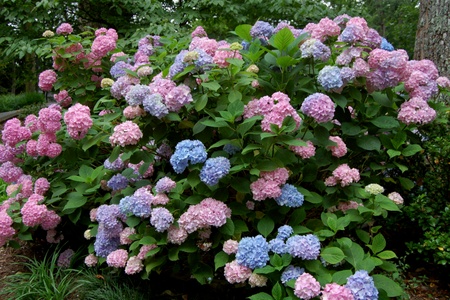
It is a spreading deciduous shrub reaching 2.5-3.5 m in height in its range; in colder places it grows 0.8-1.5 m. Grows quickly. Crown globular, 1.5 m in diameter. Shoots sturdy, glabrous, gray-straw colored. Stems strong, erect, slightly spreading, gray.
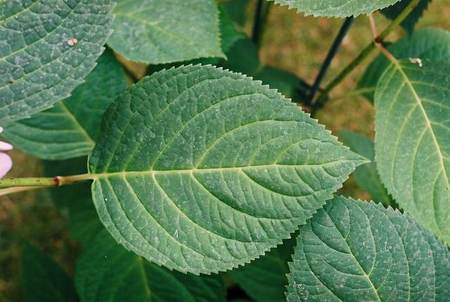
Leaves broadly obovate or broadly elliptic, shortly acuminate, 10-20 cm long, often with an acute short apex, with a broadly cuneate base, with large blunt triangular teeth, leathery, with prominent veins, glabrous, less often slightly pubescent, glossy, bright green. Petioles strong, 1-3 cm long.
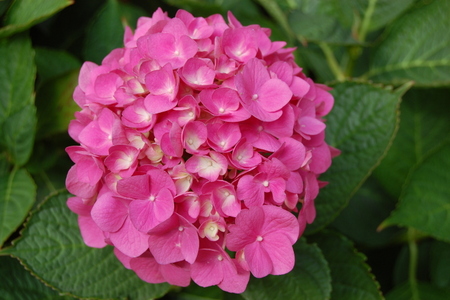
Inflorescences – umbrel-shaped corymbs, up to 15 cm in diameter, numerous, many-rayed, borne at the tips of the current year's shoots. Sterile flowers are pink, pink-lilac or blue, 2.5-5 cm in diameter, large, with toothed or entire-margined sepals; the corymbs are globular. Fertile flowers are small, numerous; corymbs are flat. Pedicels up to 5 cm long, covered with dense appressed hairs. Flower color depends on soil acidity – on acidic soils the petals are blue; on slightly alkaline soils – lilac-pink or pink. Petals are early-deciduous, oblong-elliptic. Ovary ovoid, half-inferior, with 3-4 styles. Blooms in July-August.
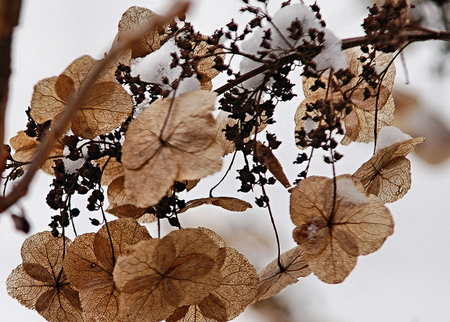
Fruits – ovoid capsules 6-8 mm long. Seeds with short wings or without them.
Varieties: H. macrophylla var. japonica hort., H. macrophylla var. mutabilis.
Cultivars: 'All Summer Beauty', 'Alpengluhen', 'Altona', 'Ami Pasquier', 'Bailmer', 'Beaute Vendomoise', 'Blaumeise', 'Blue Wave', 'Blushing Bride', 'Europa', 'Forever Pink', 'Générale Vicomtesse de Vibraye', 'Hamburg', 'Harlequin', 'Lanarth White', 'Lilacina', 'Madame Emile Mouillère', 'Marechal Foch', 'Mariesii Grandiflora', 'Mariesii Lilacina', 'Mariesii Perfecta', 'Möwe', 'Nigra', 'Nikko Blue', 'Pia', 'Penny Mac', 'Soeur Therese', 'Taube', "Teller", 'Tokyo Delight', 'Twist-N-Shout', 'Veitchii', 'Westfalen'.
Hardiness zone: 8 (-12-15°C), some cultivars to -18°C. Requires winter protection. On the Southern Coast of Crimea (YBK) it may suffer frost; in Prykarpattia and Zakarpattia it overwinters without shelter; in Lviv it flowers but does not fruit; in Dnipropetrovsk it loses half of its annual growth each year.
Position: sun-loving, but tolerates slight shading. Warmth-loving, demanding of moisture. Not drought-resistant. Grows well in semi-shaded places, but more abundant flowering is observed only in full sun.
Soil: does not tolerate lime; flower color depends on soil acidity. To obtain blue and azure inflorescences it is recommended to apply alum and iron salts to the soil every 2 weeks in the amount of 3—5 ammonium-potassium or aluminum-potassium alums per 1 l of water (approximately 2 l are used per plant). Grows well on humus-rich, alluvial and red soils with moderate moisture in areas with high annual rainfall. On podzolized and clay soils that dry out in summer, it significantly lags in growth and suffers from drought.
Planting: the optimal age for planting is 2-3 years. Planting is best carried out in spring or autumn. Size of the planting pit on light cultivated soils - 40x40x50 cm, on loamy cultivated soils - 50x50x60 cm, on heavy clay soils - 60x60x70 cm. It is recommended to place drainage at the bottom of the pit in the form of gravel or crushed brick in a layer of 5-10 cm. A layer of fertile soil 10-15 cm thick is placed over the drainage. Spread the roots over the entire area of the pit and position the root collar at soil level. Water consumption after planting per plant: on sandy soil 20-25 l, medium loamy 15-20 l, heavy loamy 10-15 l. In dry and windy weather it is recommended to spray the plant immediately after planting.
Care: To obtain blue and azure inflorescences it is recommended to apply alum and iron salts to the soil every 2 weeks in the amount of 3—5 ammonium-potassium or aluminum-potassium alums per 1 l of water (approximately 2 l are used per plant). To accelerate flowering (by 2-4 weeks) you can spray the plant twice with an aqueous solution of gibberellin with an interval of 4—7 days at a concentration of 50 mg/l; with such care the flowers become more numerous and larger. Treatment should be carried out when the inflorescences reach 2-4 cm in diameter.
Indoor cultivation: at the very end of the growing season (when the plant begins to drop leaves), it is recommended to cut the shoots short. In winter, during dormancy, keep the plant in a cool room (not below +5°C). In late winter, when buds begin to swell, move the plant to a bright and warm room, but without direct sunlight. When cultivated as a container plant, bring it outdoors only during the summer period.
Pruning: only young plants require light cosmetic pruning; at three years of age and older, cut out some old stems to stimulate the annual formation of strong replacement shoots. It is not recommended to remove faded flowers, as in winter they will provide necessary protection for floral and vegetative buds from freezing. They should be removed in early spring.
Wintering: in most of Ukraine requires protection from winter and spring frosts. In cold parts of Ukraine, in the first decade of September, remove leaves from the lower half of the shrub to accelerate lignification of shoots. Before frosts, remove inflorescences and remaining leaves, except for the apical ones which protect the buds from freezing. Gather the shoots into a bundle, bend them down to a board lying on the ground and place two boards on edge on both sides. Secure the shrub with twine, cover with dry leaves and cover with polyethylene film fixed at the edges. In spring it is recommended to remove the covering gradually – first remove the film, after the leaves have dried; if spring frosts occur the plant can be covered again. In May, when buds begin to grow, remove all coverings and untie the shrub. In milder climates, shrubs are partially pruned, remaining shoots are bent to the ground and covered with leaves and soil in November. In autumn before covering, you can apply superphosphate and potassium. At the end of April the soil and leaves can be removed and a complete mineral fertilizer applied. If the shrub is damaged by freezing, cut off the damaged shoots.
Propagation: easily propagated by green cuttings and by division of the shrub.
Pests: aphids (pelargonium, greenhouse, bean), greenhouse thrips, froghopper (spittlebug), spider mite, green plant bug, berry bug, meadow bug, shiny pale leaf beetle, nettle leaf weevil, cutworms (larvae of noctuid moths), golden chafer, hairy tussock moth, marsh crane fly, earwig, gall nematode.
Diseases: vascular wilt (tracheomycosis), white sclerotial rot, gray rot (Botrytis), common (European) canker, tubercular bark necrosis, powdery mildew, Phyllosticta, Septoria, ring and Ascochyta leaf spot,
Uses: widely used in ornamental horticulture. One of the most decorative hydrangea species. Grown as a greenhouse, tub or pot indoor plant. Used in parks, gardens, flower beds, in single and group plantings on lawns, for creating very attractive living hedges.