
Flowering shrubs
Sargent's hydrangea
Hydrangea aspera sargentiana
Synonyms: Hydrangea aspera sargentiana, Hydrangea aspera sargentiana (Rehder) E.M. McClint.
Sargent's hydrangea (Hydrangea sargentiana) – a subspecies of Hydrangea aspera, and according to some sources a species of the genus Hydrangea in the family Hydrangeaceae. Native to eastern China, where it grows in dense forests in valleys and on slopes at 700-1800 m above sea level. Named after the American botanist Charles Sprague Sargent, the first director of the Arnold Arboretum (the botanical garden of Harvard University, a suburb of Boston, Massachusetts, USA). It was introduced to the USA from China in 1908 by the Anglo-American botanist Ernest Henry Wilson (1876-1930) during one of his plant-collecting trips to the Arnold Arboretum.
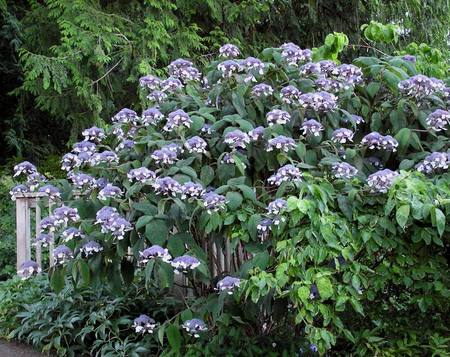
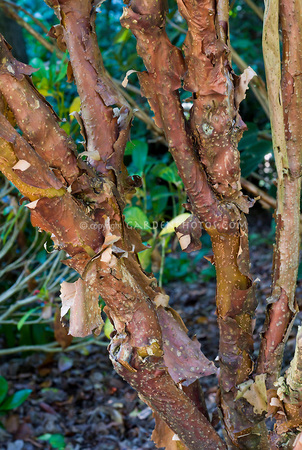
This is a deciduous shrub 1-2 (3-6) m in height and width. Grows quickly, annual increment 20-25 cm. Vegetative growth from late April until the first frosts. Shoots grow upright, thick, sparsely branched, rigid, covered with bristly, dense, almost prickly hairs. Bark brown, peeling.
Root system branched, shallow, forms root suckers and can spread widely in width.
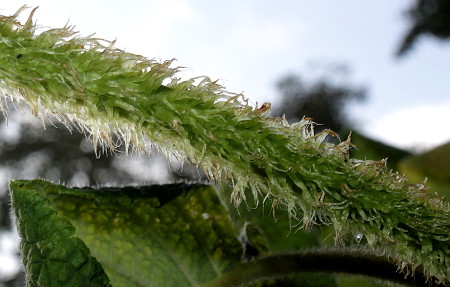
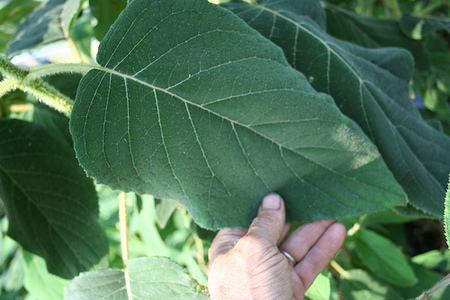
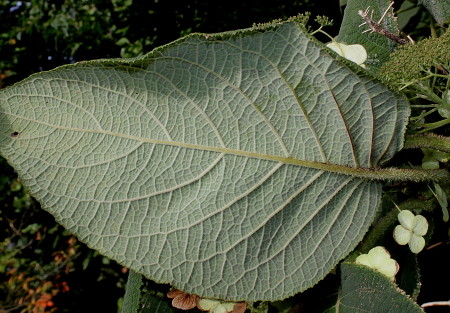
Leaves opposite, very large, reaching 30 cm in length and 6-16 cm in width, oblong-ovate or broadly ovate in shape, with an acute apex and cordate base, margins slightly serrate, petiole 5-11.5 cm long. The upper surface of the blade is green, slightly rough, covered with sparse white hairs; the underside is gray-green, velvety-rough, densely pubescent with white hairs. The petiole is densely hairy with short brown hairs 2-4 mm long. Leaves do not change color in autumn.
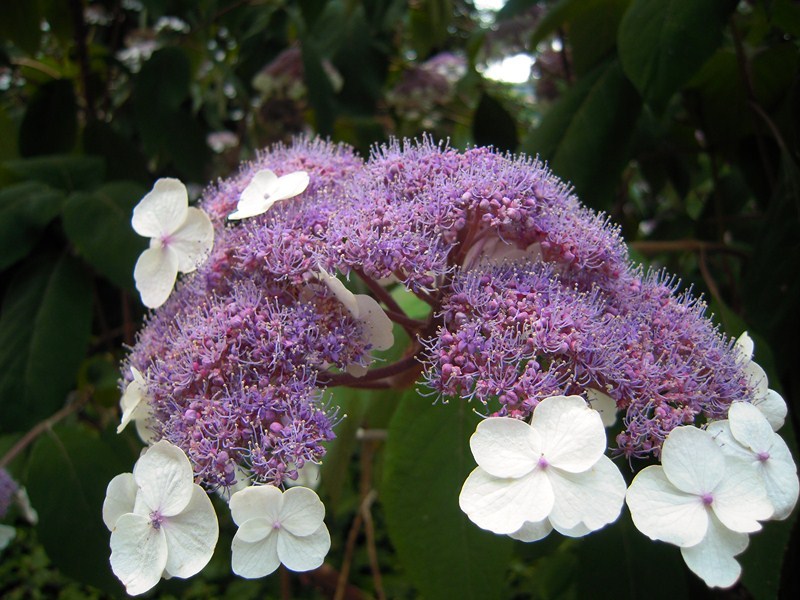
Blooms annually from late July to mid-September. Flowers form flat, umbrel- or corymb-like inflorescences 15-20 cm in diameter; fertile flowers are pale lilac or light purple inside, peripheral sterile flowers are white, 2-3 cm in diameter, consisting of 4 obovate, almost rounded sepals with smooth, sometimes curved, non-toothed margins.
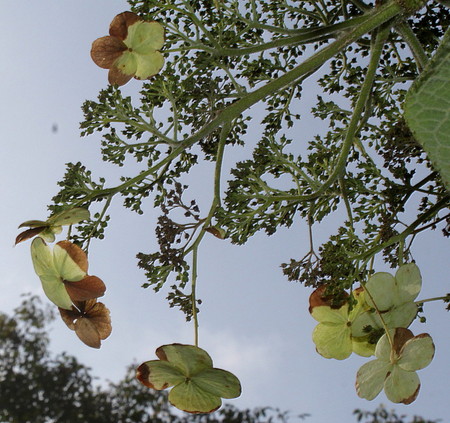
Fruits inconspicuous, small capsules 3-4 mm in diameter with a truncate apex. Ripen in October in favorable years with a warm autumn. Seeds winged, small, brown and elliptical. Begins flowering and fruiting at 13-14 years of age.
Hardiness zone: 6-7 (-23°C). In container culture it requires good winter protection. Other forms are fairly hardy. In temperate regions it behaves like a perennial, losing all above-ground parts in winter and regrowing by 80-100 cm each year. It may suffer from late frosts but regrows quickly.
Location: heat-loving and light-demanding, but leaves may scorch in strong sun. Requires shelter from strong and cold winds. Drought-tolerant but prefers moist sites.
Soil: prefers neutral to slightly acidic soil. Does not tolerate lime; on alkaline soils it develops chlorosis (to prevent this, water with an iron-containing salt solution once every 10 days). Optimal soil pH = 4.0-6.5. Most decorative on well-drained, medium-fertility soils.
Planting: optimal planting age 2-3 years. Planting is best done in spring or autumn. Planting hole size on light cultivated soils - 40x40x50 cm, on loamy cultivated soils - 50x50x60 cm, on heavy clay soils - 60x60x70 cm. Place drainage such as gravel or broken brick at the bottom in a layer of 5-10 cm. Cover drainage with fertile soil to a depth of 10-15 cm. Spread roots across the hole and position the root collar at soil level. Water consumption after planting per plant: sandy soil 20-25 L, medium-loamy 15-20 L, heavy loamy 10-15 L. In dry and windy weather it is recommended to spray the plant immediately after planting.
Care: loosen the soil around the bush at least twice a year to a depth of up to 5 cm. Water at least 5 times per season. To strengthen shoots, water along the canopy and at the root with a weak potassium permanganate solution. Fertilize with manure or mineral fertilizers at the start of growth, during bud formation, and 1-2 times in summer. In winter the plant needs shelter with spruce branches or dry leaves.
Pruning: requires pruning for winter.
Propagation: propagated mainly by division of the bush and by root suckers. Cuttings root poorly.
Pests: aphids (Pelargonium, greenhouse, pea), greenhouse thrips, froghopper (spittlebug), spider mite, green plant bug, strawberry bug, meadow bug, shining pale leaf beetle, nettle leaf weevil, owlet moths (caterpillars of nocturnal moths), golden chafer, the furry tussock moth, crane fly, earwig, gall nematode.
Diseases: Verticillium wilt, White sclerotial rot, Gray rot (Botrytis), Common (European) canker, Tubercular bark necrosis, Powdery mildew, Phyllosticta, Septoria, ring and ascochyta leaf spot, chlorosis.
Uses: used for creating ornamental flowering hedges, striking group and solitary plantings. Looks attractive in groups on lawns, edging taller shrubs and trees. A good nectar plant.