
Flowering shrubs
Rough hydrangea
Hydrangea aspera
Synonyms: Hydrangea villosa, Hydrangea aspera Buch.-Ham. ex D. Don, Hydrangea aspera D. Don
Hydrangea aspera (Hydrangea aspera) – a species of deciduous shrubs or small trees in the genus Hydrangea (Hydrangea) of the family Hydrangeaceae (Hydrangaceae). The range extends from the Himalayan region, through northern and central China, to Taiwan.
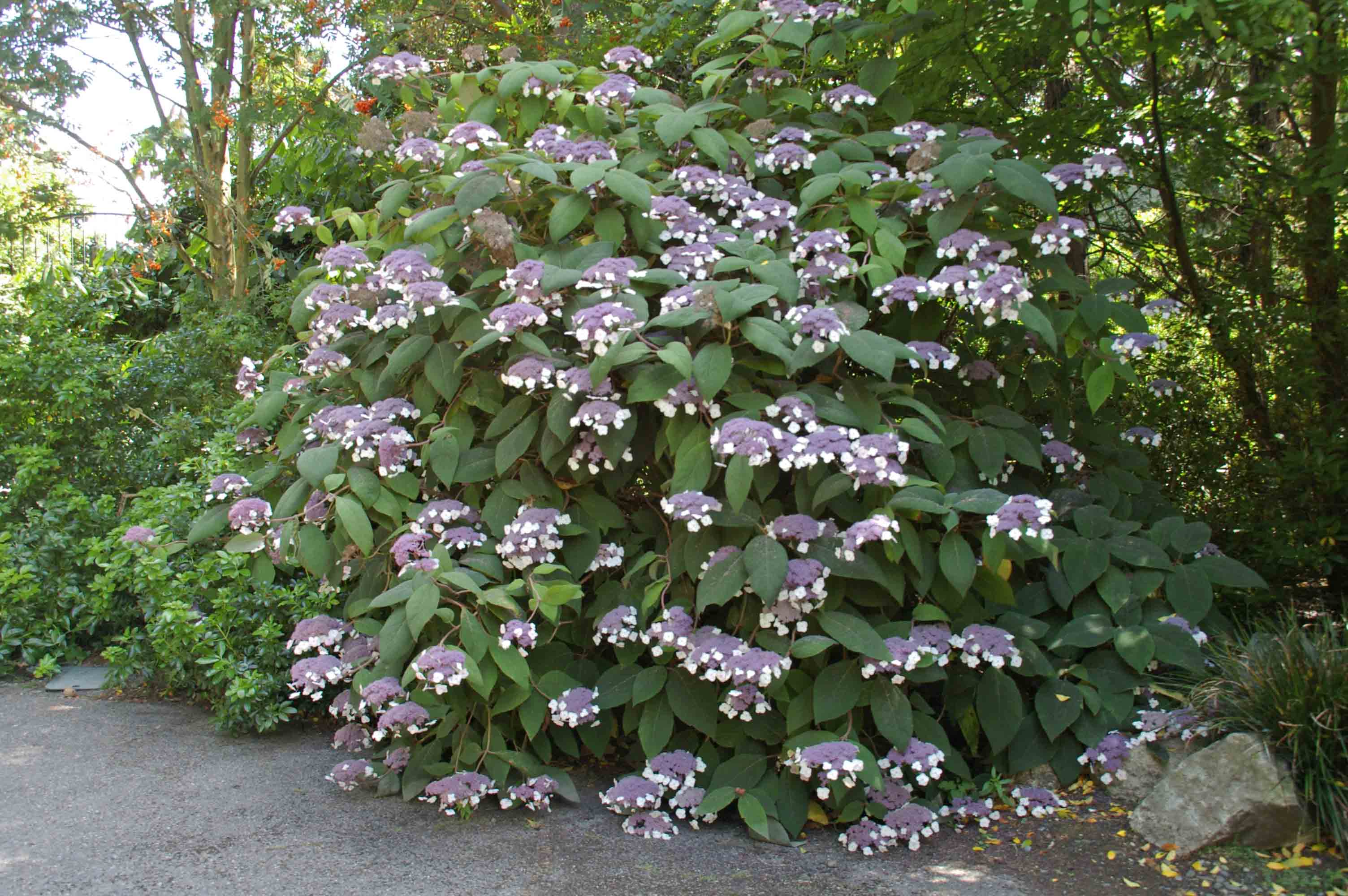
It is a small deciduous tree or shrub 1.5-3 (4) m high and 1.5-2 m in diameter. The shrub is erect, densely branched and compact. Shoots are slightly spreading, densely covered with rough and spreading hairs, pubescent from indumentum, later becoming more or less glabrescent. Bark brown or gray-brown, peeling.
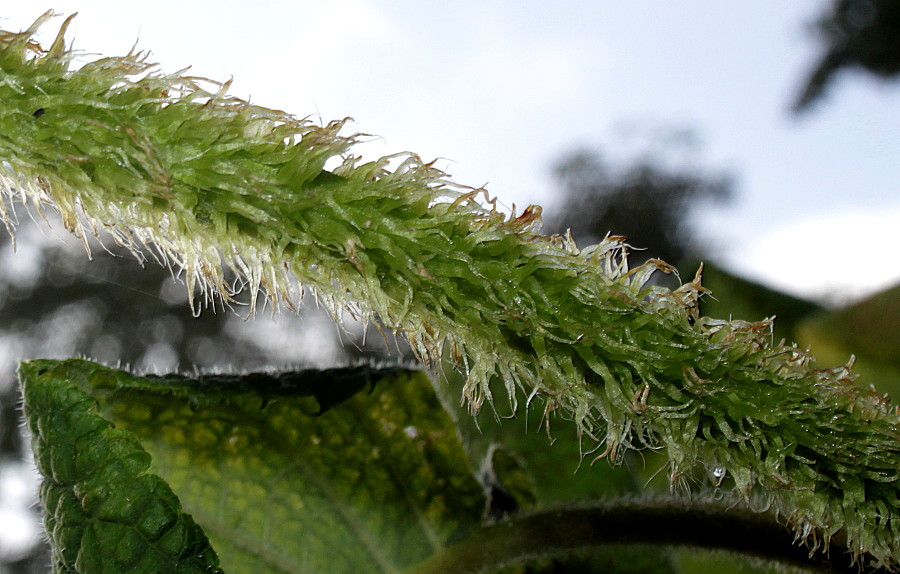
Hydrangea aspera ssp. sargentiana
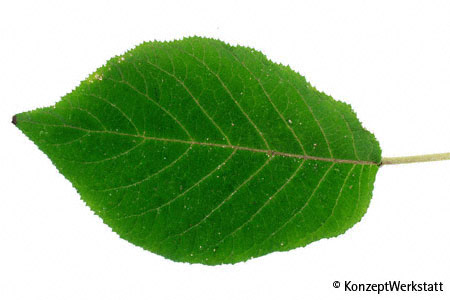
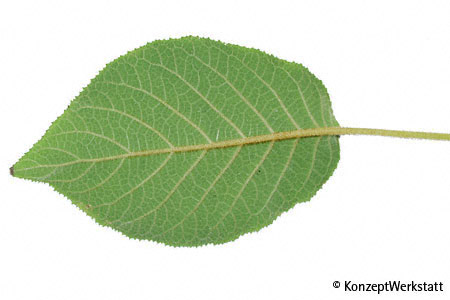
Leaves 9-25 cm long and 3-9 cm wide, lanceolate, narrowly ovate to oblong-ovate, acute with an acuminate drawn-out apex or cuneately attenuate, acuminate. Leaf base rounded or broadly cuneate, with finely or minutely serrate margin, upper surface sparsely and coarsely hairy, rough, lower surface densely pubescent, gray from indumentum. Petioles stout, short, gray-pubescent, reddish.
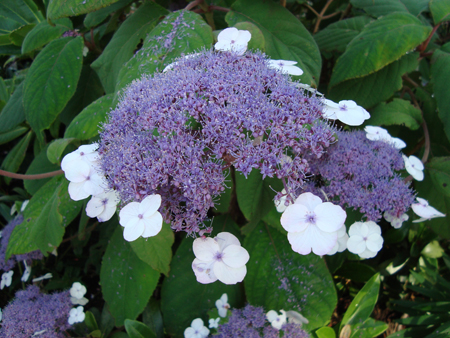
Inflorescences corymb-like, 15-20 (25) cm in diameter, fairly flat, axillary and terminal. Sterile flowers arranged several together or numerous, peripheral, up to 2.5 cm in diameter. Pedicels long, pubescent. Petals round, often toothed, in 4 pieces, white, lilac, pale pink, with darker veins. Fertile flowers small, numerous, pink or lilac-blue. Flowers from August to September.
Fruits – dry capsules green, later brown.
Subspecies:
- var. angustifolia Hemsl,
- var. macrophylla Hemsl.
- ssp. sargentiana (Rehder) E.M. McClint.,
- var. sinica Diels,
- subsp. Robusta
Cultivars: 'Hot Chocolate', 'Taiwan Pink', 'Kawakamii'
Hardiness zone: 6-7 (-23°C).
Location: Heat-loving, demands moisture, does not tolerate direct sunlight. Needs a spot protected from wind and cold.
Soil: prefers fertile neutral or slightly acidic soil.
Planting: optimal planting age is 2-3 years. Planting is best carried out in spring or autumn. Planting hole size on light cultivated soils - 40x40x50 cm, on loamy cultivated soils - 50x50x60 cm, on heavy clay soils - 60x60x70 cm. It is recommended to place drainage at the bottom of the hole in the form of gravel or broken brick in a layer of 5-10 cm. A layer of fertile soil 10-15 cm is placed over the drainage. Roots are spread over the entire area of the hole, and the root collar is placed at soil level. Water consumption after planting per plant on sandy loam soil 20-25 L, medium loam 15-20 L, heavy loam 10-15 L. In dry and windy weather it is recommended to spray the plant immediately after planting.
Care: soil around the bush should be loosened at least twice a year to a depth of up to 5 cm. Watering should be carried out at least 5 times per season. To increase stem strength, you can water along the crown and at the root with a weak solution of potassium permanganate. Fertilization with manure or mineral fertilizers is carried out at the beginning of growth, during bud formation, and also 1-2 times during the summer season.
Pruning: Pruning is carried out in late March - early April, cutting one-third of the skeletal shoots at ground level.
Propagation: easily propagated by green cuttings and division of the bush. Rooting of cuttings 100% without treatment. Also roots well from layering. Cuttings are best harvested during the flowering period by cutting the tips of the current year's shoots. In early April a hole 60-70 cm deep and 50 cm in diameter is dug. Then the cutting is placed into it and covered with a pre-prepared mixture. Soil mixture: humus, chernozem, peat and sand in the ratio 2:2:1:1. Also add 20 g urea, 30 g potassium sulfate and 30 g superphosphate. A similar fertilization is repeated after 2 years.
Pests: aphids (pelargonium, greenhouse, pea), greenhouse thrips, spittlebug, spider mite, green tree bug, berry bug, meadow bug, shiny pale leaf beetle, nettle leaf weevil, cutworms (larvae of noctuid moths), golden chafer, hairy weevil, marsh crane fly, earwig, gall nematode.
Diseases: tracheomycosis wilt, white sclerotial rot, gray mold, common (European) canker, tubercular bark necrosis, powdery mildew, phyllosticta, septoria, ring and ascochyta leaf spot.
Use: used in solitary and group plantings, for attractive freely growing hedges, in ornamental groups, in garden and park compositions.