
Flowering shrubs
Smooth hydrangea
Hydrangea arborescens
Synonyms: garden hydrangea, Hydrangea vulgaris, smooth hydrangea, wild hydrangea.
Smooth hydrangea (Hydrangea arborescens) - a species of shrubs of the genus Hydrangea (Hydrangea) in the family Hydrangeaceae (Hydrangeaceae). In the wild it occurs in the eastern part of North America (north from New York, south to Louisiana and west to Iowa), where it is found on moist or rocky forest slopes, in ravines, on cliffs, and also near streams. In cultivation since 1736 and grown widely.
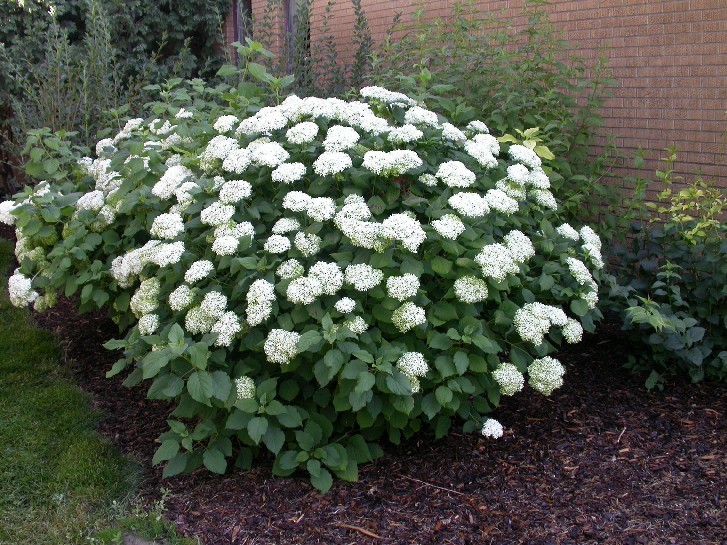
It is a deciduous shrub 1.5-2 (3.5) m in height. Grows quickly, up to 20 cm per year. The crown reaches 2 m in diameter, loose, spreading, airy, open. Shoots are slightly pubescent, later glabrous, gray-brown.
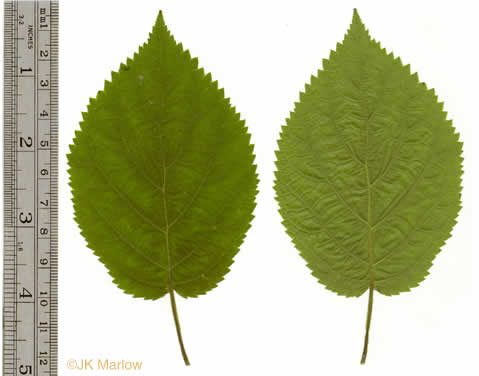
Leaves elliptic, broadly ovate to almost round, 7.5-17 (20) cm long and – cm wide, more or less shortly acuminate, with a sharp and short tip, rounded at the base, slightly cordate or truncate, serrate-toothed at the margin, glabrous above, light or dark green, glossy, lighter underneath, along the veins glaucous or slightly pubescent. Petioles 2.5-7.5 cm long. Leaves do not change color in autumn.
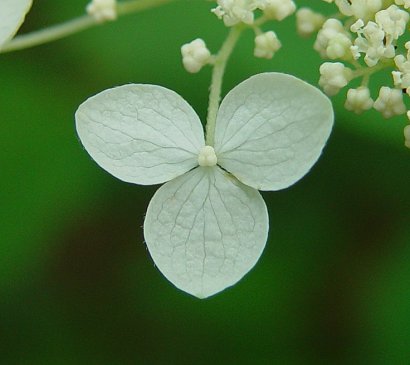
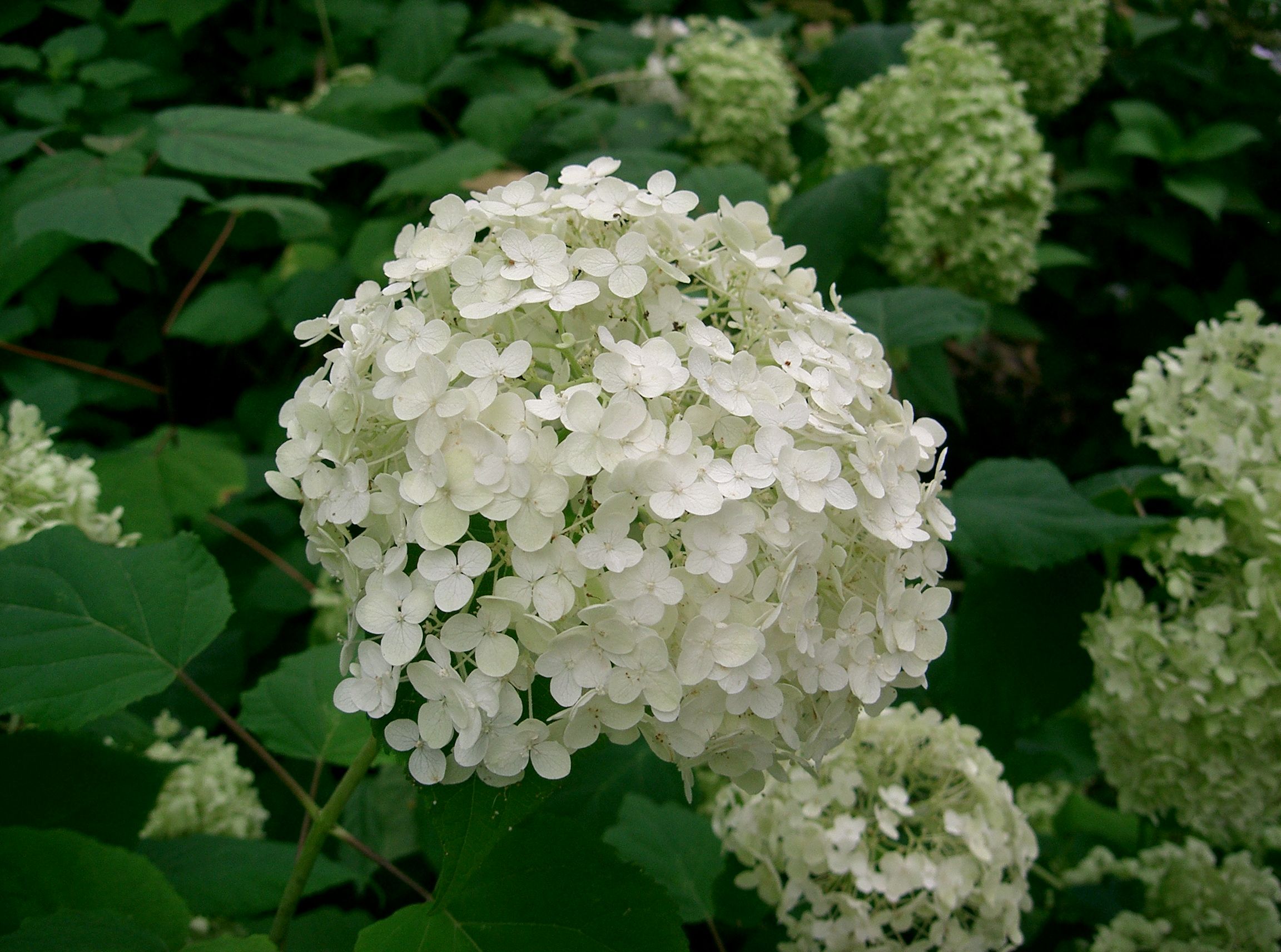
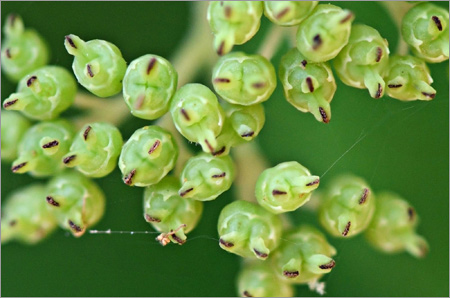
Corymbs reach 10-15 cm in diameter, slightly umbrella-shaped, many-rayed, on elongated stalks. Sterile flowers are peripheral, up to 8 in number, sometimes absent, creamy-white, 1-2 cm in diameter. Fertile flowers very small, numerous, crowded, whitish. Ovary inferior, truncate at the apex. Blooms abundantly and for a long time, in July–August, starting from 4 years old.
Capsules with 10 prominent ribs, 2.5-3 mm in diameter. Seeds small, without wings. Ripen in October.
Subspecies:
- ssp.discolor – two-colored (ashy) smooth hydrangea.
- ssp.radiata – radiate smooth hydrangea
Cultivars: ‘Annabelle’, ‘Invincibelle’, ‘Grandiflora’, ‘Incrediball’, 'Pink pincushion', ‘Hills of snow’.
Hardiness zone: 4 (-35°C). In Odesa it overwinters, the above-ground part dies back and regrows in spring, in Lviv it suffers some frost but flowers, in Zhytomyr it is slightly frosted.
Location: Warm-loving, demands moisture. Grows well in semi-shaded sites, but more abundant flowering is observed only in full sun. Can tolerate short drought. Needs a location sheltered from the wind.
Soil: does not tolerate lime. Grows well on humus-rich, alluvial and red soils with moderate moisture in areas with high annual precipitation. On podzolized and clay soils that dry out in summer it significantly lags in growth and suffers from drought. Can tolerate alkaline soil.
Planting: optimal planting age – 2-3 years. Planting is best done in spring or autumn. Planting hole size on light cultivated soils - 40x40x50 cm, on loamy cultivated soils - 50x50x60 cm, on heavy clay soils - 60x60x70 cm. It is recommended to place drainage such as gravel or crushed brick at the bottom of the hole in a layer of 5-10 cm. A fertile soil layer of 10-15 cm is placed above the drainage. Spread the roots over the entire area of the hole, and place the root collar at ground level. Water consumption after planting per plant on sandy loam 20-25 L, medium loam 15-20 L, heavy loam 10-15 L. In dry and windy weather it is recommended to spray the plant immediately after planting.
Care: it is recommended to loosen the soil around the bush at least twice a year to a depth of up to 5 cm. Watering should be carried out at least 5 times per season. To increase stem strength you can water along the crown and at the root with a weak solution of potassium permanganate. Fertilization with manure or mineral fertilizers is carried out at the beginning of growth, during bud formation, and also 1-2 times during the summer.
Pruning: perform an annual complete pruning to the base at the end of March – beginning of April. Cut shoots can be used as cuttings.
Propagation: easily propagated by soft cuttings and division of the bush. Rooting rate of cuttings 100% without treatment. Propagates well by layering. Cuttings are best taken during flowering; for this the tips of the current year's shoots are cut. In early April dig a hole 60-70 cm deep and 50 cm in diameter. After placing a cutting in it, cover with a prepared mixture. Soil mix: humus, chernozem, peat and sand in ratio 2:2:1:1. Also add 20 g urea, 30 g potassium sulfate and 30 g superphosphate. A similar feeding is repeated after 2 years.
Pests: aphids (pelargonium, greenhouse, pea), greenhouse thrips, spittlebug, spider mite, green tree bug, berry bug, meadow bug, shiny pale leaf beetle, nettle leaf weevil, cutworms (larvae of noctuid moths), bronze beetle, hairy moth ("olenka"), marsh crane fly, earwig, gall nematode.
Diseases: tracheomycosis (vascular wilt), white sclerotial rot, gray mold, common (European) canker, tubercular bark necrosis, powdery mildew, Phyllosticta, Septoria, ring and Ascochyta leaf spot,
Companions: lilies, roses, clematis
Uses: looks spectacular in solitary and group plantings. Used for creating margins in woody-shrub compositions, as well as for creating informal living hedges.