
Flowers for the garden
Hyacinth
Hyacinthus
Hyacinth (lat. Hyacinthus) — a genus of plants in the asparagus family (Asparagaceae). Previously it was placed in its own family Hyacinthaceae (Hyacinthaceae) or included in the lily family (Liliaceae). The genus comprises up to 30 species, growing mainly in Mediterranean countries, with three species in South Africa.
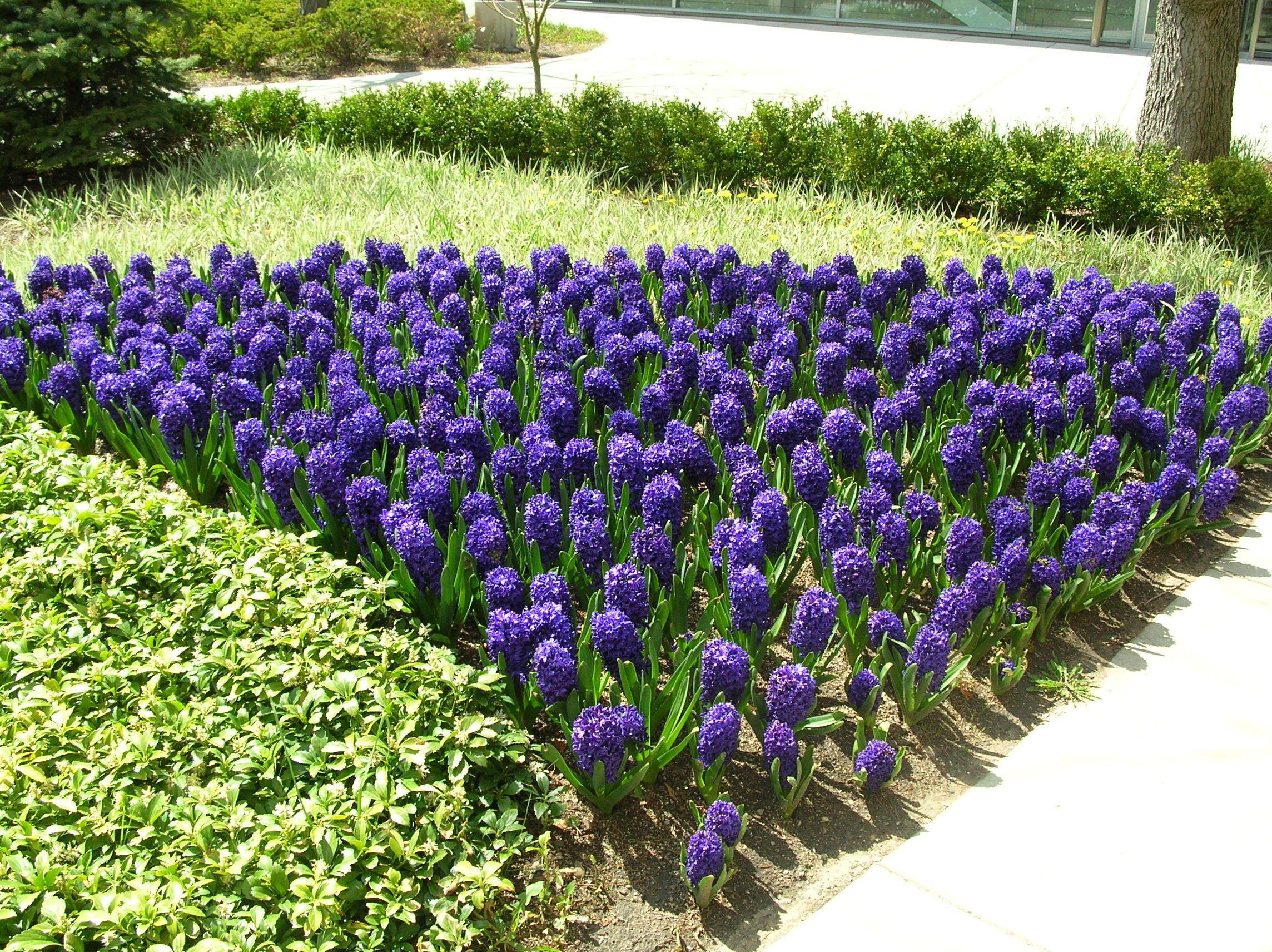
Named after a character of ancient Greek myth. Hyacinth was a youth of extraordinary beauty, beloved by Apollo. When Apollo was teaching him to throw the discus, the god of the wind (in different versions Zephyr or Boreas), also in love with him, out of jealousy directed the discus thrown by Apollo into Hyacinth's head. The youth died, and then Apollo created a flower from his blood.
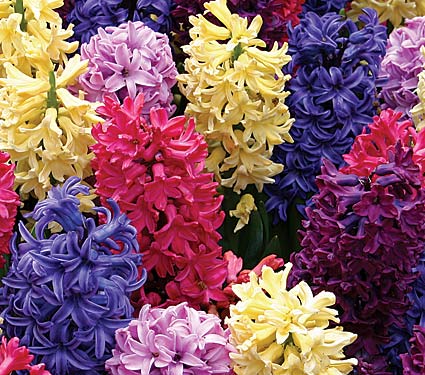
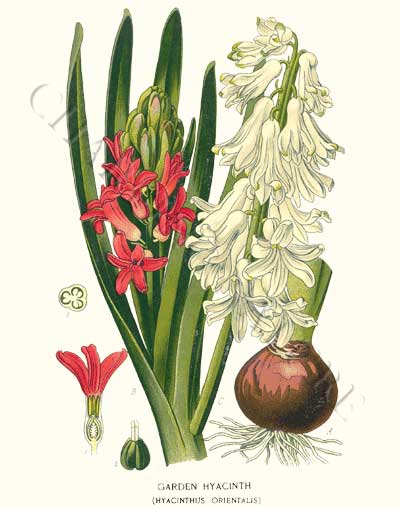
Bulbous perennial herbs. The bulb is compact, consisting of fleshy basal leaves whose bases occupy the entire circumference of the bulb's basal plate. The flowering stem is a continuation of the basal plate. After flowering the green flower-bearing stem together with the green leaves at its base withers, but in the axil of the uppermost of the green leaves a bud forms on the stem, inside the bulb, which enlarges and develops into a young bulb that flowers the following year. In this young bulb the stem with the flowers of the coming year is already formed in autumn. Besides this young bulb, in the axils of the other green leaves weaker bulbs often form, the so-called bulblets, which can be separated. After several years they may flower.
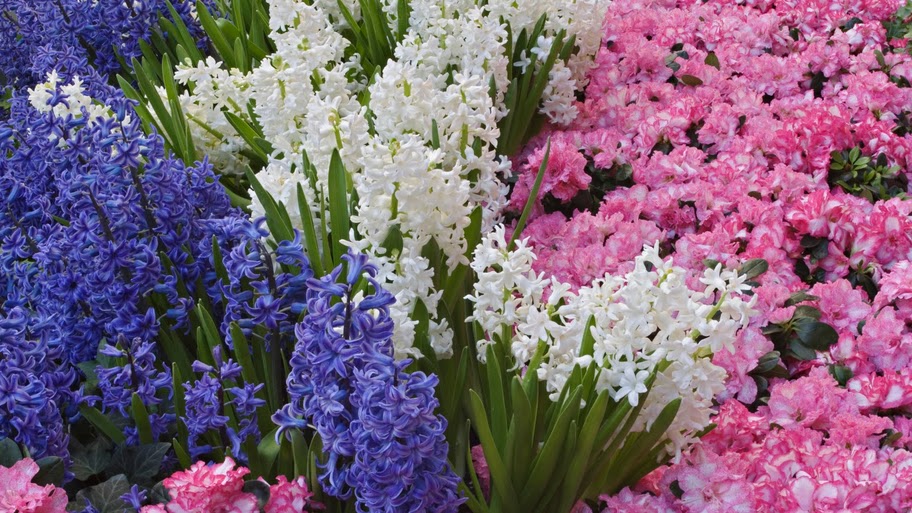
Flowers are gathered at the top of the stem in a raceme. Their perianth, in the form of a bell-shaped funnel, is brightly colored white, light blue, blue, red, pink, orange or inky, with recurved lobes. They often set fruit. The fruit is a leathery capsule with three locules, each containing two seeds with a fragile seed coat.
In cultivation:
Eastern hyacinth — Hyacinthus orientalis
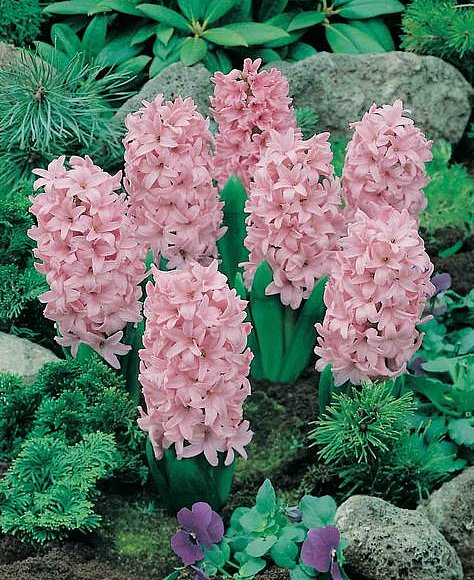
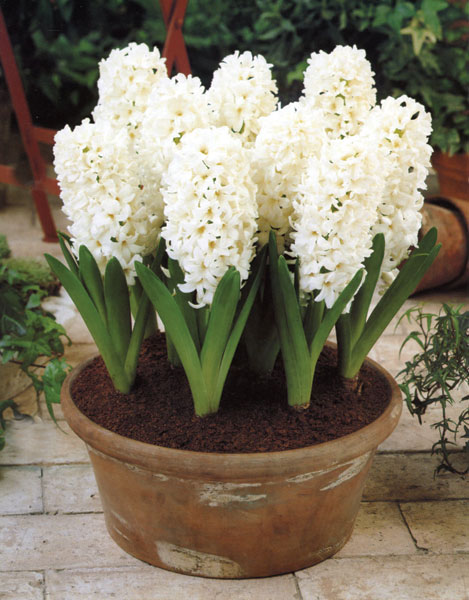
Perennial bulbous plant up to 30 cm tall. Bulbs globular or broadly conical with numerous storage and tunic scales. Leaves strap-shaped, keeled, up to 20 cm long, smooth, fleshy, bright green, glossy or matte, numbering 5–8. Scape erect, cylindrical, succulent, leafless. Flowers fragrant, bell-shaped or campanulate-funnel-shaped, borne on short pedicels; perianth lobes recurved or twisted, white, blue, violet, sky-blue, pink, yellow, single or double, gathered in a racemose inflorescence consisting of 12–35 or more flowers. Blooms in late spring for 10–15 days. Fruit — a rounded capsule. In cultivation since 1562.
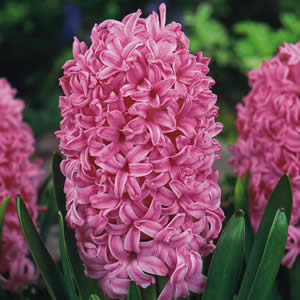
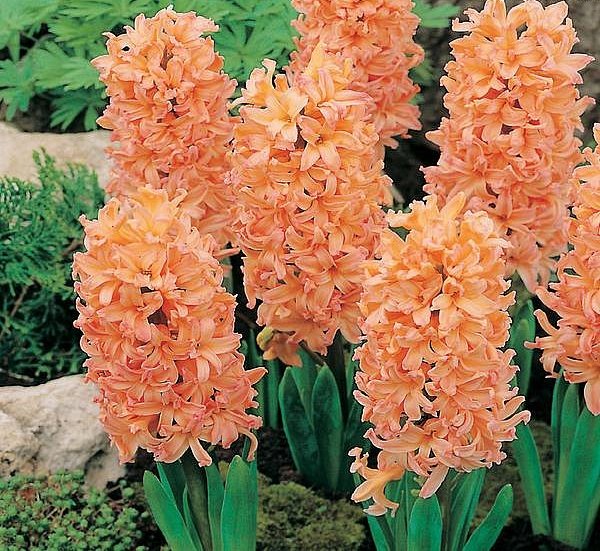
Each group of cultivars similar in flower color generally corresponds to a particular color of the outer bulb tunic. Thus bulbs of cultivars with blue, light-blue and purple flowers usually have purple outer scales, those with white flowers — light gray, and those with pink — lilac, but there are exceptions. Besides the color of the outer bulb scales, each group of cultivars usually corresponds to a certain bulb shape: broad-conical are characteristic for cultivars with blue and pink flowers, narrow-conical for cultivars with yellow flowers, ovoid for cultivars with white flowers, although there are exceptions.
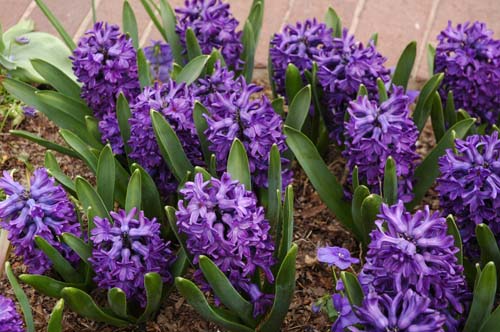
Hyacinth cultivars are distinguished by scape height and the size of the inflorescences; by flowering time there are early, mid and late varieties, the difference in the onset of flowering being within 10–15 days. The most notable cultivars:
'Bismark' ('Bismark') — Plant height 25-28 cm. Inflorescence large, 12-13 cm long, cylindrical, of medium density, with 20-25 light purple flowers in the raceme, flower diameter 4-4.5 cm. Blooms from mid-April for 10-14 days.
'Delft Blue' ('Delft Blue') — Plant height 20-23 cm. Inflorescence dense, wide, 10-12 cm long, with 20-22 flowers in the raceme. Color blue, flowers large, 4 cm in diameter. Blooms from mid-April.
'Delight' ('Delight') — Plant height 20 cm. Inflorescence dense, wide, 9-10 cm long, up to 15 flowers in the raceme, color pink, flower diameter 3.5-4.5 cm. Blooms from mid-April.
'Indigo King' ('Indigo King') — Plant height up to 25 cm. Inflorescence loose, 9-10 cm long, with 7-18 flowers in the raceme. Color black-lilac (inky). Flower diameter 3 cm. Blooms in late April for 11-17 days.
'Jellow Hammer' ('Jellow Hammer') — Plant height 25-30 cm. Inflorescence dense, 11-12 cm long, with 20-25 flowers in the raceme. Color pale yellow. Flower diameter up to 3.5 cm. Blooms in late April for 11-16 days.
'King of the Blues' ('King of the Blues') — Plant height 20 cm. Inflorescence of medium density, large. Color dark blue-violet. Flower diameter 3 cm. Blooms from late April for 9-16 days.
'Lord Balfour' ('Lord Balfour') — Scape up to 24 cm tall. Inflorescence loose, with 8-13 flowers in the raceme, colored purple-violet, the tips of the lobes lighter. Flower diameter 4 cm. Blooms from mid-April for 11-16 days.
'Marie' ('Marie') — Plant height 25-30 cm. Inflorescence compact, 12 cm long, with 15-17 dark violet flowers in the raceme, flower diameter 3.5 cm. Blooms in late April for 12-14 days.
'Menelik' ('Menelike') — Plant height 25-30 cm. Inflorescence fairly compact, 13-15 cm long, up to 15 black-violet flowers in the raceme, the edges of the perianth lobes lighter. Flower diameter 3.5 cm. Blooms in late April for 18-20 days.
'Sunflower' ('Sunflower') — Plant height 23-27 cm. Inflorescence narrow, cylindrical, dense, 10 cm long. 10-15 flowers in the raceme. Color pale-cream with a pink tint, strongly double. Flower diameter 3.5 cm. Blooms in late April for 10-13 days.
'City of Haarlem' ('City of Haarlem') — Plant height 25-28 cm. Inflorescence large, 10-12 cm long, with 12-15 cream-colored flowers in the raceme, flower diameter 4 cm. Blooms from late April.
'Chestnut Flower' ('Chestnut Flower') — Plant height 18-25 cm. Inflorescence loose, 10-12 cm long, with 12-15 double, light-pink flowers in the raceme, flower diameter 4-4.5 cm. Perianth lobes strongly twisted. Blooms from late April.
'Edelweiss' ('Edelweiss') — Plant height 20-25 cm. Inflorescence wide, dense, 10-11 cm long, with 13-20 white flowers in the raceme, flower diameter 3.5 cm. Blooms in mid-April.
'Edison' ('Edison') — Plant height 20-22 cm. Inflorescence loose, with 7-10 pink, double flowers in the raceme, flower diameter 3-3.5 cm. Blooms in late April.
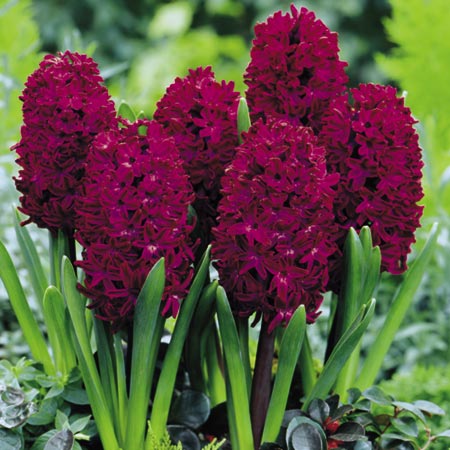
'Jan Bos' ('Jan Bos') — Plant height 20-25 cm. Inflorescence dense, 12 cm long. 18-26 dark-raspberry flowers in the raceme, flower diameter 2.5-3 cm. Blooms in late April for 17-20 days.
Location: prefer a well-lit, sheltered-from-strong-winds site. A level plot is preferable, ideally with a slight slope to provide runoff during spring snowmelt and heavy rains. Prolonged waterlogging leads to widespread disease and death of bulbs.
Soil: hyacinths require permeable, well-fertilized soils with a high humus content, but fresh or poorly decomposed manure is unacceptable. River sand and peat are added to clay, heavy soils. It is undesirable to grow hyacinths on acidic soils. Acidic soils should be limed, using chalk or limestone to a pH not lower than 6.5.
Care: among the care measures for hyacinths, fertilization plays a special role. Nitrogen mineral fertilizers for hyacinths are applied in early spring in the form of sodium nitrate or ammonium sulfate.
Propagation: by bulbs, bulb offsets (bulblets), bulb scales. The seed method is used in breeding new cultivars. Seedlings do not reproduce the external characteristics of the parent plants and they flower only after 5-7 years.