
Flowering shrubs
Hydrangea
Hortensia
Synonyms: hydrangea
Hydrangea (Hydrangea) – a genus of flowering plants in the family Hydrangeaceae (Hydrangeaceae). It occurs in East and South Asia, North and South America. The greatest species diversity grows in East Asia (especially China and Japan). It is also rarely found in Russia (the Far East).
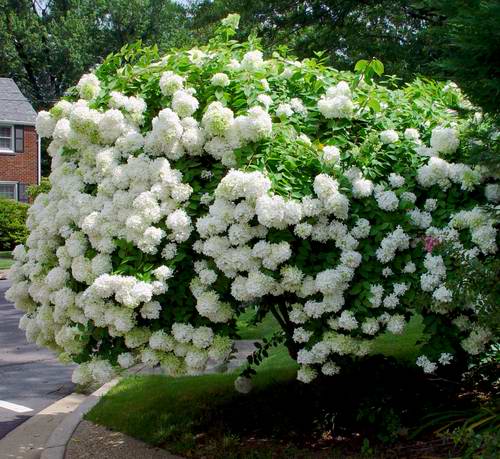
Panicle hydrangea
The name "Hydrangea" was given in honor of Princess Hortense, who was the beloved of the French physician and naturalist Philibert Commerson, who discovered it in the 18th century during his journey to Japan. It was first brought from Japan to Europe in the 1820s. Breeding began from 1900. Mostly these were less winter-hardy cultivars from Hydrangea macrophylla and garden hydrangea, so the plant was grown as a houseplant. The first cultivars were developed by the breeders Nancy, Lemuane, Muer and Vendome. By the 1960s about 100 cultivars had already been bred.
The Latin name of the genus comes from the Greek words "hydor" – water and "aggeion" – vessel. According to one version the name was given because of the cup-shaped fruits that open at the top; according to another version – because the plant loves moisture.
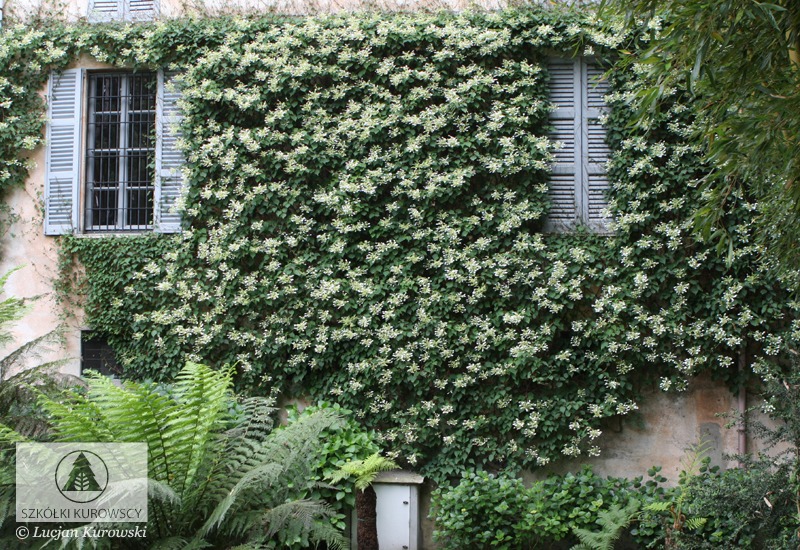
Hydrangea anomala
Members of the genus are deciduous, less often evergreen trees or shrubs 1.5-3 m high, sometimes lianas that climb up the trunks of other trees to heights of up to 30 m. Cultivated species in the temperate zone are deciduous. The bark often peels off in thin flakes.
Leaves are opposite, less often whorled in threes, large, simple, without stipules, often toothed.
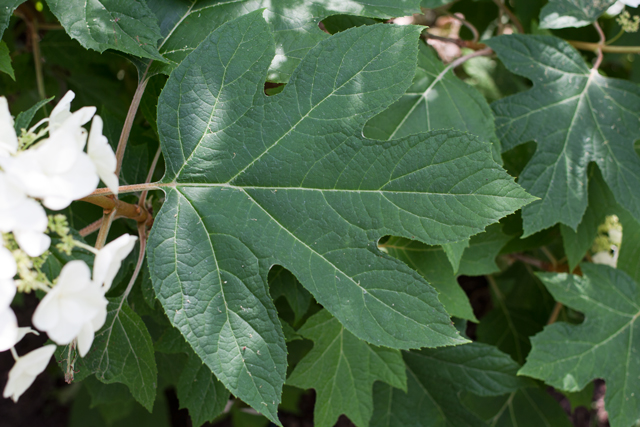
Oak-leaved hydrangea
Flowers are small, bisexual, numerous, radially symmetric, gathered in large, terminal, multi-branched corymbose or paniculate inflorescences. There are 4 or 5 calyx lobes, small and inconspicuous. Petals 4 or 5, white. Stamens 8-9 (10), more rarely up to 20.
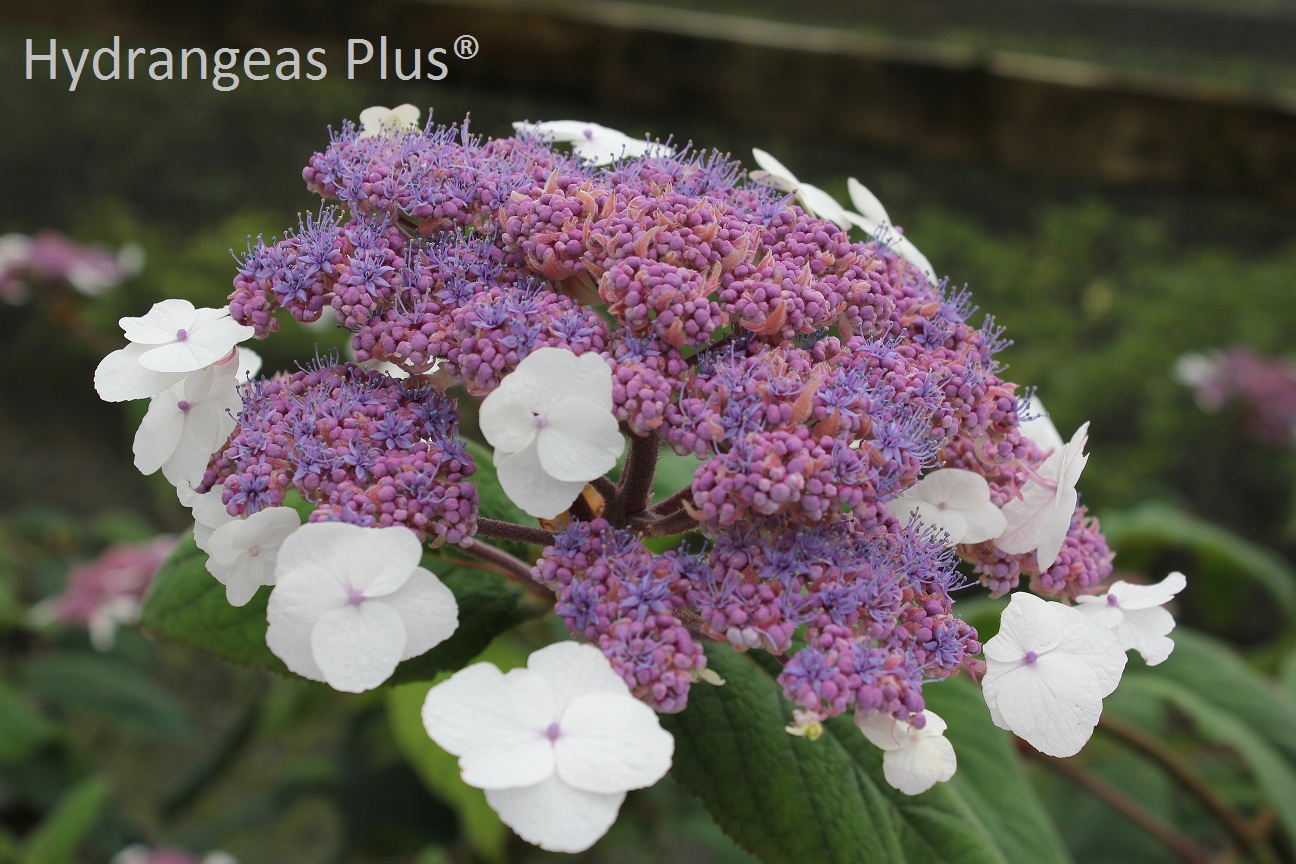
Sargent's hydrangea
In many species the peripheral flowers of the inflorescence are sterile, persist on the inflorescences for a long time and differ significantly from the fertile ones. These flowers lack an ovary, stamens and petals, and consist of 3-6 petaloid, greatly enlarged, white or colored, unequal calyx lobes. The ovary is half-inferior or inferior. Blooms abundantly and for a long time, depending on the species, from mid-summer to September – October.
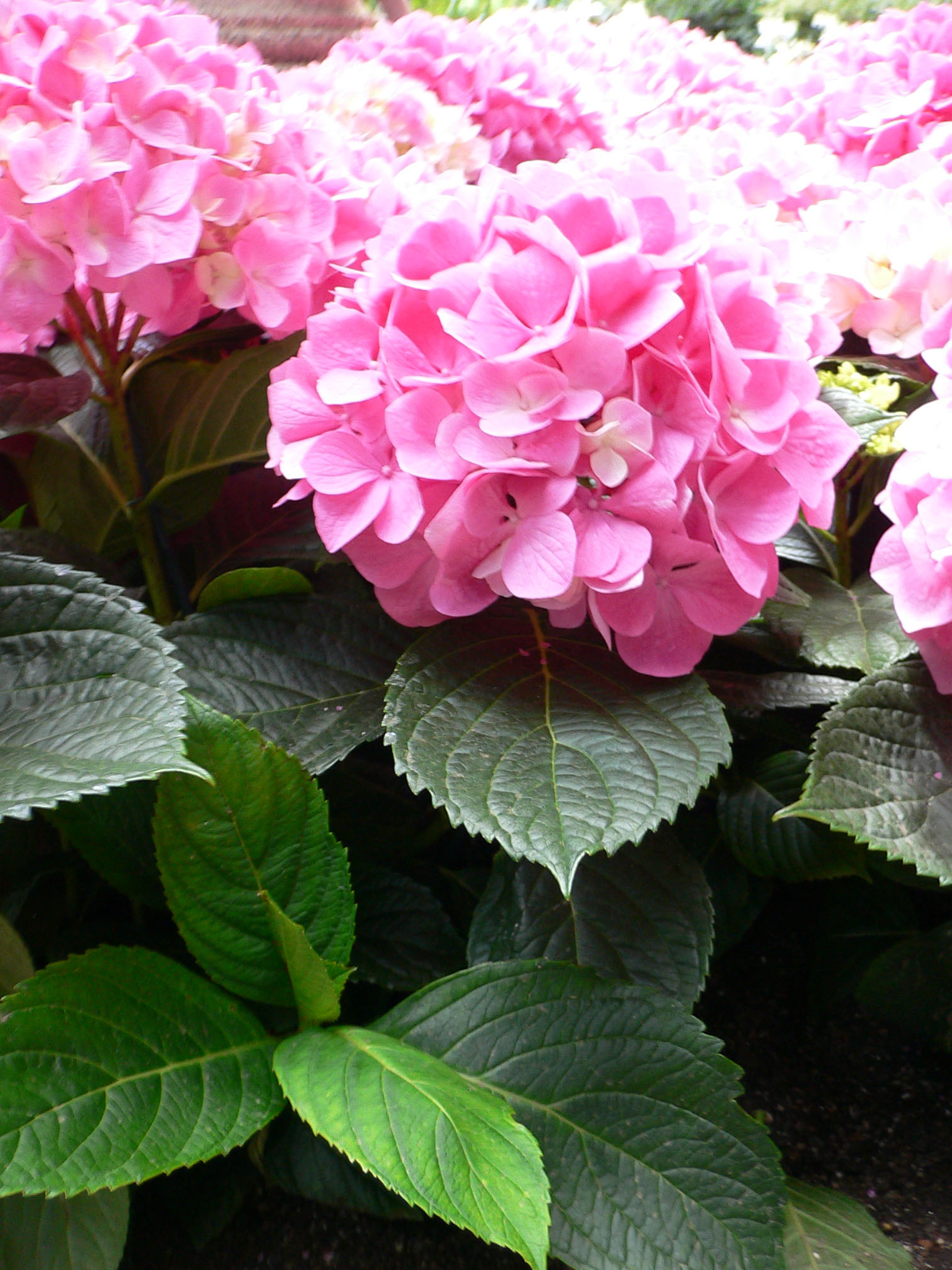
Bigleaf hydrangea
Fruits - small 2-5-chambered cup-shaped capsules, opening at the top. Seeds are small and numerous.
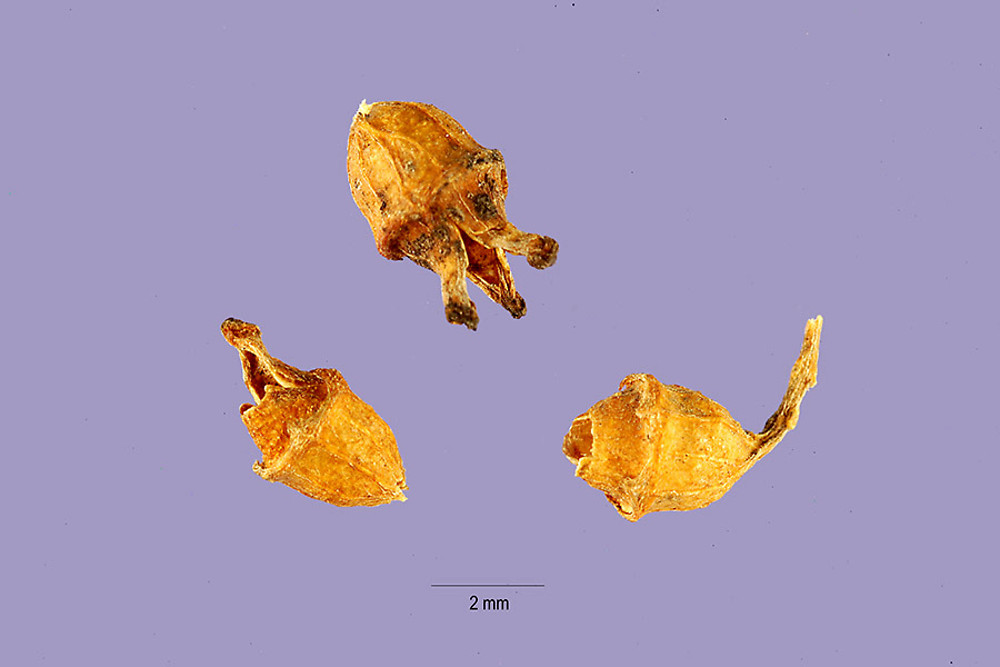
Panicle hydrangea
Species: the genus comprises 44-70 (90) species.
Popular ornamental species:
- Hydrangea anomala, the tall species – Hydrangea anomala D.Don.
- Smooth hydrangea – Hydrangea arborescens L.
- Rough-leaved hydrangea – Hydrangea aspera D.Don.
- Groundcover hydrangea – Hydrangea heteromalla D.Don.
- Bigleaf hydrangea, garden hydrangea – Hydrangea macrophylla (Thunb.) Ser.
- Panicle hydrangea – Hydrangea paniculata Sieb.
- Climbing hydrangea – Hydrangea petiolaris Sieb. & Zucc.
- Oak-leaved hydrangea – Hydrangea quercifolia Bartr.
- Sargent's hydrangea – Hydrangea sargentiana Rehd.
- Sawtooth hydrangea – Hydrangea serrata (Thunb.) Ser.
Hardiness zone: 6-7 (−23°C). Young plants must be carefully covered with dry leaves or peat. Bigleaf hydrangea is covered even in the southern zone; panicle hydrangea is prophylactically covered with peat or manure; hydrangea arborescens does not require covering. In container culture rough-leaved hydrangea and Sargent's hydrangea require good protection. Other species are sufficiently hardy. Standard (grafted) specimens are covered with burlap.
Location: Plants are generally sun-loving but need protection from the midday sun. The optimal place for cultivation is a sheltered site with eastern or western exposure. Some species grow well in light shade. They are tolerant of urban conditions.
Soil: prefers neutral or slightly acidic soil. Does not tolerate lime; on alkaline soil it suffers from chlorosis (for protection, water once every 10 days with a solution of iron-containing salts). Optimal soil acidity pH=4.0-6.5. Most decorative on well-drained and fertile soils. Moisture-loving, poorly tolerates drought.
Planting: the optimal age for planting is 2-3 years. Planting is best done in spring or autumn. Hole size on light cultivated soils - 40x40x50 cm, on loamy cultivated soils - 50x50x60 cm, on heavy clay soils - 60x60x70 cm. It is recommended to place drainage such as gravel or broken brick at the bottom of the hole in a layer of 5-10 cm. Above the drainage, fertile soil is poured in a layer of 10-15 cm. Spread the roots over the entire area of the hole and place the root collar at soil level. Water consumption after planting per plant on sandy soil 20-25 L, medium loam 15-20 L, heavy loam 10-15 L. In dry and windy weather it is recommended to spray the plant immediately after planting.
Care: it is recommended to loosen the soil around the bush at least twice a year to a depth of up to 5 cm. Watering should be carried out at least 5 times per season. To increase the strength of the shoots you can water along the crown and at the root with a weak potassium permanganate solution. Fertilize with manure or mineral fertilizers at the beginning of growth, at the bud formation stage, and also 1-2 times during the summer period.
Pruning: pruning is required only for Hydrangea arborescens and Hydrangea paniculata.
Propagation: easily propagated by semi-hardwood cuttings, grafting, layering and seeds. Cuttings are taken at the beginning of summer 10-12 cm long from shoots growing in the lower part of the stem, leaving 2-4 leaves on them. Cuttings root in 2.5-3 weeks. The next year they are pruned leaving only 2 buds. Layerings are separated from the parent plant after a year. Seeds are sown in a warm room, without covering. Seedlings grow slowly, reaching only 12-15 cm in the second year. Ornamental cultivars are recommended to be propagated by grafting onto hardy species.
Pests: aphids (pelargonium, greenhouse, pea), greenhouse thrips, spittlebug, spider mite, various bugs and beetles (e.g., green tree bug, berry bug, meadow bug, shining pale leaf beetle), leaf weevils, cutworms (larvae of noctuid moths), rose chafers, certain moth larvae, long-legged marsh crane fly, earwig, gall nematode.
Diseases: tracheomycotic wilt, white sclerotial rot, gray mold, common (European) canker, tubercular bark necrosis, powdery mildew, Phyllosticta, Septoria, ring and Ascochyta leaf spots, chlorosis.
Uses: 17 species are used in ornamental horticulture. Highly ornamental shrubs, small trees, less often lianas, with ornamental and picturesque large leaves, flowering for a long time and very abundantly. Used for solitary and group plantings on lawns, as a backdrop in flower beds, in compositions with trees and shrubs, in informal hedges, for borders, for flower containers, for cut flowers and for making dried winter bouquets. Climbing lianas are used for vertical greening of trellises, fences, walls or as groundcover.