
Indoor plants
Hoffmannia
Hoffmania
This plant of the Rubiaceae family received its name in honor of the German botanist G. F. Hoffmann (1761-1826), the first director of the Botanical Garden of Moscow University.
The genus Hoffmannia comprises about 100 species distributed from Mexico to Argentina. But only three are used in cultivation. The most striking of them is G. Ghiesbreght (H. ghiesbreghtii) and, especially, its garden form `Variegata`.
Unlike their better-known relatives, such as coffee and the cinchona tree, Hoffmannias are used by people purely as ornamental plants.
These are not very large shrubs, barely reaching a meter in height, adorned year-round with very attractive leaves.
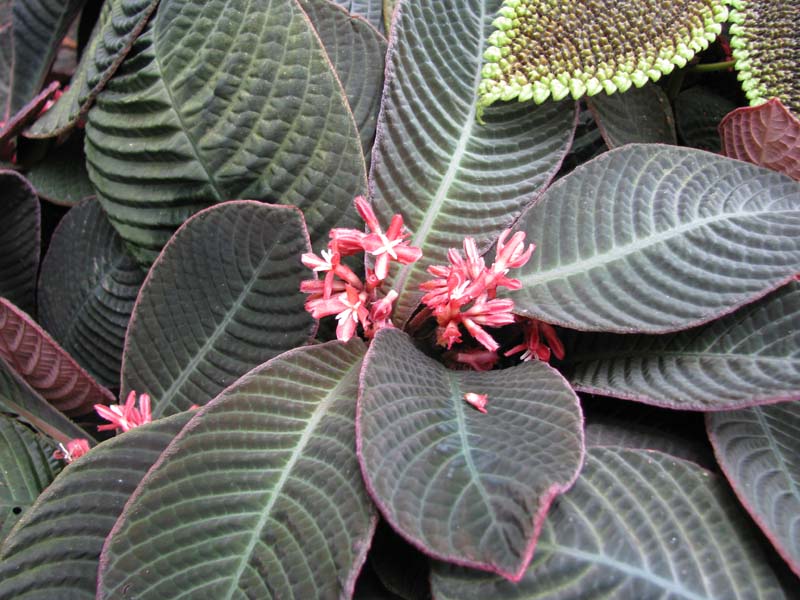
Mature, fully developed leaves are about 30 cm long and 10 cm wide. The overall color of the leaves is olive-green, but the surface of young leaves is densely covered with large patches of white and even pale pink. In mature leaves these patches disappear, but the leaf still looks magnificent, as its surface gleams like good velvet.
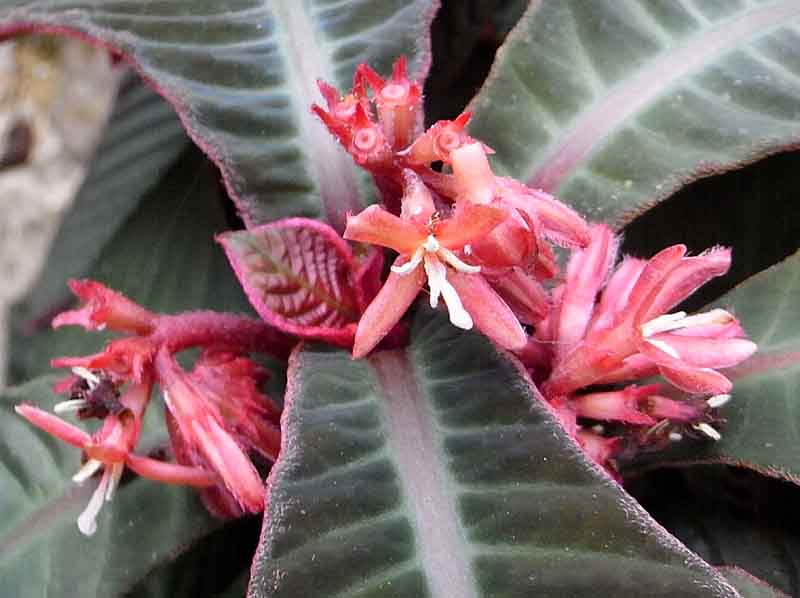
Hoffmannia flowers are quite inconspicuous, small (1.5-2 cm long), and flesh-colored. Interestingly, they are borne directly on the stem of the plant. Because of this they become even less noticeable. Being purely tropical plants, Hoffmannias even in apartments require constant warmth. A drop in temperature below +18 °C can have a very negative effect on their condition.
Hoffmannias grow fairly quickly, and in unfavorable winter conditions they lose a significant portion of the lower leaves. All this affects the plant's overall decorative appearance. Therefore, in early spring it makes sense to perform a severe pruning of the shoots that have been denuded.
Location: a bright spot, semi-shade, shade. Protect from strong sunlight, drafts and dry air from heating devices.
Watering: moderate year-round, avoid overwatering, waterlogging and letting the substrate dry out. Watering is slightly reduced in winter.
Humidity: moderate, can be occasionally misted with warm boiled water.
Temperature: room temperature, 20-23 °C. Temperatures below 18 °C are lethal to the plant.
Repotting: in spring, once a year. Do not forget drainage.
Propagation: by terminal cuttings with bottom heat at 30 °C, in a mini-greenhouse or by division of the clump.
Pruning: severe—prune in spring the shoots denuded over winter.
Fertilization: every 2 weeks in summer and once a month in winter with a weak solution of complete mineral or organic fertilizers.