
Fruit trees
Variable-leaved Hazel
С. heterophylla Fisch. ex Trautv.
Synonyms: variable-leaved hazel, Corylus heterophylla Fisch. ex Trautv., Siberian hazel.
Variable-leaved Hazel – a species of the genus Corylus of the birch family. In cultivation since 1882. First described in 1834. Naturally occurs in Eastern Siberia (Chita region), Mongolia, China, Russia (Far East), Japan, and Korea. Found in the understorey of oak, dark birch, mixed and pine forests, as well as on forest edges, burned areas, clearings, on slopes of ravines and hills, on the foothill slopes of plateaus, terraces of river valleys, and plateaus. Forms thickets, often quite dense and impenetrable.
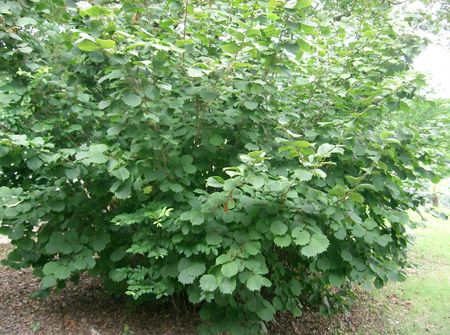
It is a tall shrub 2-4 m high with a stem diameter up to 10 cm. Growth rate high. At 54 years it reaches 3.6 m in height and 330 in diameter. Crown ovoid or spherical, very dense and wide. Young shoots glandular, densely pubescent; one-year-old shoots light brown, almost bare, with fissured lenticels. Bark on the trunk brown or brownish-gray. Lives up to 80 years.
Has a shallow root system.
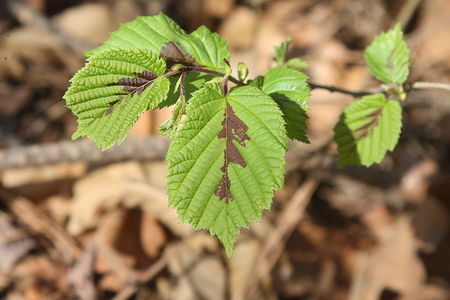
Buds ovoid, small, obtuse; scales rounded, ciliate. Leaves broadly obovate or rounded, 6-10 cm long, 5.5-10 cm wide, slightly cordate at the base and truncate or almost two-lobed at the apex, with an acute tip that usually does not exceed the broad lateral lobes; irregularly doubly serrate, glabrous and dark green above, pubescent along the veins beneath and lighter in color there. Petioles glandular, hairy, from 1 to 2.5-3 cm long. In spring leaves are reddish when unfolding, in summer become dark green, in autumn golden-orange, orange, golden-yellow. Leaves unfold in early May, turn yellow in September, and fall quickly.
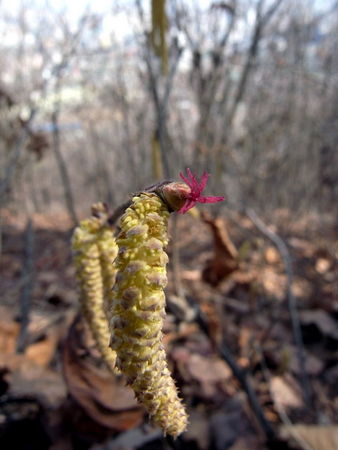
Flowers from the second half of March until the end of April. Male catkins up to 4 cm long and 4-6 mm thick, pale brown, grouped 1-5 per peduncle. Female flowers during flowering are hidden in the buds with exposed crimson stigmas.
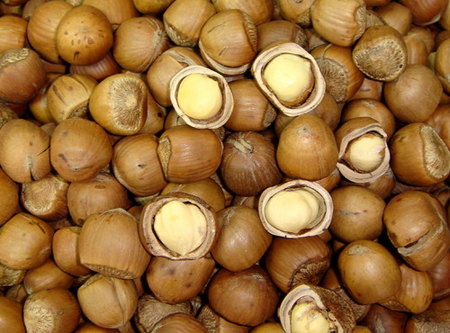
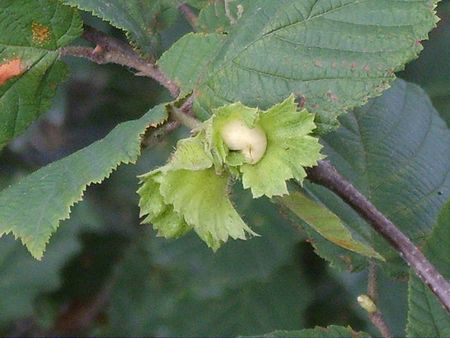
Fruits from 9 years of age. Fruits borne 2-3 at the tips of shoots and grow on a stalk up to 3 cm long. Nuts are flattened-globose, up to 1.5 cm in diameter, edible; shell very hard, gray-pubescent. The involucre consists of 2 bracts divided into 6-9 toothed almost equal lobes, bell-shaped, not fully covering the nut, velvety-pubescent. Nuts ripen in mid-August - September.
Varieties: Corylus heterophylla var. heterophylla, Corylus heterophylla var. sutchuenensis Franch., Corylus heterophylla var. thunbergii Blume
Hardiness zone: 4 (°C -45°С).
Location: Shade-tolerant. Can grow under the canopy of trees. In open sunny sites can spread vigorously. Prefers humus-rich, fresh (moist) soils, but can grow on semi-rocky dry mountain soils, on sandy alluvial loamy soils of forest valleys. Poorly tolerates waterlogging. Does not require a deep soil layer.
Planting: Optimal seedling age – 2 years. Planting is best done in autumn. Planting hole size 50x60 cm. Into the hole add 10-15 kg of humus, 200 g of superphosphate, 50 g of potash salt and mix with the top layer of fertile soil. Before planting, seedlings should be pruned to 20-25 cm, and roots dipped in a clay-and-manure slurry. Spacing between plants 4-5 m apart, slightly denser in a hedge. For good pollination it needs several pollinator varieties.
Care: Care consists of shallow cultivation of the trunk circles and mulching (for example, with mown grass). Watering is recommended during dry periods.
Pruning: should be performed in early spring before sap flow begins. Needs only sanitary pruning.
Propagation: seed germination 33%. Seeds require stratification for 2-3 months at 0 - 5°С. Sowing depth 4-5 cm. Soil emergence 79 - 86 %. Cutting rooting when treated with a 0.01% IMK solution for 16 h is 50%.
Pests: hazel leaf beetle, nut weevil, hazel leafroller, bud mite, rodents.
Diseases: anthracnose, gray and fruit rot.
Uses: used for producing valuable nuts. For ornamental purposes widely used in forestry and landscaping; planted in large groups, stands, on forest edges, and as individual specimens in parks and forest parks.