
Deciduous shrubs
Henry Cotoneaster
С. henryanus Rehd et Wits.
Synonym: Cotoneaster henryanus (C.K. Schneid.) Rehder & E.H. Wilson, Cotoneaster rugosus var. henryanus C.K. Schneid., Henry willow-leaved cotoneaster, Cotoneaster salicifolius var. henryanus (C.K. Schneid.) T.T. Yu
Henry Cotoneaster (Cotoneaster henryanus Rehd et Wits.) – a species of non-spiny shrubs of the genus Cotoneaster in the rose family (Rosaceae). Native to the western part of China (Hubei province). A specimen from the Arnold Arboretum was first described in 1907 by Ernest Henry Wilson and later revised in 1912 by Charles Sprague Sargent. It was first introduced into cultivation in Britain in 1901.
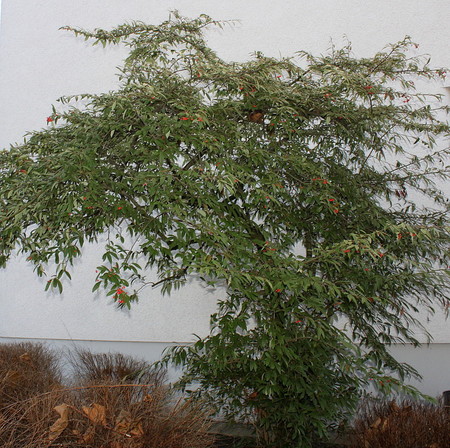
It is a semi-evergreen shrub up to 5 m in height with a tent-shaped crown. Shoots are long, curved. Grows quickly.
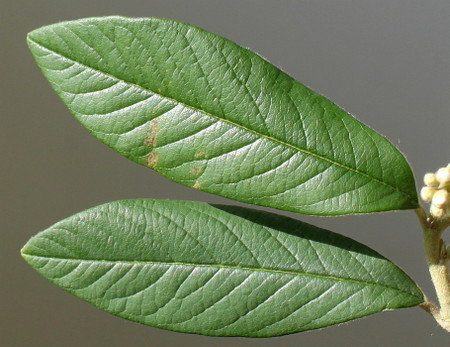
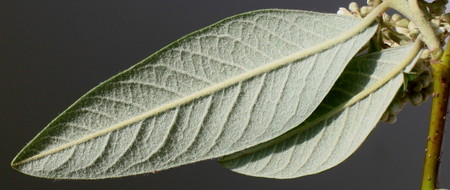
Leaves long, up to 12 cm in length, glossy, glabrous on the upper surface, dark green, beneath initially grayish-tomentose, later becoming grayish-green. In autumn the leaves acquire orange tones.
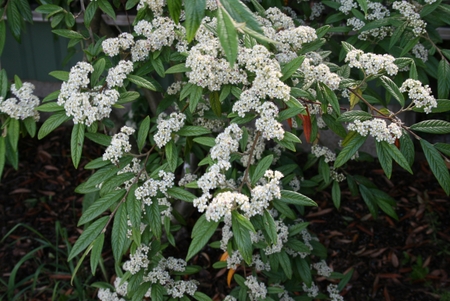
Flowers small, up to 1 cm in diameter, white with purple anthers, fragrant, borne in corymb-like inflorescences.
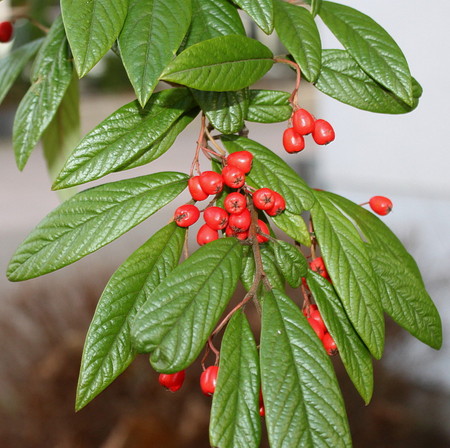
Fruits ovoid in shape, bright red. Collected in clusters of 3-5. Seeds 3, more rarely 5. Fruits ripen in October.
Forms:
- cotoneaster franchetii var. Sternianus
- Cotoneaster franchetii var. cinerascens Rehd.
- cotoneaster franchetii var. franchetii.
Hardiness zone: zone 5-8 (-23°C).
Site: A light-loving mesoxerophyte, mesotroph, mesotherm. Tolerates urban conditions well. Drought-resistant.
Propagation: propagated by seeds and vegetatively. Green cuttings root faster under plastic. Cuttings are taken in the second half of July. Substrate – peat and sand in equal proportions. Does not tolerate prolonged waterlogging and stagnant moisture, requires good drainage.
Soil: Not demanding regarding soil fertility. Grows on slightly acidic, neutral and slightly alkaline soils.
Planting: planting mixture – compost consisting of topsoil, peat and sand in proportions 2:1:2.
Care: In hot and dry summers, to maintain its ornamental value it is recommended to water the plant 1-2 times a month at a rate of 1-2 buckets per plant.
Pruning: Tolerates trimming and pruning well. After pruning it regrows well while maintaining its growth habit. When shaped, it produces dense hedges and sculptural groups. Recommended pruning – remove 1/3 of the length of the annual shoot, in places where a dense and compact habit is required.
Diseases: Fusarium (remove and burn affected parts)
Pests: apple aphid, plum sawfly, cotoneaster mite.
Use: ornamental for its attractive tent-shaped crown, striking dark-green glossy foliage, as well as fragrant corymb-like white-purple flowers. Used in single and group plantings.