
Indoor plants
Heliotrope
Heliotropium
The name of the genus comes from the Greek words 'helios' — sun and 'tropos' — turn, direction, and is explained by the fact that the flower stalks of these plants turn following the movement of the sun, so the inflorescences are always turned toward it.
The genus includes 250 species distributed in tropical and subtropical regions of the globe. Herbaceous perennials or subshrubs. The best known are: European heliotrope (Н. еиrораеит), native to the Mediterranean; throughout North and South America Curassavica heliotrope (Н. curassavicum) grows widely. In horticulture the tree heliotrope, or Peruvian (Н. arborescens = Н. peruvianum), native to Peru and Ecuador, is most often used, where it forms a lush bush up to 190 cm tall, covered with flowers with a vanilla scent. Much more rarely used are the stem-clasping heliotrope (Н. amplexicaulus) and the corymbose (shield-shaped) heliotrope (Н. corymbosum).
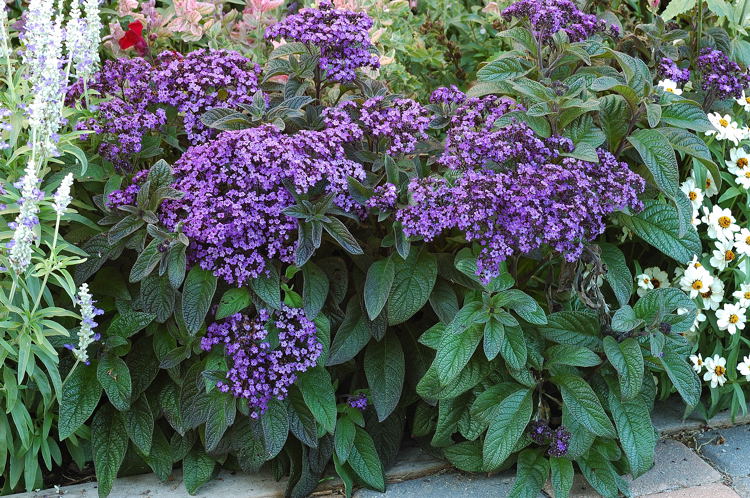
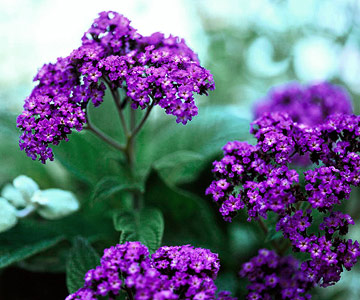
All heliotropes have obovate, pubescent, dark-green, wrinkled or wavy leaves on short petioles. Leaf arrangement alternate. Flowers small, fragrant, gathered in corymb-like inflorescences. The corolla is dark purple or dark blue, with a short tube and a 5-lobed limb; there are cultivars with white or light-blue petal coloration. Heliotrope flowers contain a fragrant essential oil that perfumers use to make perfumes.
Location: heliotrope prefers a bright, sunny spot. When grown in shade the plant produces weak slender shoots and small pale flowers. In summer it is recommended to place heliotrope outdoors; in winter the plant should be kept in a bright room at a temperature of 5-6 °С.
Care. In summer regular abundant watering is necessary; the root ball should always be moderately moist. In winter water sparingly, but ensure the root ball does not dry out.
Flower fertilizers are applied to heliotrope from March to October 2-3 times a month. Each spring transplant into a substrate consisting of leaf soil, turf, clay soil and sand in a ratio of 1:1:1:1. Prune the plant before planting.
Pests and diseases: the main pests are aphids, whitefly, and spider mite. With improper care the plant can be affected by gray mold and rust.
Propagation: by cuttings in February-April if the substrate is heated to 22-25 °С; also by seeds, which are sown in soil in March.
Tip: to make heliotrope bloom well in winter rather than in summer, regularly remove the flower buds.