
Flowers for the garden
Sunflower
Helianthus
Sunflower (lat. Helianthus) — a genus of herbaceous plants of the family Asteraceae (Asteraceae). It includes from 50 to 180 species. Its natural range is North and South America.
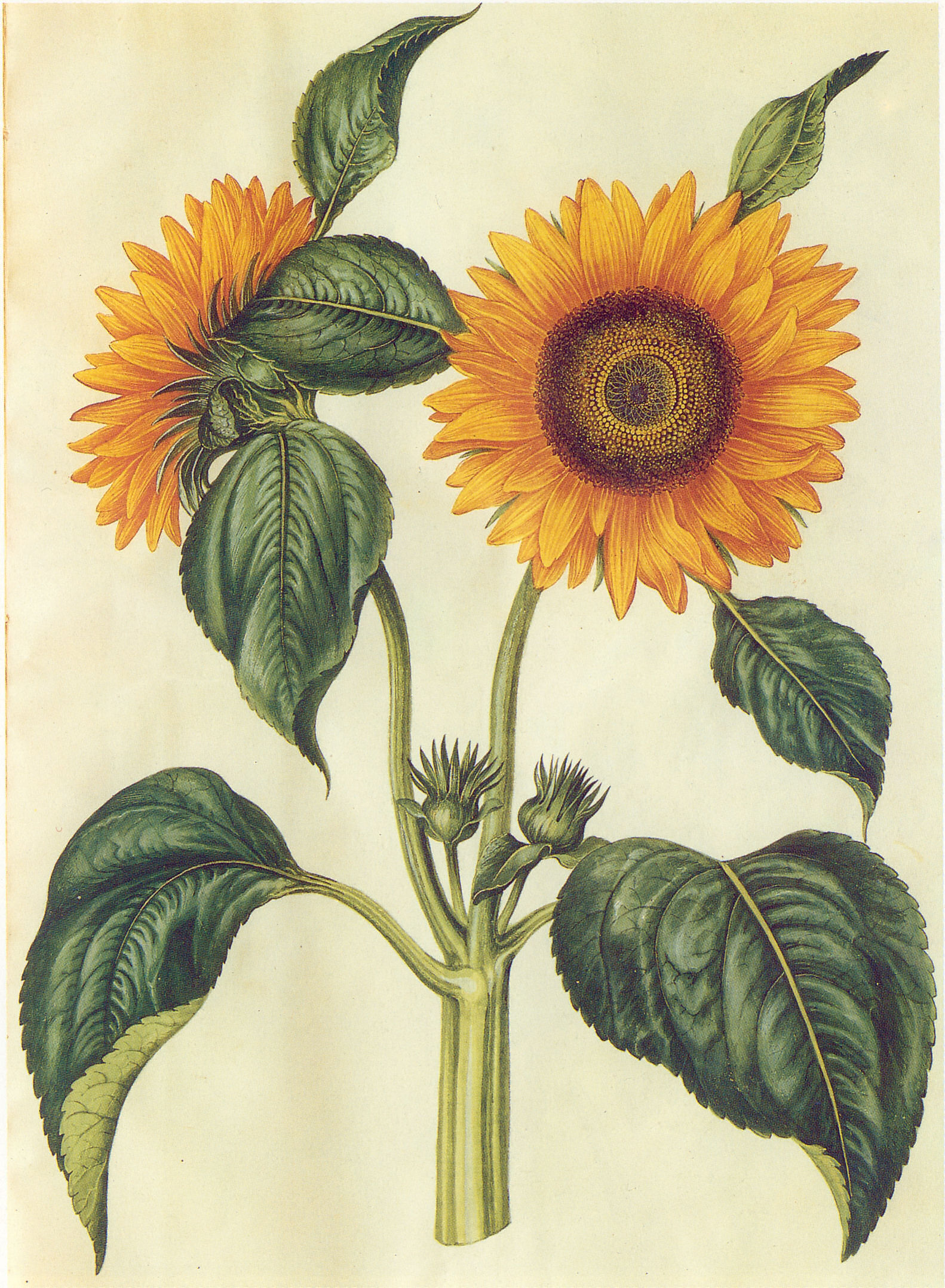
Annual, less often perennial herbaceous plants, but some South American species are shrubs. Wild sunflower species reach up to 3 meters in height. The stem and leaves are densely covered with bristly hairs. Leaves are ovate-cordate with three main veins. Inflorescences are usually large, bright, in the form of many-flowered heads (capitula). Inside the head are tubular brownish-yellow florets, at the edges — ligulate florets of brownish, yellow, or reddish color. After pollination they develop into achenes.
In cultivation:
Common sunflower, or oil - Helianthus annuus
An annual herbaceous plant. Stem 0.6 to 3 meters high, erect, mostly unbranched, covered with stiff hairs.
Leaves alternate, on long petioles, dark green, ovate-cordate up to 40 cm long, pubescent, with serrated margins.
Flowers in terminal, very large heads, 30—50 cm in diameter, turning during the day to follow the sun. Ray florets at the edges are ligulate, yellow, orange-yellow, usually sterile; the inner ones are tubular, yellow, brownish-yellow, brown in color, bisexual, numerous. Sunflower usually forms a single inflorescence, but there can be additional shoots with small inflorescences. Blooms in July—August. Fruits — oblong-ovoid achenes, slightly ribbed, white, gray, striped or black.
It has quite a number of ornamental forms, the most common of which are:
variegated (f. variegatum) — with variegated leaves;
Californian (f. califomucum) — double, golden-yellow inflorescences composed of ligulate florets;
round inflated (f. globosus fistulosus) — double, globular inflorescences composed of tubular florets;
round multiflowered (f. globosus multiflorus) — numerous inflorescences arranged along the entire stem up to 100 cm high.
Tuberous sunflower, or Jerusalem artichoke (earth pear) - Helianthus tuberosus
A perennial herbaceous plant up to 1.5 meters tall (sometimes up to four) with an erect, unbranched, pubescent stem.
Leaves opposite, ovate, dark green, pubescent.
Flowers in head-type inflorescences, yellow, 6—10 cm in diameter.
On its stolons (underground shoots) many tubers are formed of cylindrical, pear-shaped or rounded form with convex buds (eyes) — white, yellow, purple, pink (depending on the cultivar); the flesh is tender, juicy, with a pleasant slightly sweet taste.
Location: Require a sunny, warm, sheltered-from-wind site. Annual species are heat-loving and do not tolerate frost.
Soil: not demanding, grow well on fertile, loose and neutral soil.
Care: Do not require special care. Spent inflorescences should be removed so the plant can bloom again. In exposed, windy locations staking is necessary.
Propagation: by seeds; Jerusalem artichoke — by division of tubers and by seeds.