
Indoor plants
Hebe Armstrong
Hebe armstrongii
Synonyms: Veronica armstrongii.
Hebe armstrongii (Hebe armstrongii) – a species of the genus Hebe (Hebe Comm. ex Juss.) in the family Plantaginaceae (Plantaginaceae). It was first found in 1869 by the botanist Joseph E. Armstrong near the Rangitata River in New Zealand.
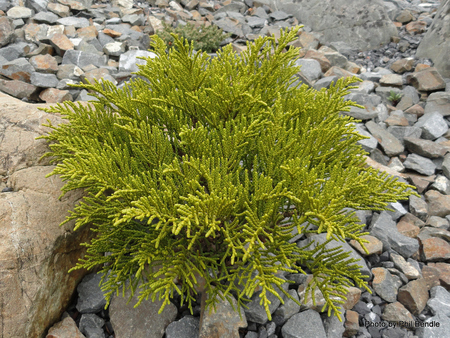
In the wild it grows on Polter Hill, near the River Esk, on the Castle Hill rocks and in East Canterbury in New Zealand. Closely related to Hebe annulata and Hebe salicornioides. Grows near bogs, on the banks of rivers and lakes with shallow groundwater and a moderately high level of available moisture. In the mountains it rises to elevations of 1200-1550 m above sea level.
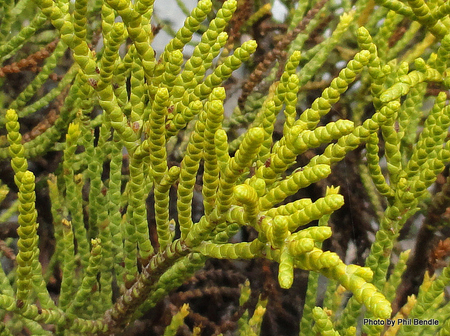
It is a prostrate evergreen shrub reaching up to 1 m in height and 1 m in diameter in the wild, and up to 60 cm in cultivation. Main branches are rigid, growing horizontally; lateral branches are dense, evenly arranged and curved in one direction. Young shoots are 1.5-2 mm in diameter, light green.
Leaves are scale-like, up to 1 mm long, fused for one to two thirds of their length, light olive-green in color.
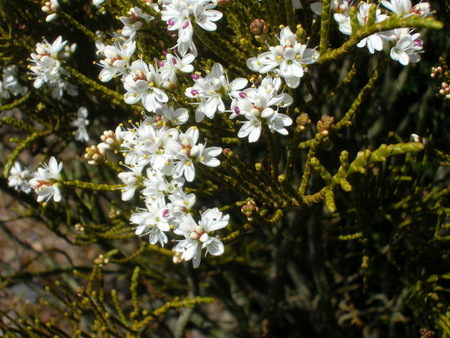
Flowers white, borne in raceme-like inflorescences of 2-6 flowers, appearing in early summer. Rarely flowers in cultivation.
Cultivars: yellow
Hardiness zone: 7b (-5°C).
Temperature: In most of Ukraine the species is grown as a houseplant. For winter it is preferable to cover with conifer boughs while maintaining air circulation or bring into a warm room. In summer outdoors place in a spot protected from dry and hot air. Summer temperature should be 18-22°C, and winter 8-14°C.
Soil: tolerate most soil types with good drainage; prefer deep and loose soil. Do not like heavy compact clay.
Light: prefer sunny locations or partial shade. Protection from direct sunlight is necessary. A west- or east-facing window is suitable for cultivation.
Watering: regular, moderate watering in summer. Poorly tolerate waterlogged soil and standing water. The soil should not dry out completely between waterings. Reduce watering in winter.
Air humidity: in nature they tolerate salty sea spray well and enjoy warm moist winds. In summer and winter it is preferable to mist with room-temperature water.
Care: in spring and summer it is useful to fertilize twice a month with complete fertilizers. Stop fertilizing from mid-summer. Pinching shoots stimulates abundant flowering.
Repotting: carried out when the plant becomes strongly overgrown. The pot diameter should be 5-6 cm larger than the rootball.
Potting mix: prefers slightly acidic soil. Mix: leaf mold, turf soil, peat and sand in a ratio of 1:3:1:1.
Pests: spider mites, whitefly, aphids, scale insects, mealybugs.
Diseases: rots.
Propagation: easily propagated by seed, division of the bush and cuttings.
Uses: grown in gardens and public spaces. In most of Ukraine grown as a houseplant.