
Flowering shrubs
Hebe
Hebe
Synonyms: Antirrhinaceae Pers., Aragoaceae D.Don, Callitrichaceae Link, Chelonaceae Martinov, Digitalidaceae Martinov, Ellisiophyllaceae Honda, Globulariaceae DC., Gratiolaceae Martinov, Hippuridaceae Vest, Littorellaceae Gray, Psylliaceae Horan., Sibthorpiaceae D.Don, Veronicaceae Cassel, Hebe.
Hebe (Hebe Comm. ex Juss.) – a genus of plants in the Plantaginaceae (plantain) family. The genus was first described in 1789 by the French botanists Philibert Commerson and Antoine Laurent de Jussieu in their «Genera Plantarum 105». The genus was first segregated in 1721; before that its representatives were included in the genus Veronica. The genus is named after the Greek goddess of youth, Hebe.
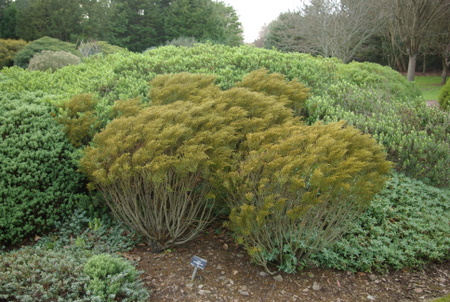
Members of the genus occur in New Zealand, on the Falkland Islands and Rapa Iti, as well as in South America. Almost all species grow in New Zealand, except H. rapensis, which is endemic to Rapa Iti. They grow on coasts, along forest edges, in highland areas, and on alpine meadows.
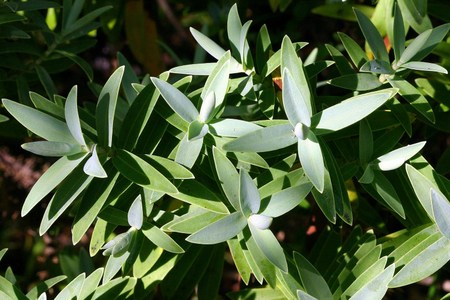
Plants of the genus are small shrubs 20–60 cm tall, less commonly trees up to 7 m tall. They have 4 perpendicular rows of leaves, with opposite pairs crossing at right angles. In temperate climates they grow as evergreen plants.
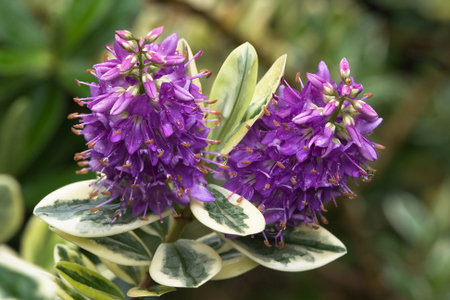
Flowers are arranged in a spike-like inflorescence, appearing from May to July. The flower is perfect (bisexual). The corolla consists of 4 petals. There are 2 stamens. Flowers are blue, purple, or white, gathered in racemose inflorescences.
Species: the genus includes about 100 species and subspecies. Some of them:
- Hebe armstrongii – Hebe armstrongii
- Hebe cupressoides - cypress-like Hebe (Hebe cupressoides)
- Hebe magellanica J.F.Gmel. (V. elliptica G.Forst.) – Hebe magellanica (type species)
Hybrids: Hebe × franciscana
Hardiness zone: 6a (-12°C).
Temperature: in most parts of Ukraine these plants are grown as houseplants. For winter it is preferable to cover them with conifer boughs while maintaining air circulation, or bring them into a warm room. In summer outdoors they should be placed in a location protected from dry hot air. Summer temperature should be 18–22°C, and winter 8–14°C.
Soil: most species tolerate a variety of soils provided there is good drainage; they prefer deep, loose soil. They do not like compact heavy clay.
Light: they prefer sunny sites or partial shade. Protection from intense direct sunlight is necessary. A west- or east-facing window is well suited for cultivation.
Watering: in summer watering should be regular and moderate. They do not tolerate waterlogged soil or standing water. The soil should not dry out completely between waterings. Watering is reduced in winter.
Humidity: in nature they withstand salty sea spray well and enjoy warm moist winds. In summer and winter it is preferable to mist with room-temperature water.
Care: in spring and summer it is useful to feed twice a month with balanced fertilizers. Fertilizing is stopped from mid-summer. Pinching shoots stimulates abundant flowering.
Repotting: carried out when the plant becomes overgrown. The pot diameter should be 5–6 cm larger than the rootball.
Planting mix: prefers slightly acidic soil. Mix: leaf mold, turf soil, peat and sand in the ratio 1:3:1:1.
Pests: spider mites, whitefly, aphids, scale insects, mealybugs.
Diseases: rots.
Propagation: easily propagated by seeds, division of the bush and cuttings.
Uses: grown in gardens and public places. In most of Ukraine it is cultivated as a houseplant.