
Flowers for the garden
Gypsophila
Gypsophila
Gypsophila (Lat. Gypsophila) — a genus of plants in the family Caryophyllaceae (Caryophyllaceae).
Includes about one hundred species occurring in Southern Europe, along the shores of its Mediterranean region and in extratropical Asia; one Australian species is also known.
Annual and perennial (mostly) low herbs with a much-branched stem. Leaves always entire and simple, narrow in shape — lanceolate, oblong-oval or spatulate, sometimes linear.
Flowers small, white, whitish-green, pinkish and pink, arranged in the form typical of Caryophyllaceae. The calyx is bell-shaped, five-lobed. Fruit — a one-chambered many-seeded capsule, globular or ovoid, dehiscing with 4 valves; seeds rounded.
In cultivation:
Panicled gypsophila — Gypsophila paniculata L.
A perennial plant up to 120 cm high. Stems knobby, strongly branched, especially in the upper part, forming an airy, spherical-shaped bush. Leaves small, narrow; basal leaves lanceolate or linear-lanceolate, pubescent. The whole plant is grayish-green. Flowers small, up to 0.6 cm in diameter, white or pink, single or double, collected in paniculate inflorescences. Blooms in July-August. Fruit — a capsule with small seeds. There are garden forms and cultivars that differ in flower color and form, and plant height.
Cultivated as an ornamental plant and used in bouquet compositions. An excellent honey plant.
Creeping gypsophila — Gypsophila repens L.
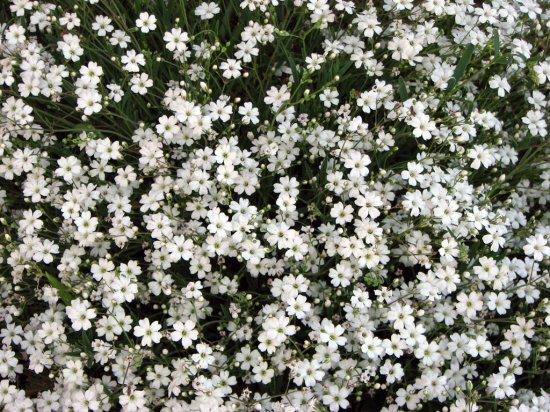
A perennial herbaceous plant no more than 20 cm high. Stems prostrate, glabrous, forming dense cushions. Leaves narrow-lanceolate, dark green. Flowers small, white or pink. Blooms in June-July, with a short pause and a secondary bloom in autumn. In cultivation since 1774.
After flowering it is recommended to trim shoots to stimulate the regrowth of basal shoots, which root easily from cuttings. This way the plant can be rejuvenated and propagated. Undemanding, but prefers sunny, well-drained sites with loose, non-acidic soil. May winter-kill in snowless winters, but recovers well by self-seeding. Can become weedy under favorable conditions. Very good for planting on rocky walls.
Location: sunny site, does not tolerate high groundwater, fairly winter-hardy.
Soil: grows poorly on acidic soils, requires the addition of lime or chalk; achieves greatest ornamental effect on fertile, loose sandy loam soils.
Care: water during prolonged periods of dry and hot weather. Feed plants every 2 weeks with a solution of complete mineral fertilizer.
Propagation: by seed in spring. Can be sown in autumn. Very easily propagated by self-seeding.