
Flowers for the garden
Gladiolus or Sword-lily
Gladiolus
The name derives from the Latin word 'gladus' — sword and was given because of the shape of the leaves. The plant's name in Hebrew is "seifan" from "saif" — rapier, sword.
The native range of the gladiolus includes the tropical and subtropical regions of Africa and the Mediterranean, Central and Southern Europe, Central Asia, and Western Siberia. About 200 species are known. Plants are perennial, cormous. Stems are vertical, unbranched, solitary, leafy, 50-


Leaf sheaths clasp around the stem, giving it additional strength. Flowers are gathered in a one-sided, two-sided or spiral spike-like inflorescence up to

A common habitat characteristic for most species of gladiolus is good moisture during the growing season but without waterlogging (good drainage or runoff of rainwater down slopes), sunny exposure and loose fertile soils. For successful cultivation of garden gladioli, these environmental factors also remain primary.
Location: the site intended for planting gladiolus should be level or have a slight (up to 5°) south-facing slope, which provides runoff of excess water and good soil warming. Cold sites with high groundwater levels are poorly suited for planting gladiolus, because soil in such places "matures" later than on elevated sites; planting and flowering of gladioli are delayed, and late varieties may not bloom at all due to lack of heat.
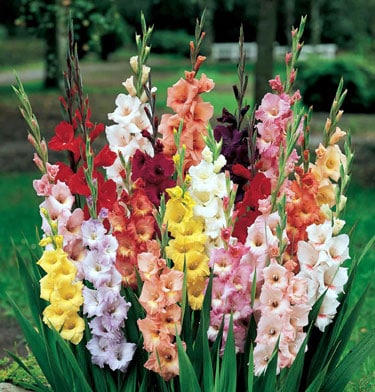
Lighting: well-lit, wind-protected and well-drained sites. In northern regions even slight shading of gladiolus plantings at any time of day delays plant growth, reduces their ornamental qualities and leads to later flowering compared to fully sunlit sites. In southern regions, sites with partial shading at midday are more favorable for gladiolus; in this case plants are less exposed to high temperatures and the flowers retain their decorative qualities longer than on open sites.
Soil: demanding of soil. The best soils for gladiolus are structured chernozem, light loam or sandy loam. The necessary soil structure is achieved by adding sand to heavy loamy soils, clay to sandy soils, and a sufficient amount of well-rotted compost and humus. The bed for gladiolus is prepared in autumn.
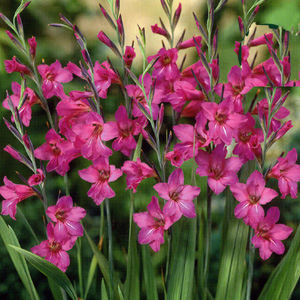
Planting: the timing and methods of planting corms depend on several factors, in particular on soil readiness, which should dry out and warm to at least 10 °C at a depth of 10-
Care: gladiolus responds well to careful care. Main care measures during the growth period include: watering, soil loosening, weed removal, mulching, fertilization and use of micronutrients, and measures to prevent diseases. Watering should be abundant, 10-


Fertilizations have a large influence on the growth, development and ornamental qualities of gladioli. A rational and biologically justified system is to apply fertilizers timed to specific stages or phases of plant development.
The first feeding is nitrogenous, applied at the stage of emergence of the 2nd–3rd true leaves. Per 1 m2 apply 25-
The second feeding — nitrogen-potassium-phosphorus — is carried out at the stage of appearance of the 5th–6th true leaves; apply 10-
The third feeding — potassium-phosphorus — is given at the beginning of bud formation or slightly earlier when the scape emerges. It ensures good flowering and better corm formation. Per
After flowering and drying of the above-ground parts, corms are dug up, dried, sorted and stored until the next planting in a dark cool place.

Propagation: gladioli are propagated by sowing cormlets, dividing corms and by seed. Vegetative propagation is an adaptation of plants for survival when seed reproduction is unreliable due to harsh conditions, i.e. seeds do not mature. In wild species the main method of reproduction is generally by seed, and therefore many species lack vegetative reproduction. The garden gladiolus inherited the ability for vegetative propagation from its wild ancestors. This trait is very useful in cultivation, as it provides rapid reproduction while preserving all the morphological characteristics of the cultivar. Naturally, this trait has received particular attention in breeding new varieties.