
Deciduous trees
Ginkgo
Ginkgo
Synonyms: Ginkgo biloba, temple tree, silver apricot, silver fruit, maiden's braids, Maidenhair tree.
Ginkgo (Pseudocydonia sinensis (Thouin) C.K.Schneid.) – a relict gymnosperm plant, a living fossil, a genus of the family Ginkgoales (Ginkgoales). The species was first described by Carl Linnaeus in 1771 in Mantissa Plantarum. Generum Editionis vi et Specierum Editionis ii. 2: 313. Ginkgo was first mentioned by the German traveler and naturalist Engelbert Kaempfer in Amoenitatum exoticarum (1712). He mistakenly wrote Ginkgo, Itsjo instead of Ginkjo, Itsjo. Carl Linnaeus repeated his mistake in the description, and the name stuck to the plant. The name from Japanese translates as "silver apricot."
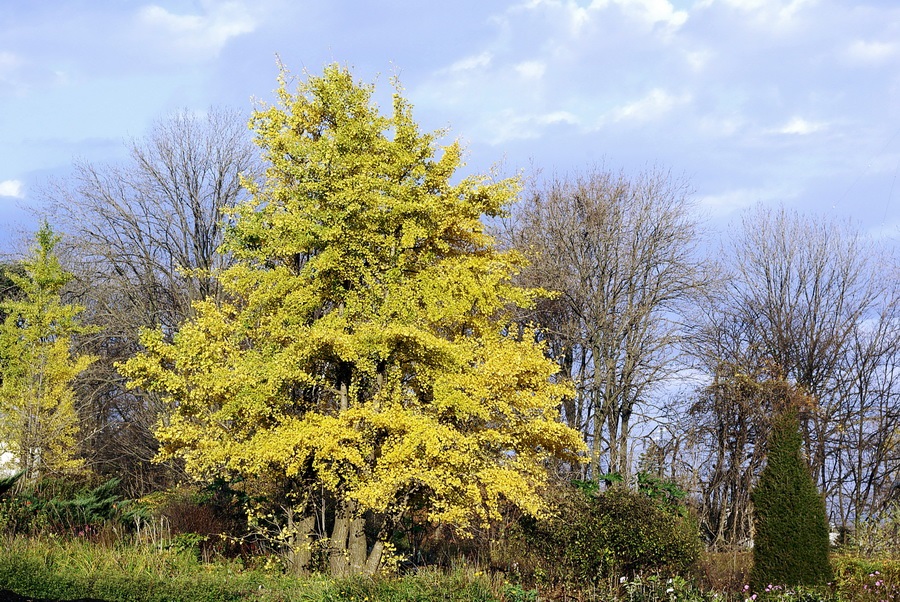
Photo Yu. Semeykin
In nature it is found only in two small areas in the eastern part of China (Zhejiang Province). It grows in cool valleys and in mixed conifer-broadleaf forests, alongside Cryptomeria, Nissa, various laurels and other Tertiary relicts. It rises into the mountains up to 300–1100 m above sea level. In cultivation since the 11th century. Widespread in Western Europe, North America, Russia.
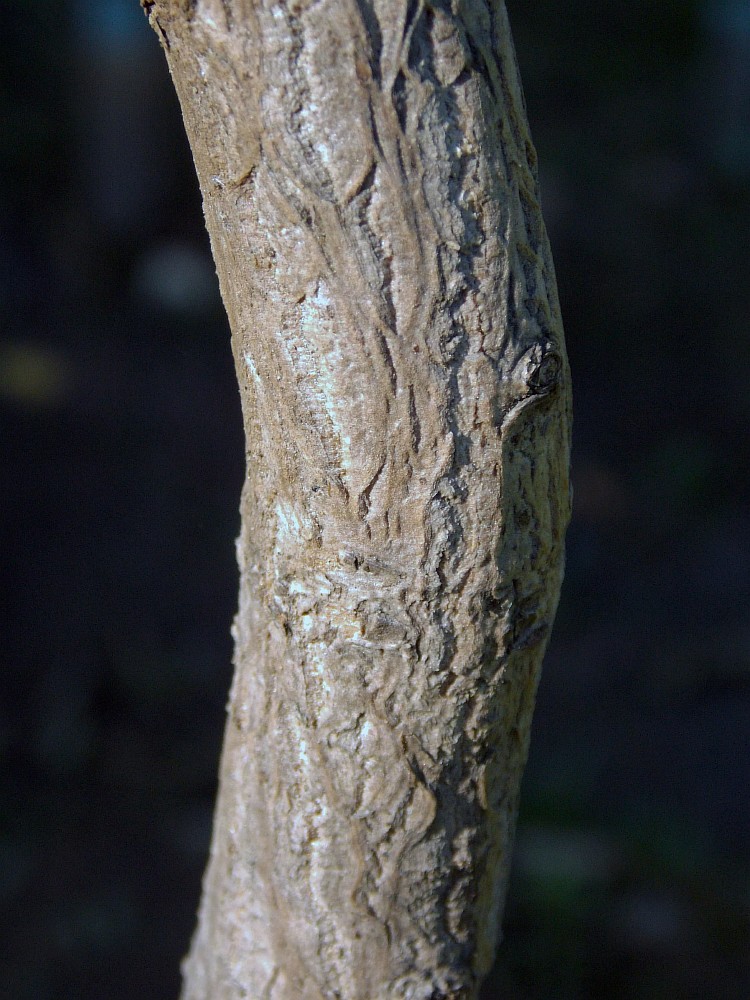
Photo L. Trofimuk
It is a deciduous tree up to 40 m in height, diameter up to 4.5 m. Grows slowly, 2–4 cm per year. Crown abundantly branched, initially pyramidal, later spreading. Branches arranged in whorls, departing from the trunk almost at right angles. Buds are spherical, brown. Trunk bark is brownish-gray, in old trees cracked and furrowed. Root system deep, well developed, branched. Young trees have a central root longer than 1 m. Lives up to 3000 years.
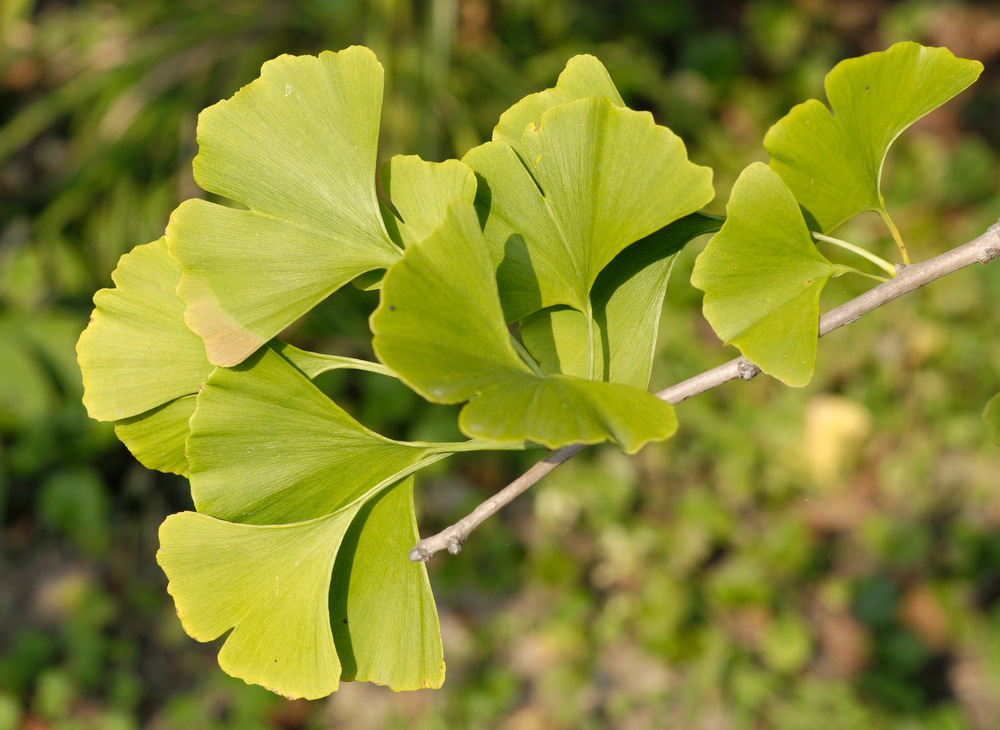
Photo Yu. Semeykin
Leaves are fan-shaped, two-lobed, the blade reaches 5–8 cm in width and up to 10 cm in length, leathery, glabrous, slightly corrugated and wavy at the edge, bright green. Veins with dichotomous branching. Leaves develop singly and quickly on long shoots or in groups of 2–4 slowly on shortened shoots. Leaves on short shoots are gathered in clusters of 2–5, and on long shoots are arranged alternately. Petioles are thin, up to 10 cm long. In autumn leaves acquire a golden-yellow color.
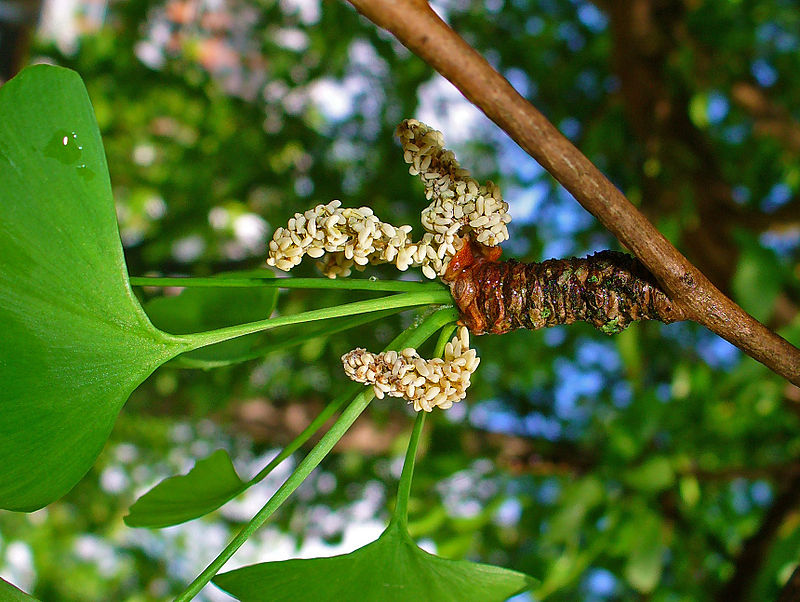
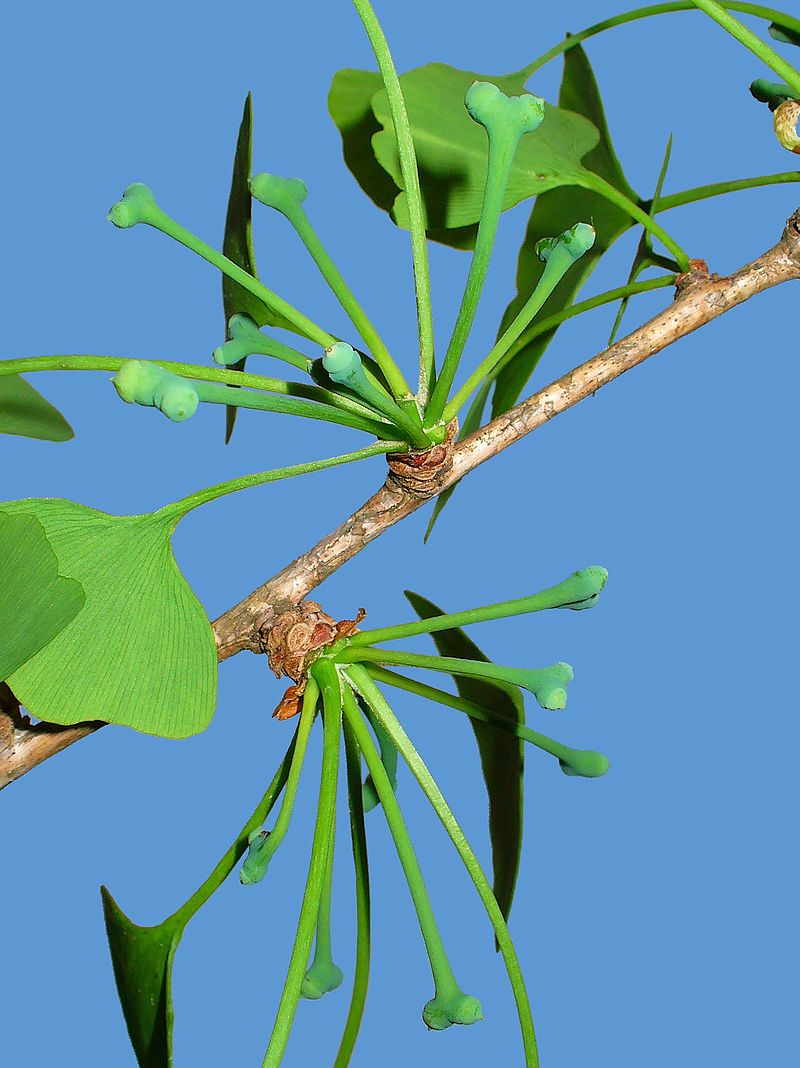
Photo H. Zell
The plant is dioecious. On male plants catkin-like inflorescences consist of separate "stamens", and female ones have 2 flat and green ovules on a long peduncle. Pollinated by wind. Flowers in May–June.
Fruits are plum-shaped, fleshy, at first green, later yellow with a bluish bloom. Seeds are obovoid, 2.3–2.7 × 1.9–2.3 cm, have a pungent-astringent taste and an unpleasant smell. Ripen in October. Begins fruiting late, at 30–35 years. Weight of 1000 seeds – 200 g.
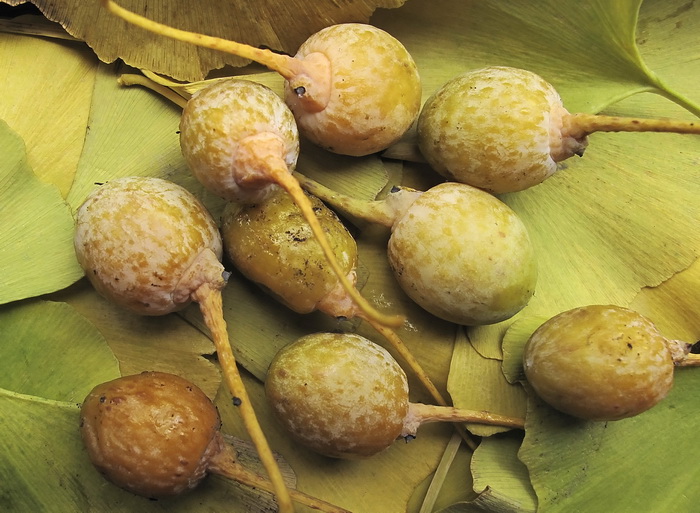
Photo Yu. Semeykin
Species: only one species has survived – Ginkgo biloba L..
- Ginkgo adiantoides
- Ginkgo apodes
- Ginkgo biloba L., 1771 — Ginkgo biloba
- Ginkgo cranei
- Ginkgo digitata
- Ginkgo dissecta
- Ginkgo gardneri
- Ginkgo ginkgoidea
- Ginkgo huolinhensis
- Ginkgo huttonii
- Ginkgo yimaensis
Forms:
- f. fastigiata – pyramidal,
- f. pendula – weeping,
- f. аureа – golden,
- f. variegata – variegated.
Cultivars: Laciniata, St. Cloud, Tremonia, Chris' Dwarf (Chris s Dwarf, Munchkin), Fastigiata Blagon.
Hardiness zone: 3b (-30°C)
Location: sun-loving, but young plants do best in light partial shade. Wind-resistant. Not demanding regarding soil composition, but requires consistently moist soil without waterlogging. Smoke- and gas-tolerant.
Planting: does not tolerate transplanting well.
Care: practically does not require care. Organic fertilizer with low nitrogen content can be used.
Pruning: tolerates pruning well; grown in bonsai style.
Diseases and pests: highly resistant to diseases and pests.
Propagation: propagated by cuttings (stem and root) and by seed. Seeds have high germination, but it is quickly lost. Immediately after collection the seeds are cleaned of the fleshy covering in salt water and sown at 10–15 g per 1 running meter, planting depth 3–5 cm. Soil germination 91%. In the first year seedlings reach a height of 12–15 cm. Cuttings are prepared at the end of June – beginning of July. Preference is given to short and semi-woody shoots – they are cut into cuttings with a "heel" or with part of the last year's wood. It is necessary to remove half of the leaves and place them for several hours in a rooting solution. After that, plant in a soil-covered plastic frame. Substrate: coarse sand, raised peat and perlite. Cuttings should be regularly sprayed with a solution of "Epin" or "Zircon". By autumn the plants form roots or callus. In winter the cuttings are covered with fir boughs. Replant the cuttings in April.
Uses: ornamental for its light trunk, original crown, unusual leaves that turn golden in autumn. Male specimens are used in parks, squares, and in urban landscaping. Looks impressive against the background of coniferous and evergreen trees. Seeds are used as food.