
Indoor plants
Gerbera
Gerbera
Family Asteraceae (Compositae). Native to South Africa. The genus was first described in 1737 by the Dutch botanist Jan Gronovius (Dutch: Jan Frederik Gronovius, 1690—1762) and named by him in honor of his colleague, the German physician and botanist Traugott Gerber (Ger. Traugott Gerber, 1710—1743), director of the Apothecaries' Garden (botanical garden) in Moscow in 1735—1742, an explorer of the flora of the Volga region. Carl Linnaeus used this name in his work published in 1758. Since, according to the International Code of Botanical Nomenclature, scientific plant names published before 1 May 175 are not considered effectively published, Linnaeus is formally the author of this name and the genus name is written as Gerbera L
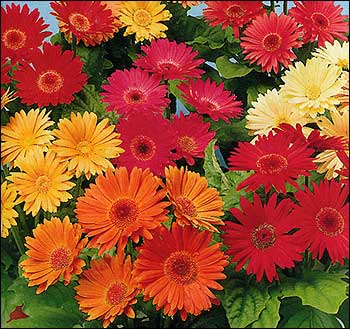
Gerbera is grown not only for cut flowers but also as a houseplant. In autumn flowering dwarf cultivars are supplied from the Netherlands. In cultivation there are both single and double forms with capitulum inflorescences up to 5 cm in diameter, often incorrectly called flowers, of various colors - with yellow, orange, red, pink and white ray florets («petals») around a yellow center. Gerbera leaves are deeply divided, up to 15 cm long, pubescent.
If you have purchased a truly dwarf cultivar of gerbera, it will not exceed 25–30 cm in height. But often ordinary tall plants are treated with growth-retarding substances. In that case the dwarf habit will end the following year and the plant will turn into a large bush.
Gerbera jamesonii - a compact form with scapes 25 - 30 cm high. Plants grown from seed usually have taller scapes. More consistent results are given by the cultivar Parade.

Location: flowering depends on day length, so the plant usually blooms from late August until November. Gerbera is a light-loving plant, grows well in a sunny spot or under bright diffused light. The temperature is moderate; during flowering 16-20 °C. In summer it is useful to put plants out on the balcony or ventilate the room well. In winter, after flowering has finished and until February, keep gerbera at 12-14 °C.
Light: bright light
Watering: should be abundant but not excessive. Between waterings the root ball should be allowed to dry slightly. Excessive watering promotes the development of fungal infections.
Air humidity: moderate, it is useful to occasionally mist the leaves.
Care: from spring until the end of August fertilize gerbera with a complete mineral fertilizer (no organic fertilizer) once every three weeks.
Propagation: sow seeds in March. Sow seeds at shallow depth, only lightly covering with soil. Seedlings appear in 10-15 days. Prick out seedlings at the stage of three true leaves. Established plants can also be propagated by division of the clump when repotting.
Repotting: as needed in early spring. Soil: leaf soil, peat, sand or sphagnum (2:1:1). Under no circumstances add compost or fresh manure to the soil.
Diseases and pests: spider mite, aphids, scale insects, mealybugs.