
Indoor plants
Gasteria
Gasteria
Gasteria (Gasteria Duval) – a genus of succulent plants from the Aloe tribe of the Asphodelaceae subfamily. It was first described by the botanist Duval in 1806. Named for the resemblance of the flower's shape to a stomach.
Endemic to the Cape botanical province (South Africa). They occur on rocky slopes, where, thanks to their ability for vegetative reproduction, they form small clumps.
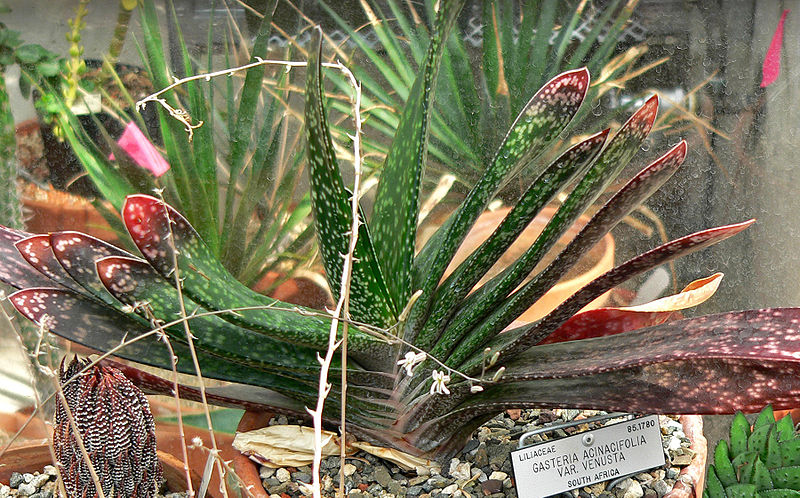
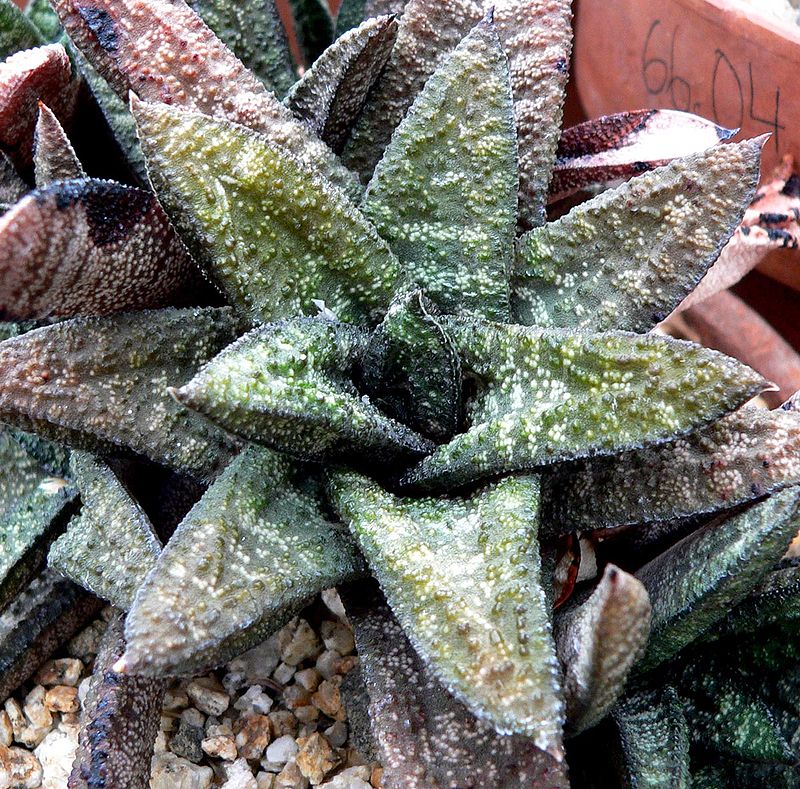
It is a perennial leafy herbaceous succulent up to 20 cm tall with thick fleshy tongue-shaped leaves arranged in dense rosettes. Young gasterias are characterized by a two-ranked leaf arrangement; with age the leaves are arranged spirally (in some species, e.g., Gasteria verrucosa, the two-ranked leaf arrangement is retained). Leaves smooth, tongue-shaped, 16-20 cm long, dark green, the margin sharply roughened, with diffuse light spots (a pattern specific to each species), the leaf tip abruptly narrowed into a firm point.
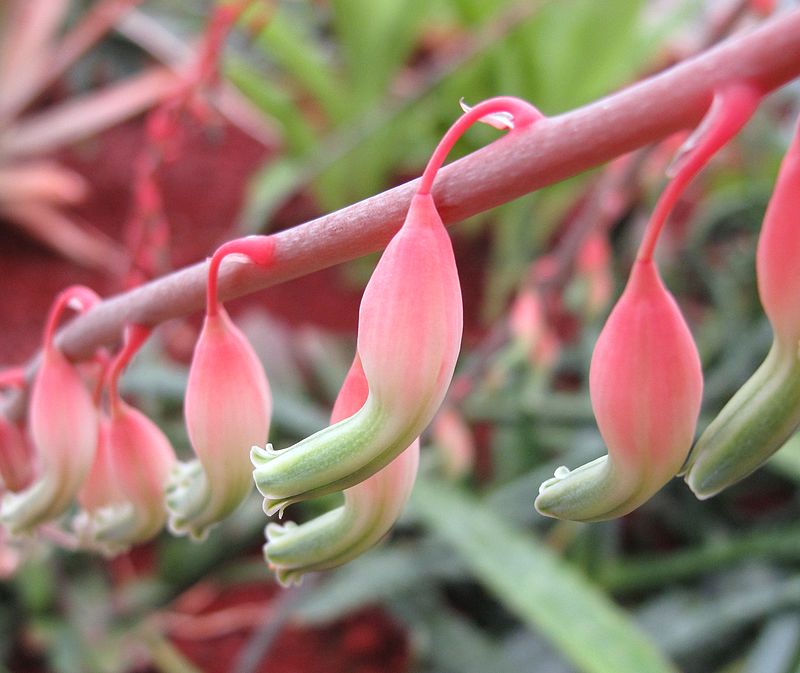
Flowers small, tubular, swollen at the base, red, yellow, or orange, arranged on a long inflorescence in a terminal one-sided raceme. As with aloes, gasteria flowers have nectaries that attract insects, although the plant is self-pollinating.
Fruits — capsules with dust-like seeds, which are dispersed by the wind that shakes the tall inflorescence.
Species: Two species of Gasteria are usually cultivated indoors:
-
warted gasteria (Gasteria verrucosa), with dark green leaves covered on both sides with numerous convex, hard, white warts
-
spotted gasteria (Gasteria maculata), whose leaves, unlike those of Gasteria verrucosa, are smooth, dark green with white or light green spots.
There are also the following species:
-
Gasteria acinacifolia (J.Jacq.) Haw.
-
Gasteria batesiana G.D.Rowley
-
Gasteria baylissiana Rauh
-
Gasteria brachyphylla (Salm-Dyck) van Jaarsv.
-
Gasteria carinata (Mill.) Duval
-
Gasteria croucheri (Hook.f.) Baker
-
Gasteria disticha (L.) Haw.
-
Gasteria doreeniae van Jaarsv. & A.E.van Wyk
-
Gasteria ellaphieae van Jaarsv.
-
Gasteria excelsa Baker
-
Gasteria glauca van Jaarsv.
-
Gasteria glomerata van Jaarsv.
-
Gasteria minima Poelln.
-
Gasteria nigricans Haw.
-
Gasteria nitida (Salm-Dyck) Haw.
-
Gasteria obliqua (Aiton) Duval
-
Gasteria pendulifolia van Jaarsv.
-
Gasteria pillansii Kensit
-
Gasteria poellnitziana Jacobs.
-
Gasteria polita van Jaarsv.
-
Gasteria pseudonigricans Haw.
-
Gasteria pulchra (Aiton) Haw.
-
Gasteria rawlinsonii Oberm.
-
Gasteria transvaalensis De Smet ex Bak.
-
Gasteria tukhelensis van Jaarsv.
-
Gasteria vlokii van Jaarsv.
Hardiness zone: 12 (+10+15°C)

Soil mix: turf soil : leaf mold : sand : fine expanded clay (1:1:1:0.5)
pH: acidic to slightly acidic
Repotting: repot in spring or summer once every 2 years
Dormancy period: in indoor conditions it is forced (from October to February) due to reduced light and air humidity
Winter care (October-February): optimal temperature: 10-15°C
Watering: sparingly
Specific cultural requirements: Gasteria prefers a bright location, tolerates light shading, and should be protected from direct sunlight
Propagation: by division of the clump, separation of offsets, or seeds
Recommended for growing: on bright windowsills; for creating compositions of desert plants
Problems in cultivation:
-
poorly tolerates lack of light;
-
overwatering of the soil can cause root rot; the plant may become watery and soft;
-
affected by scale insects, mealybugs, and gray rot
Usage: as a houseplant for creating compositions of desert plants