
Flowers for the garden
Snowdrop, or Galanthus
Galanthus
Snowdrop, or Galanthus (Latin Galanthus) — a genus of perennial herbs of the family Amaryllidaceae (Amaryllidaceae). It includes 18 species. The plant is distributed in Central and Southern Europe, on the Black Sea coast, on the western coast of the Caspian Sea and in Asia Minor. The greatest species diversity of snowdrops is in the Caucasus (16 species).
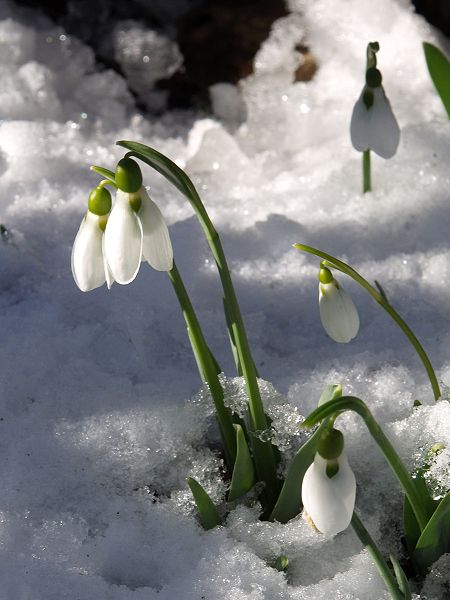
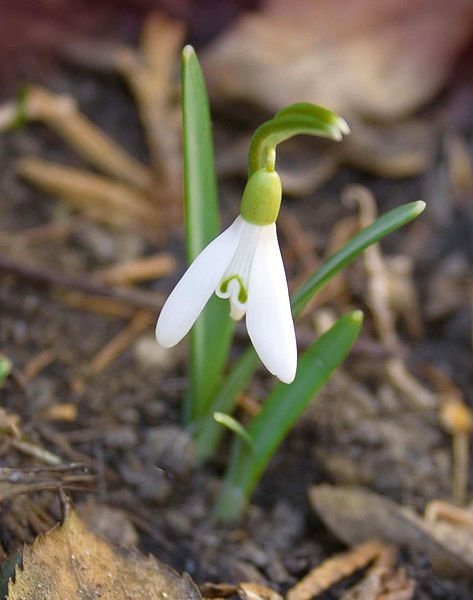
The name literally means 'milk-flower' in ancient Greek, given for the white color of the flowers. Representatives of the genus are called "snowdrops" for their very early flowering, which occurs literally from under the snow. The English call this flower a snowdrop or snowbell, and the Germans a snow bell.
Perennial bulbous plants with a short growing period. The length of the growing season depends on the latitude and altitude of their habitat. A bulb 2—3 cm in diameter consists of the scales of one or two previous years and a renewal bud. Three scales arise annually, one from the basal leaf and two from the base of dormant leaves. The scales are concentric, and one formed from the base of the leaf preceding the flower is not closed. Offsets are located in the axils of the scales of the mother bulb.
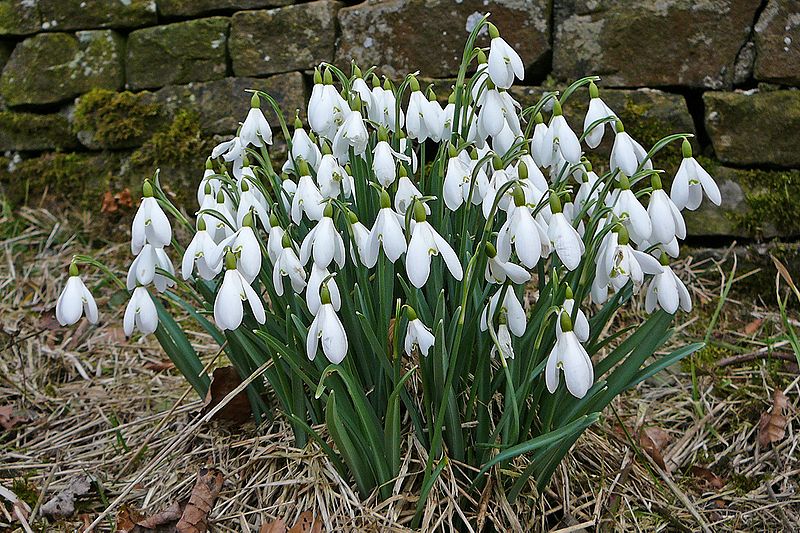
Leaves are two, rarely three, linear or narrow-lanceolate, emerging from the neck of each bulb. Leaves appear simultaneously with the buds and during flowering are equal to or significantly shorter than the scape. Later, after flowering, they expand, reaching a length of 10—20 cm. Leaf color ranges from light green with a yellow tint (Galanthus woronowii) to dark green (Galanthus alpinus). They can be shiny, matte, with a greasy sheen or with a waxy bloom. The apex is acuminate or rounded. The leaf base is broad or narrowed, passing into a petiole. The leaf surface is smooth or folded.
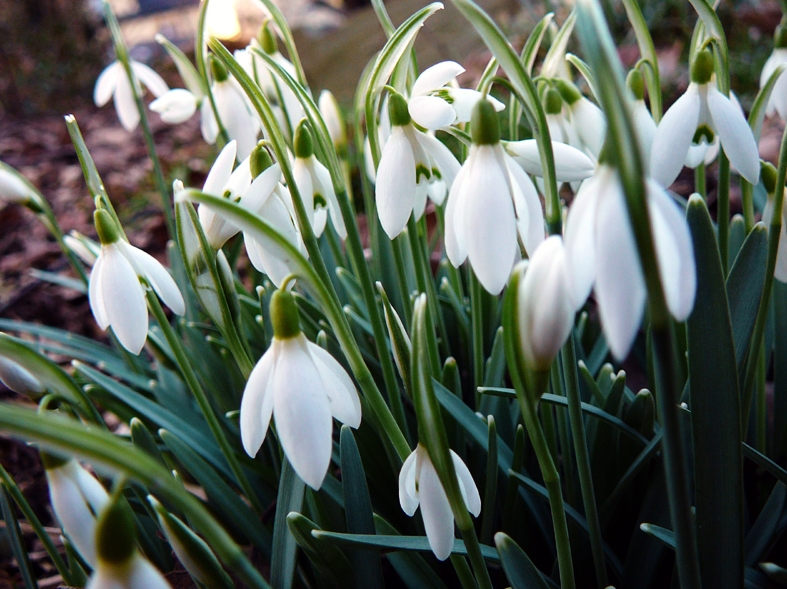
The flower consists of six segments: three outer — pure white, 15—30 mm long, mostly spoon-shaped; three inner — obcuneate, with a green spot at the tip. Pollination is carried out by butterflies, beetles, flies, bees.
The fruit is a fleshy capsule opening by valves. Seeds are globular.
Cultivated as an ornamental. Used for planting in large groups, in borders, and on rock gardens.
Location: grow under the canopy of trees and shrubs, in partial shade, but prefer open places. Hardy.
Soil: develop best in sufficiently moist, loose, well-drained fertile soil after the addition of humus or compost. They do not tolerate sites that are high and dry or low with waterlogging. Heavy clay soils require the addition of sand.
Care: leaves should not be cut until they have completely withered. During active growth apply liquid inorganic fertilizers.
Propagation: plants reproduce vegetatively, forming one or two bulbs over the summer. Propagation by seed is also possible. Sow directly in the ground immediately after collection; plants flower in the 4—5th year. Planted on lawns under the canopy of trees and shrubs, they multiply by self-seeding.