
Flowers for the garden
Gaillardia
Gaillardia Foug.
Family Asteraceae. Widespread in America. The genus includes about 20 species of annual or perennial herbaceous plants. G. pulchella, or bicolor (G. pulchella Foug., syn. G. bicolor Lam.). Native range - Florida.
An annual plant, a bush 50- 60 cm tall, densely branched, profusely flowering. Leaves elongated-oval or spatulate, covered with hairs. Inflorescences large, single, semi-double or double. Semi-double inflorescences consist of 2-3 rows of ligulate (ray) florets and small tubular ones in the center, while double ones consist of greatly expanded tubular (funnel-shaped) brightly colored flowers. The color of the inflorescences ranges from pure yellow to orange, red-brown, bronze, red and bicolored. Flowers bloom from June until the frosts. There are garden forms - G. picta (G.p. var. p/cta A. Gray, G. picta hort.), whose cultivars are widely used in floriculture; G. lorenziana (G. lorenziana hort., G. p/cta var. lorenziana hort.) - a bush 50 cm tall, large double inflorescences, and there is a form with a globular low bush (25 cm tall). In recent years tetraploid forms with larger double inflorescences have been obtained - 'Tetra Fiesta', 'Sanguinea Tetra' and 'Super Chief'.
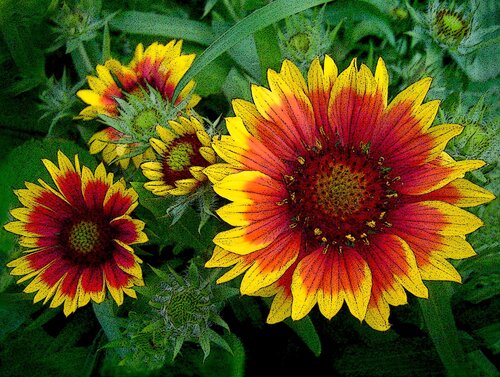
Gaillardia is sun-loving, fairly cold-hardy, grows well and blooms abundantly on any humus-rich, light, non-acid soil (pH 6.0-7.0). It does not tolerate manure fertilization and excess moisture. Seeds are sown in early April in boxes or in semi-warm frames; seedlings are pricked out into frames. Transplant to the ground in late May. Fertilize during the budding period with a mixture of mineral NPK fertilizers (25-30 g/m2). Seeds can be sown outdoors at the end of April in rows or two seeds per hole. Outdoor sowings bloom in July. Fruit - an achene, elongated, with stiff hairs along the margin. In 1 g - 400-500 seeds. Viability is retained for 2 years. Used for borders, mixed borders, group plantings (simple and mixed), and for cutting.