
Flowers for the garden
Goose onion, or Bird's onion, or Gagea
Gagea
Goose onion, or bird's onion, or Gagea (lat. Gagea) — a genus of herbaceous bulbous plants of the family Liliaceae (Liliaceae), widespread in the temperate regions of Eurasia and also in North Africa. All members of the genus are early-spring ephemeroids. The total number of species is about one hundred.
The genus received its scientific name in honor of Sir Thomas Gage (Eng. Thomas Gage, 1781—1820) — an English amateur botanist, a researcher of the flora of Ireland and Portugal.
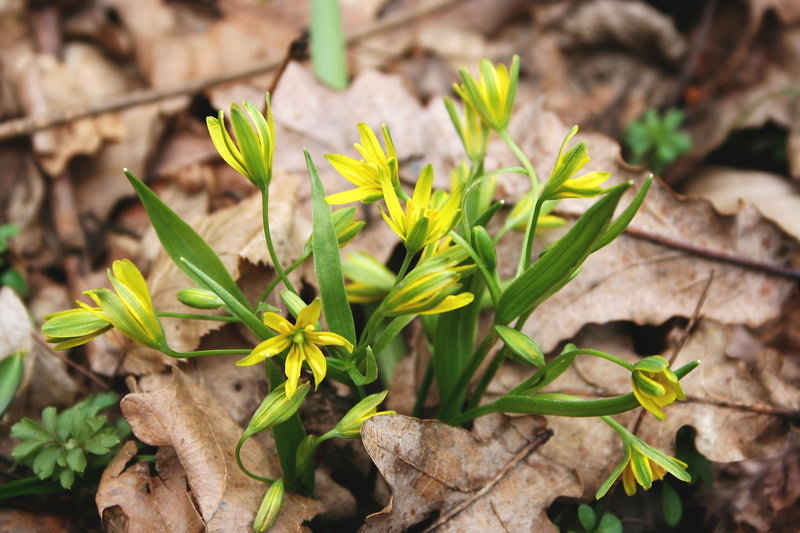
Perennial, herbaceous, bulbous plants 3 to 35 cm tall. Plants may have a single bulb, but often several daughter bulbs are also formed, connected to the mother bulb by stolons. The bulb is small, oblong-ovoid, covered with gray-brown tunics. The basal leaf is flat, broadly lanceolate, narrowed at the tip, exceeding the inflorescence; below the inflorescence there are two unequal leaves, the lower one lanceolate, usually longer than the inflorescence, the second smaller, linear-lanceolate or linear, usually shorter than the inflorescence.
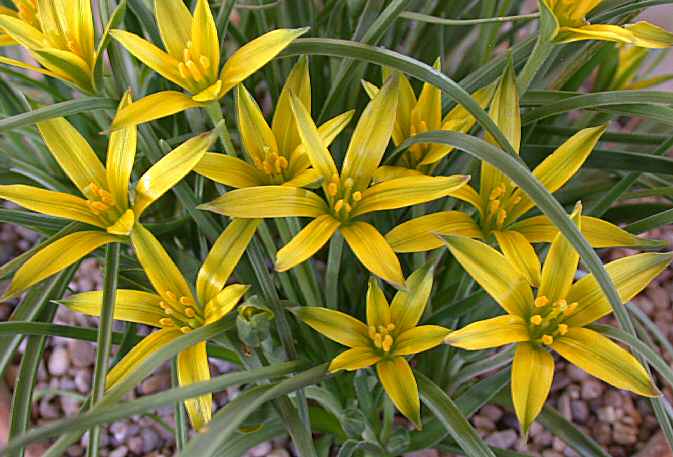
Inflorescences are umbel-like, with a small number of flowers. Flowers are small, yellow, star-shaped. The perianth is simple, corolla-like, consisting of six tepals (segments) arranged in two whorls. There are six stamens. Pollination is carried out by insects attracted by nectar. The fruit is a three-angled membranous capsule. It blooms in April. Fruits ripen in May—June. Shortly after flowering, the above-ground parts die back.
Gageas reproduce vigorously also by small bulbs that form on the base of the bulb, in the axils of basal and stem leaves, and sometimes at the sites of buds. Gageas can be seen as colonizing plants, establishing in new habitats. They have a rather modest appearance but can sometimes be extraordinarily attractive in rock gardens. They are hardy plants. Used for low borders and in rock gardens.
Location: requires a fairly well-lit position, can tolerate partial shading, in deep shade it develops poorly and hardly flowers
Soil: loose, fertile, with adequate moisture but well-drained, without waterlogging.
Care: plants are undemanding, develop well without external intervention.
Propagation: by seeds and vegetatively.