
Flowers for the garden
Fritillary, or Fritillaria
Fritillaria
Fritillary, or Fritillaria (Latin: Fritillaria) — a genus of perennial herbaceous plants of the family Liliaceae (Liliaceae). About 150 fritillaries are known, growing wild in the temperate climates of the Northern Hemisphere. Some species occur in the forests of East Asia, many — in West Asia.
The scientific Latin generic name Fritillaria comes from the Latin 'fritillus' — a dice-throwing cup, referring to the shape of the corolla. The Russian common name is based on the mottled (speckled) pattern of the flower of the most widespread species in Russia — the Russian fritillary, or on the resemblance of the flowers, sprinkled with multicolored spots, to the feathers of a forest bird of the grouse family.
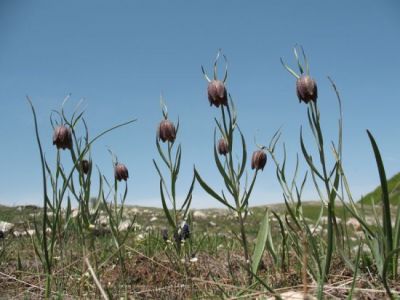
Perennial herbaceous bulbous plants. The bulb consists of several (two—four—six and more) fleshy broad scales, in some species unfused, in others — fused entirely or halfway; some of the scales bear buds in their axils that develop into new bulbs. Fritillaries are typical ephemeroids (plants with a very short vegetative period). Their bulbs are renewed annually. From the bulb grows an aerial stem with more or less numerous, oblong-lanceolate or narrow-linear leaves, arranged along the stem alternately or in whorls. Bracts are erect, sometimes spirally twisted.
Large pendulous flowers appear singly or several together (in an umbel or panicle) at the top of the stem. The perianth is simple, brightly colored (yellow, red, white, purple), often spotted, six-petaled, bell-shaped; at the base of each petal there is a nectar pit in the form of a triangular, oval or round depression. The fruit is a six-angled capsule, three-chambered, winged or unwinged, with numerous flat seeds.
In cultivation:
Fritillary imperial — Fritillaria imperialis
The most commonly encountered species in gardens. Also known as the Turkish fritillary or crown imperial. In cultivation in Europe at least since the 16th century. Several cultivars are known in both red-orange and yellow forms.
Bulbs are large – up to 12–15 cm in diameter (bulbs of yellow cultivars are smaller), have a characteristic unpleasant odor and often a reddish tint. Bulbs often split into two. The plant is robust – up to 1 m and taller. The bulb is planted at a depth of 25–30 cm and at roughly the same spacing.
There are usually six flowers, arranged on a tall, bare scape ending in a tuft of leaves. The flower color of the imperial fritillary is brownish-orange. In cultivars it is quite varied, though it remains within the red-orange-yellow range. The petals of red and orange flowers often have dark burgundy streaks at the base and along the midrib on the outside.
The species is undemanding but does not tolerate excess moisture — in that case it stops flowering and may die. Annual lifting is recommended, followed by storage in sand or covering plantings with black film for the summer. Most cultivars are resistant to spring frosts, but may produce underdeveloped flowers, especially with a rapid onset of spring. Excellent as a cut flower (to avoid weakening the bulb it is recommended to cut above the upper whorl of leaves).
Fritillary meleagris — Fritillaria meleagris
Occurs wild in Western Europe. Undoubtedly Fritillaria meleagris is the best-known and most popular representative of this botanical genus. The specific epithet meleagris means "spotted plumage," as in a pheasant or grouse.
A perennial bulbous plant up to 35 cm tall. Leaves linear-lanceolate, narrowed, blunt at the tip. Flowers solitary, more rarely in pairs, bell-shaped and nodding, reddish-brown or white with a distinct checkered pattern, up to 2.5 cm in diameter. Blooms in late spring for 2–3 weeks. The bulb is flattened, up to 2 cm in diameter. In cultivation since 1519.
This species is propagated by mature bulbs, by the numerous bulblets, and by seed (the white form produces few seeds); the period from sowing seed to flowering of seedlings takes about 3 years. Fritillaria meleagris can remain in one place for several years. An excellent plant for naturalizing. Bulbs are usually lifted when propagation is required. A moisture-loving species. Lifted bulbs should preferably not be stored for long.
Fritillary Michailowsky — Fritillaria michailowskyi
Occurs in northeastern Turkey. This species, described in 1904 by Michailowsky, became truly popular only after it was rediscovered in Turkey by the English in 1983. It has recently become widely grown in cultivation.
A characteristic feature of the species is solitary, maroon flowers with a yellow edge. Blooms in mid-May. The plant is low, only up to 20 cm tall, so it is well suited to rock gardens. Grows in sun and partial shade. Usually propagated by seed. Seedlings can be grown without lifting until they flower. However, large bulbs are less resistant to disease, which is especially evident in years with a wet summer. They should preferably be lifted regularly. In nurseries two forms are encountered: a taller form (up to 25 cm) producing 1–2 flowers, and a dwarf form no more than 15 cm, which flowers much more abundantly. Winter hardiness zones 4–9 according to Western catalogs.
Fritillary Persian — Fritillaria persica
A tall Asian species. Occurs in Iran and Turkey. Also found in Jordan and Israel.
One of the oldest species in cultivation. A large plant, demanding of warmth and light. Its stem reaches 1—1.2 m in height. This is a very striking plant: up to 30 purple flowers open at its apex. Should be planted only in a fully sunny site. A cool summer does not kill this fritillary, but it may fail to set next year, so summer lifting is absolutely necessary. It is very useful to warm the bulbs, for example by placing them in a greenhouse, protected from direct sunlight. Propagates well vegetatively. In winter plants should be covered with organic material to protect young shoots from frost damage. The flowering stems of this species are used in floristry.
Fritillary Russian — Fritillaria ruthenica
In nature it occurs only within the territory of the former USSR, in the forest-steppe and steppe zones of the European part of Russia, in Western Siberia, and also in Ukraine and Kazakhstan. Listed in the Red Book of Russia.
A graceful plant with a slender stem up to 50 cm tall, clothed in the upper part with narrow leaves. The uppermost leaves are filiform, coiled like a snail. With these leaves the plant clings to supports. Flowers 1–3 (up to 8–10) at the stem apex, externally brownish-purple with an indistinct checkered pattern, inside brighter with greenish stripes along the petals and at their tips. The bulb is flattened, up to 2 cm in diameter. In cultivation since 1877. Hardy. Light-loving, but develops normally in partial shade as well.
Grows well on loose, fertile soils. Propagated by seed and by daughter bulbs. Propagation by all methods is generally poor. Blooms annually in early May. A promising garden plant that, besides its ornamental qualities, possesses medicinal properties.
Location: requires a fairly well-lit site, can tolerate some shading; in deep shade it grows poorly and does not flower
Soil: prefers neutral, light, well-aerated soils.
Care: fairly frost-hardy and mature bulbs rarely perish with correct cultivation, but in low-snow winters they should be mulched or covered. This is also necessary for bulbs grown in warmer climates. All types of fertilization are suitable, except concentrated foliar feeds, which can burn the leaves. If there is no need to produce seed, be sure to remove the seed pods after the petals have fallen.
Propagation: by seed and vegetatively.
Zone: 4-9.