
Indoor plants
Fittonia
Fittonia
Fittonia (Fittonia) — a genus of South American plants of the Acanthus family (Acanthaceae), includes 4 perennial ornamental-leaved species (three of them with creeping, prostrate shoots and one erect). In nature Fittonia grows in warm, humid conditions, so it proves to be a rather difficult and capricious plant for the home. Fittonia is best grown in a terrarium. In spring, under favorable conditions, Fittonia may flower, but its inconspicuous yellowish flowers have no ornamental value.
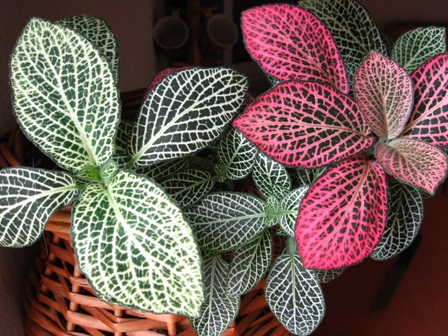
Fittonias were named after two sisters — Elizabeth and Sarah-Maria Fitton (c. 1810—1860). These English ladies were honored for creating in the early 19th century the first classical botany textbook.
Fittonias are perennial low-growing herbaceous plants with creeping, pubescent shoots. Flowers are sulfur-yellow, solitary, sessile, gathered into terminal spike-like inflorescences in the axils of small, 1.1 cm long and 1.1 cm wide, ovate-rounded, ciliate, oppositely arranged green bracts. Fittonias are notable for the coloration of their leaves. The plants require extra care, as they do not tolerate temperature fluctuations and dry air well and need pruning.
In cultivation:
Fittonia Verschaffeltii - Fittonia verschaffeltii
A perennial herbaceous plant, it has creeping, heavily branching stems about 10 cm high. Stems are pubescent, with silvery-gray hairs when young, becoming green with age. Leaves are oval, about 10 cm long, glabrous or sparsely pubescent, dark green, covered with a network of bright red veins. Flowers are small, yellow, covered on top by a bract, gathered into spike-like inflorescences.
Fittonia agryroneura (silver-veined Fittonia) - Fittonia agryroneura
A small herbaceous plant with erect stems. Leaves are oval, light green, with silvery veins. There are large-leaved cultivars with leaves about 10 cm long, and small-leaved ones with leaves about 2.5 cm long.
Fittonia gigantea - Fittonia gigantea
A perennial herbaceous plant, erect stems up to 55-60 cm long, which become woody over time. Leaves almost cordate, up to 15 cm long, dark green with a network of reddish veins. Flowers are dark pink, with a yellow spot on the corolla.
Temperature: Fittonia is heat-loving; the temperature should never drop below 15–17°C. In summer the optimal range is 20–25°C, in winter 18–20°C. Fittonia does not tolerate drafts and sharp temperature fluctuations.
Light: Partial shade; in bright light or in too dark a place the leaf coloration fades. Protect from direct sunlight. In winter plants should not be placed close to windowpanes.
Watering: Abundant in summer; the soil should be kept slightly moist at all times. In winter water more moderately; the soil must not dry out completely. Water Fittonia only with soft water.
Fertilizing: From April to August feed Fittonia with a liquid fertilizer for indoor ornamental-leaved plants every two weeks. Fittonia is sensitive to excess fertilizer or overfeeding, so use half the dose recommended for other plants.
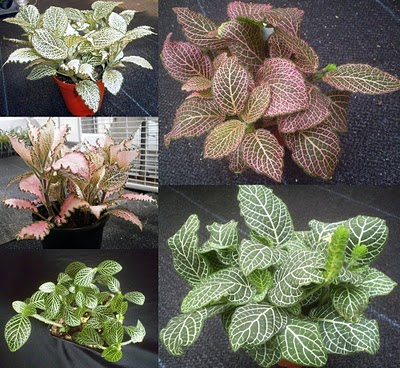
Humidity: Likes humid air up to 90%. Regular leaf misting is necessary. Place the pot in damp peat or in a terrarium.
Repotting: Annually in spring into a loose, light soil composed of 1 part garden (sod) soil, 1 part ericaceous (or coniferous) soil, 1/2 part peat, 1/2 part sand. Choose a pot that is not deep but wide, as this plant has shallow roots.
Propagation: Fittonia is easily propagated by cuttings, division, or layering.