
Indoor plants
Ficus
Ficus
Family Moraceae. This is one of the most common houseplants.
The first honorary place among the various species of ficus is occupied by the rubber tree, Ficus elastica. Also very popular are Ficus benjamina, the fiddle-leaf fig, the Bengal fig, dwarf ficus and others.
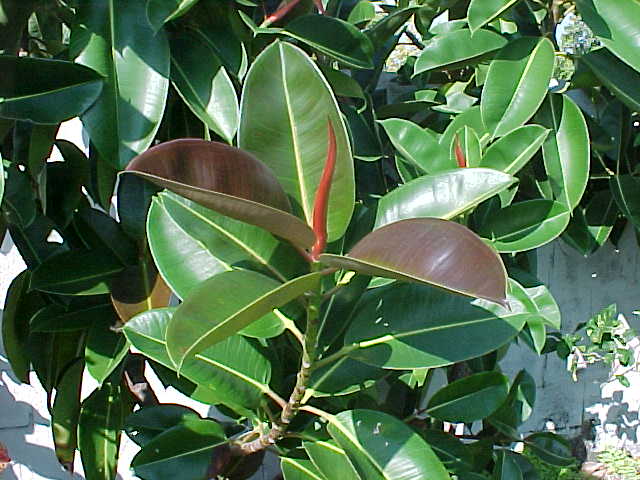
All ficuses do not tolerate drafts, overwatering of the soil or direct sunlight (variegated forms of ficus are more light-demanding and can tolerate direct sun, but should be shaded during the hottest hours).
In winter a ficus also needs light, so pots with plants are moved closer to the window. Variegated forms, for example Ficus benjamina, can stand on a south-facing windowsill all winter. With insufficient light in winter, weak and twisted shoots and leaves form.
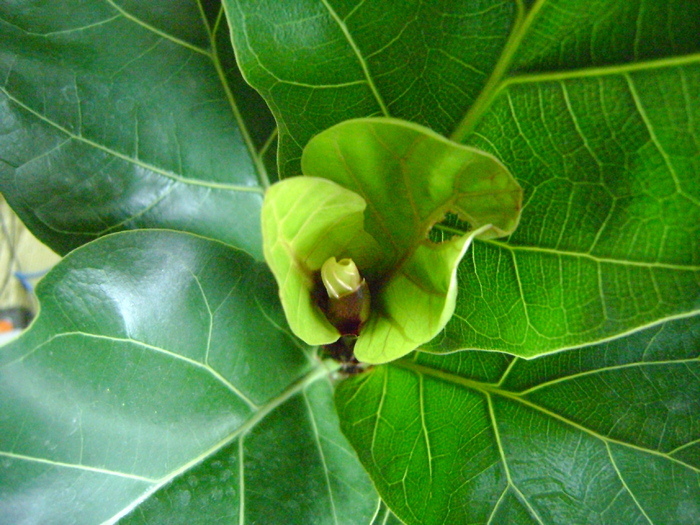
Ficuses are propagated by cuttings. From one shoot you can obtain as many cuttings as there are leaves on it. A cutting for propagation should consist of a single leaf with an undamaged bud and half of the lower internode without a bud. After cutting, place the cutting in warm water to stop the flow of milky sap. For better rooting, make a slit or split at the base of the cutting (for a cutting with hard wood make a cross cut, for a cutting with soft wood make a single incision). Cuttings root better with bottom heat and covered with a polyethylene bag.

The best soil mixture for all ficuses is: 2 parts leaf mould, 1 part peat soil and 1 part humus. Ficuses do not like to be planted into a container significantly larger than their root system, so they are repotted when the roots are presumed to have filled the entire pot or tub. They grow fairly quickly, therefore the soil for repotting should be nutritious; in addition, fertilizing is carried out in spring and summer (they respond well to organic fertilizers; well-rotted cow manure or the commercial fertilizer "Ispolin" are suitable). Ficuses can also be fed with fertilizers such as "Raduga" and "Palma". Old specimens of large ficuses are repotted very rarely - every 5-6 years. However, the top layer of soil can be replaced annually. The top layer of soil should also be replaced if a white crust - a salt deposit - appears on it.

Temperature: Preferably moderate, not below 18 °C. They like to "keep their feet warm" - do not put a ficus pot on a cold windowsill, marble or tiled floor, etc. In a room warmer than moderate, the leaves begin to hang down.
Lighting: All varieties of the rubber ficus prefer a bright place protected from direct sunlight. Variegated forms require a brighter and warmer location than dark-leaved forms.

Watering: Moderate; they do not like waterlogged soil. Use room-temperature, well-settled water. Fertilize with fertilizers from March to August every two weeks.
Air humidity: Leaves should be regularly wiped with a damp sponge.
Repotting: Performed in spring, when roots have entwined the whole root ball; young plants every one to two years, older ones every few years.
Propagation: By terminal cuttings; for better rooting use soil heating and cover the cutting with a polyethylene bag.
Air humidity: Leaves should be regularly wiped with a damp sponge.
Repotting: Performed in spring, when roots have entwined the whole root ball; young plants every one to two years, older ones every few years.
Propagation: By terminal cuttings; for better rooting use soil heating and cover the cutting with a polyethylene bag.