
Deciduous trees
Large-leaved beech
F. grandifolia Ehrh.
The large-leaved beech, or American beech (F. grandifolia) - a monoecious deciduous tree, slender, reaching 45-50 m in height and with a trunk diameter up to 2 m. It belongs to the beech family, which is one of the most widespread families of dicotyledonous evergreen trees and shrubs in the world. Its native range is the eastern part of North America. It is a valuable forest-forming and slope-stabilizing species. This beech, like the eastern beech, usually grows together with other deciduous and coniferous species on small elevations, and sometimes forms pure stands. At the same time, it prefers rich, moist soils with a high humus content.
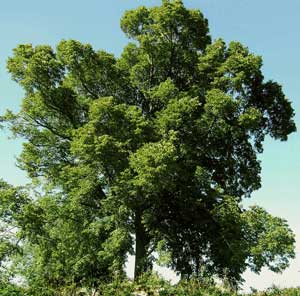
The beech has a rich structure, thanks to a developed system of medullary rays and distinct annual rings. It has a broadly cylindrical or ovoid crown; smooth, gray bark that hardens and becomes brittle with age. Leaves are elliptical in shape, downturned underneath, dark green in summer, and turn reddish-brown in autumn. The crown of a large-leaved beech over 100 years old may contain up to 200,000 leaves. Each day the tree emits up to 5 kg of oxygen and is capable of absorbing up to 6 kg of carbon dioxide. Its fruits – reddish nuts consisting of 4 lobes ending in spines.
A tree at 10 years reaches 2.8 m in height, and crown diameters of 160-170 cm; at 20 years the beech's height is about 6 m, and crown diameter about 350 cm. The large-leaved beech grows from May until the end of October; dead leaves remain on the branches until spring. During this period it consumes up to 400 liters of water per day. The tree has an average growth rate. It does not flower and has high winter hardiness. Such beeches are prone to disease agents in the form of bacteria, nematodes, and fungi. Bacterial diseases include: nectrioses and wet rot, i.e. bacterial rots, infectious diseases.
Beech is quite often affected by wetwood: watery spots appear on the bark of shoots and branches, then the affected areas sink in, and the bark falls off or cracks. Thus a yellow-red liquid begins to flow from the cracks. Sanitary felling, pruning of affected branches, destruction of affected trees in nurseries, and soil treatment help combat diseases. Like the oak, the large-leaved beech belongs to tree species that strongly dry out. The moisture content of freshly felled beech wood is approximately 80%, and its maximum moisture content when water-saturated is 120%.
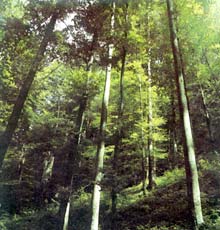
It is worth noting that beech wood is highly valued by furniture makers for its good workability and, as already mentioned, rich texture. Today, exquisite beech parquet has become widely popular due to its ability to create a cozy and noble atmosphere. Its pinkish tint creates an illusion of warmth and perfectly complements any interior.