
Indoor plants
Lisianthus or Eustoma
Eustoma
The genus Lisianthus (Lisianthus L.) contains about 60 species of plants in the family Gentianaceae. Lisianthus occur in warm regions of the southern United States, Mexico, the Caribbean and the northern part of South America. The plant is popular in gardening as an ornamental and is also used as a houseplant. Lisianthus became widespread as a potted plant in the 1990s. Most often they can be bought in summer, during the flowering period.
Only one species is usually sold – Lisianthus russelianus. It has a number of cultivars with different flower shapes and color patterns, and with varying plant heights.
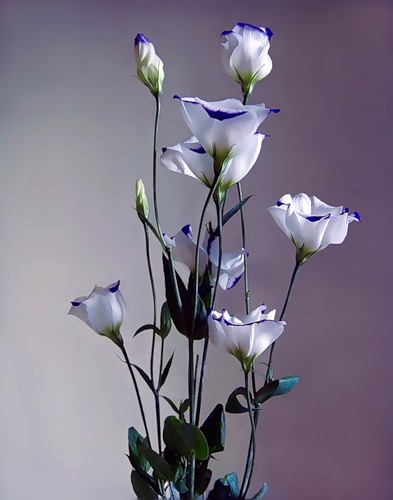
Russell lisianthus (Lisianthus russellianus = Eustoma russellianum), in various sources the main synonym is mentioned as Eustoma grandiflorum. The species occurs in Central America. A shrub with erect stems, grown under indoor conditions as an annual or biennial. Flowers gathered in clusters somewhat resemble poppy flowers. Flowers single or double, blue, purple, pink-lilac or white, depending on the cultivar. Bicolored cultivars are very attractive. For indoor culture compact cultivars no taller than 45 cm are preferable.
Location: lisianthus should be kept in the spring-summer period at 20-25 °C, the plants do not tolerate heat very well. If you decide to grow the plant not as an annual, you should provide a winter rest period, reducing the temperature from autumn to 12-15 °C.
Light: prefers bright diffused light, can tolerate some direct sunlight.
Watering: water lisianthus abundantly with soft settled water as the top layer of the substrate dries. In cool weather reduce watering to avoid over-wetting the substrate.
Humidity: when watering be careful to avoid getting moisture on the leaves. Spraying the plant is also not recommended, as moisture on the leaves can provoke fungal diseases, especially gray mold, and lead to the death of the plant.
Care: feed lisianthus weekly during active growth with a complete mineral fertilizer for flowering plants.
Propagation: by seed in spring or by division in the autumn.
Repotting: lisianthus are usually grown as annuals or biennials, so they are repotted when grown from seed or when propagated by division.
Possible problems: the plant is sensitive to overwatering – in case of waterlogged soil or poor drainage it can die.
Some cultivars produce fairly long stems that require support.
After the first flowering flush problems may occur; some plants become diseased.