Deciduous shrubs
Winged euonymus
Euonymus alatus
Winged euonymus (lat. Euonymus alatus) — a genus of plants of the spindle family (Celastraceae). The natural range is Japan, Manchuria and Central China, in open forests and shrub thickets.
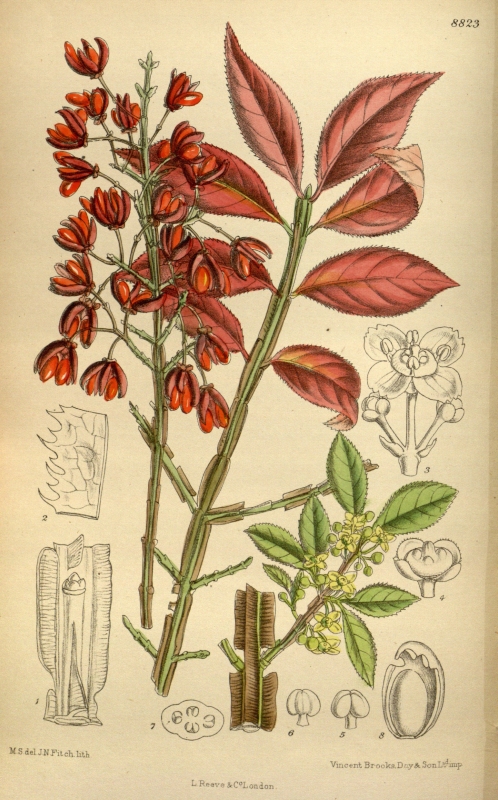
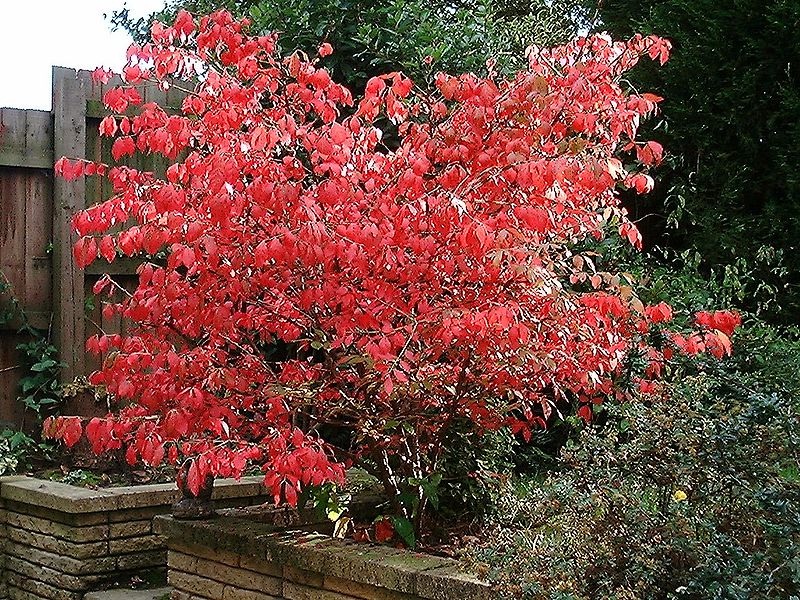
Winged euonymus is a slow-growing deciduous shrub with a broad, densely branched crown. Height 2 - 3 (4) m, with age (in the wild) spreading in width. Annual increase in height and width about 15 cm. Roots are very thin and densely branched, superficial, with a large number of fine roots and therefore sensitive to soil compaction and mechanical damage. The bark of the euonymus is very interesting: unusual corky wings along the edges of the four-angled greenish-brown shoots create an impression of airiness. Leaves are opposite, obovate or elliptic, green above and lighter beneath, 3 - 5 cm long; autumn coloration is bright carmine-red or purplish-red, appearing early and very distinct, in shade more lilac-pink.
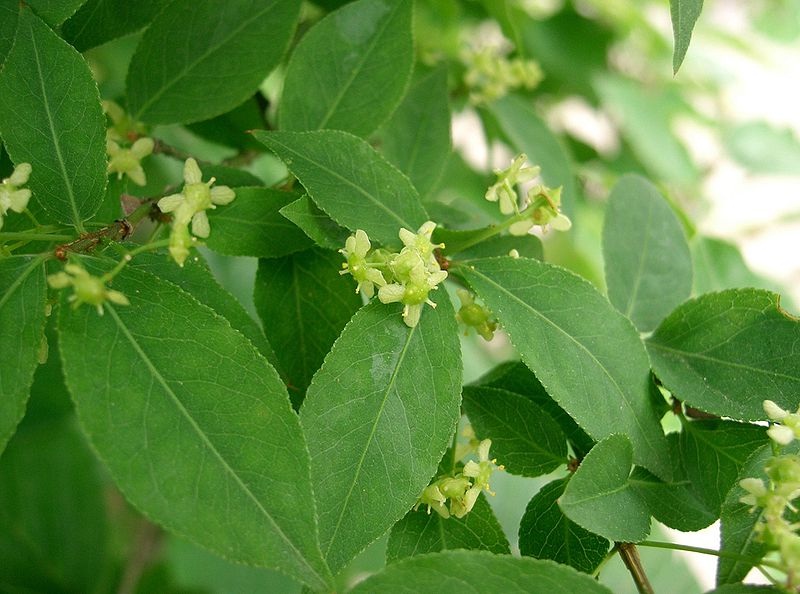
It blooms abundantly in May-June with attractive yellowish-green but small and therefore, unfortunately, inconspicuous flowers.
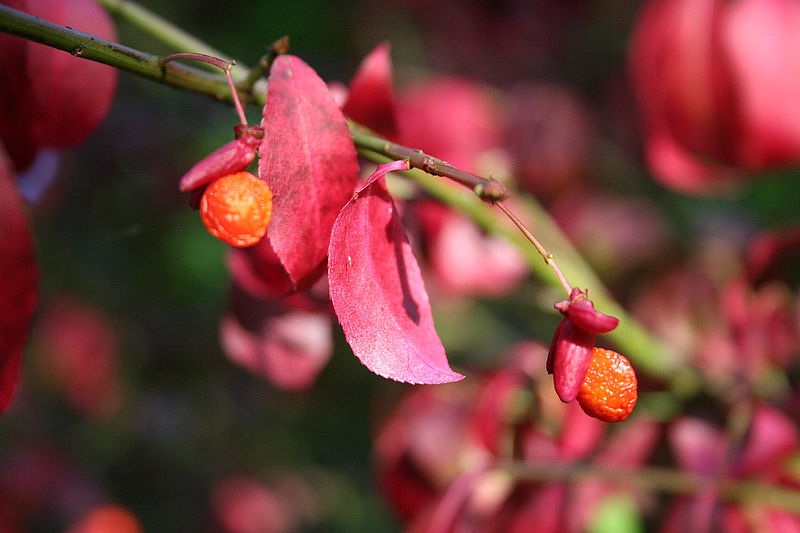
However, the numerous fruits will please you and your guests in autumn and winter. Against the background of still green leaves, garlands of bright fruits look strikingly contrasting. From a distance it appears as if the plant is in bloom. They are very original, reddish, and the leathery four-angled capsule turns bright orange when ripe, remaining on the branches much longer than the leaves, practically all winter. When the time of leaf "burning" comes, the capsules split along the seams, forming a "parachute" under which on short stalks hang the "parachutists" — several seeds covered with bright orange arils. Such original fruits are characteristic only of euonymus. As for their toxicity, they are not as dangerous as sometimes presented in some publications. Euonymus fruits indeed contain a number of toxic alkaloids, but an adult would have to eat a large quantity to be poisoned. They are somewhat sweet but have an extremely unpleasant aftertaste, making it very difficult to eat many. Even in small doses they have emetic and strong laxative effects. Nevertheless, pay attention to this if you have small children or grandchildren.
Light: Light-loving but tolerates partial shade. It also endures shade, but autumn colors will be less vivid.
Soil: Tolerates all cultivated, well-drained, not too dry garden soils, from acidic to slightly alkaline; not demanding regarding pH, prefers evenly moist, fertile substrates. Does not tolerate waterlogging. Can grow in shaded locations. Tolerant of gases and smoke.
They tolerate pruning well and transplant easily. Require regular feeding with a complete mineral fertilizer. May be affected by various pests; control measures should be taken at the first sign of their appearance. As for fruit toxicity, they are not as dangerous as sometimes presented in some publications. Euonymus fruits do indeed contain a number of toxic alkaloids, but one would have to eat a very large amount to become poisoned.
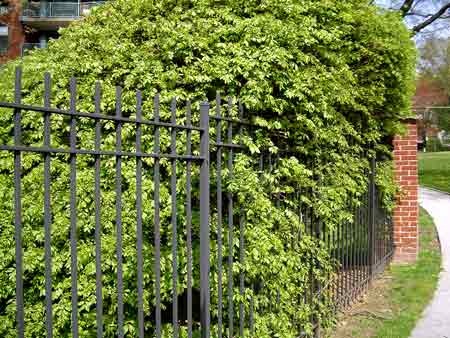
Used as a plant for a neat clipped hedge, as single specimens, in mixed borders, edging, on rock gardens; looks effective in shrub and small tree compositions. Responds well to formative pruning. Serves to fill space and impart lightness to a composition. Recommended for small private gardens. Grows well in urban conditions.
Features: Hardy, tolerates shade, leaves open early, transplants easily, tolerates heavy pruning, resistant to urban conditions, tolerant of smoke and gases.
Hardiness zone 4.