
Flowers for the garden
Eucomis
Eucomis
The genus name, translated from Greek, means «beautiful whirl».
Eucomis - a bulbous plant. It differs from other lilies by the presence of a cluster of large green or colored bracts without flowers at the top of the scape. Leaves are all in a basal rosette, strap-shaped or oblong, often with purple spots. Flowers are wheel-shaped, greenish or whitish, with purple or brownish tones, in a cylindrical raceme. The perianth consists of 6 lanceolate, equal segments fused at the base. Stamens 6, fused at the bases to the perianth segments; anthers pendulous. Ovary trigonous; style filiform; stigma capitate. Capsule flat-rounded, deeply three-grooved or three-lobed. Seeds obovoid.
Distributed in the southern tropical and subtropical zones of South Africa. The genus contains 14 species. These plants are valued for their long flowering and high ornamental value afterwards.
Eucomis spotted - (Eucomis punctata L'Herit = Eucomis comosa hort. = Ornithogalum punctatum Thunb.)
This species was introduced to Europe from South Africa in 1778. Plants 30—60 cm tall. Leaves are channelled or flat, linear or lanceolate, up to 60 cm long and 6—7 cm wide, with brown spots on the underside. Raceme lax, of 40—100 flowers. Pedicels 1.2—3 cm long. Bracts in the terminal cluster are oblong, acute, numbering 12—20. Flowers green, 2—2.5 cm wide. Cultivar 'Stricta' - the leaves of this garden form, bred as early as 1790, are streaked on the underside with longitudinal brownish-red stripes.
Eucomis bicolor (E. bicolor). This exotic species, native to South Africa, reached Europe in 1878. Scape height 40–50 cm, the scape itself has numerous purple streaks. The light-green flowers and bracts that appear at the end of summer have purple edging, and the fruits are purple. Cultivar 'Alba' - plants of this cultivar, raised by Van Tubergen, have greenish-white flowers. Stems and leaves have a uniform coloration.
Location: In southern Ukraine they may possibly overwinter in the open ground with light protection. In more northern areas cultivation is similar to gladiolus. Bulbs are planted in early May, and in late September they must be dug up and stored on the lower shelf of the refrigerator at 4 – 6 °C. With such a technique eucomis bloom readily and regularly, but produce very few offsets.
In other regions of the country they must be grown indoors, on balconies or as a container crop, planting the bulbs in March-April into pots, and in summer the grown-on plants are buried together with the container in warm soil in a sunny spot. The planting soil must be well drained, with the addition of coarse sand, and rich in humus. Purchased spring bulbs are planted singly in pots. Pots should be deep, as the plant forms a powerful, well-branched root system. The bulb is planted slightly deep so that its top is at soil level or even slightly above. From planting until the start of active growth, watering should be minimal. Then, when vegetative growth begins, the plant needs light, warmth and regular watering. Liquid organic fertilizers every two weeks are recommended. This promotes active growth and abundant, prolonged flowering.
Containers with eucomis can be planted outdoors only when the soil has well warmed and the risk of frosts has passed. The planting site should be sheltered from wind. You can plant an adult plant directly into the ground — carefully, without damaging the root system, knocking it out of the pot. But in any case remember that this exotic came to us from Africa and does not like dampness and strong winds.
From large bulbs (diameter 4 – 9 cm) a rosette of long strap-shaped leaves develops, then a sturdy scape 20 to 100 cm high appears. The inflorescence resembles a pineapple: it consists of numerous star-shaped flowers gathered in a dense many-flowered raceme, which open from the bottom upward. Flower colors are greenish, golden-green, cream, pink and even raspberry. The inflorescence ends with a cluster of 10-20 leaves, which give the plant its resemblance to a pineapple. Flowering is prolonged and attracts attention with its beauty and originality.
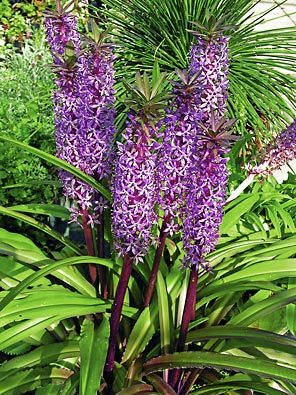
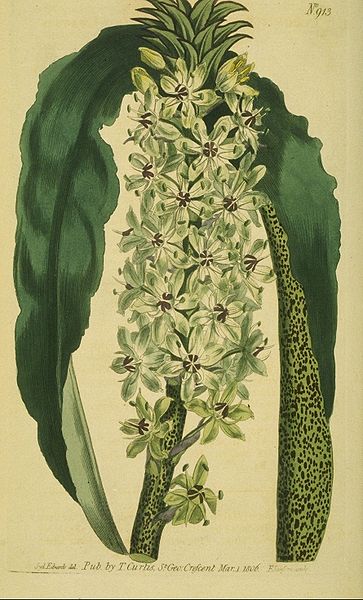
Care: In summer the plants need watering and feeding. After flowering, which lasts 2–2.5 months (begins in May-June and ends in August), the leaves gradually die back, but the plant does not lose its ornamental value thanks to the seed capsules ripening on the still sturdy scape. Then the plant enters a period of dormancy. Seeds can be collected and the dry leaves cut off. Bulbs should be dug up or the pot brought indoors before frosts.
Store eucomis at 10-12 °C in a perforated bag without soil in a cool dry place. Bulbs keep well in a pot with soil under indoor conditions. Bulbs overwintering in pots are watered very rarely and only in spring, when dormancy ends (early March) and young shoots emerge from the soil; then watering is increased and feeding is started.
Propagation: On the mother bulb, bulbils (offsets) form during the growing season. The best time to separate them is during dormancy. All cultivar characteristics are preserved. Another method of propagation is by seed: collected seeds are sown after harvest in boxes or pots. With this method one can obtain plants with different flower or leaf coloration. Care for seedlings is the same as for adult plants: warmth, light, moisture, feeding. Seedlings bloom in the third year.