Flowers for the garden
Eschscholzia, or California poppy
Eschscholzia
Eschscholzia (lat. Eschscholzia) — a genus of plants in the poppy family (Papaveraceae), comprising about ten species distributed in the western part of North America. The genus is named after the Russian traveler and naturalist (physician, botanist, zoologist) Johann Friedrich von Eschscholtz (1793—1831).
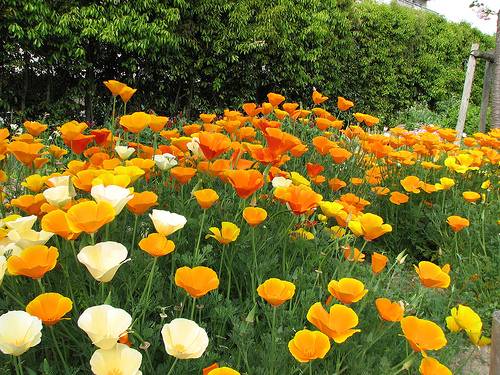
Members of the genus are annual and perennial herbaceous plants with deeply divided leaves; the flowers are usually orange or red.
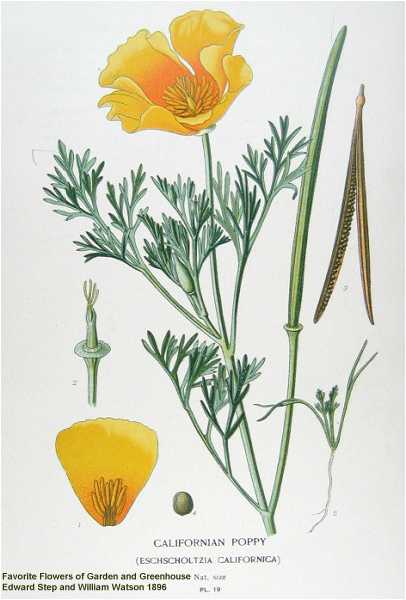
The best-known species is the California poppy (Eschscholzia californica), a perennial herbaceous ornamental and cut flower often grown as an annual. It forms a mound 20—45 cm high. Leaves are triply divided, borne on long petioles. Flowers are solitary, cup-shaped, 5—8 cm in diameter, simple or double, ranging from white to orange. Blooms from June to October. Eschscholzia californica is also called the "California poppy." The plant is used ornamentally in meadows and Moorish-style lawns, in flower beds, and as a cut flower.
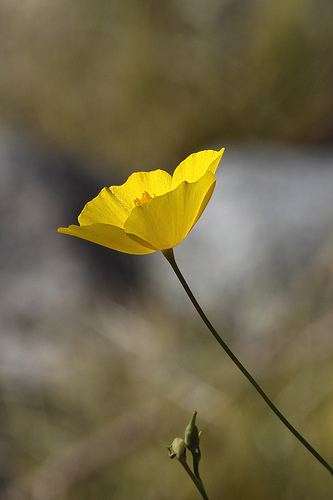
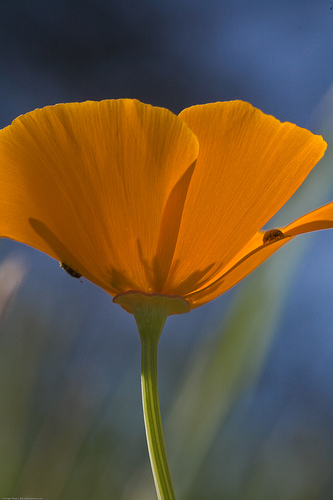
Eschscholzia californica, or California poppy — Eschscholzia californica Cham.
Native range — western regions of North America.
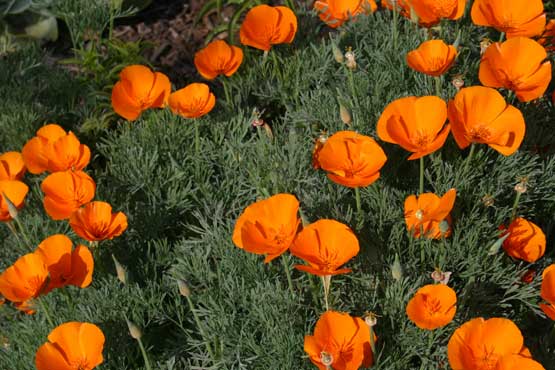
The plant is perennial and herbaceous but is used as an annual. It forms branched, compact or creeping clumps 20–45 cm high. Stems are erect, slender, with numerous ribbed, gray-green, glabrous shoots. Leaves are triply divided, on long petioles; basal leaves form a rosette, glaucous from a waxy bloom, resembling wormwood leaves. Flowers are solitary, cup-shaped, 5–8 cm in diameter, simple or double, glossy, white, cream, yellow, orange to carmine, opening only on sunny days and at midday hours (from 10 to 16). The calyx is cap-like, deciduous, gray-green. Petals are glossy, smooth, or slightly ruffled. Flowers abundantly from June to October. Fruiting occurs a month after flowering. Fruit is a pod-like capsule. Seeds are brown and remain viable for 2–3 years. Up to 650 seeds per 1 g.
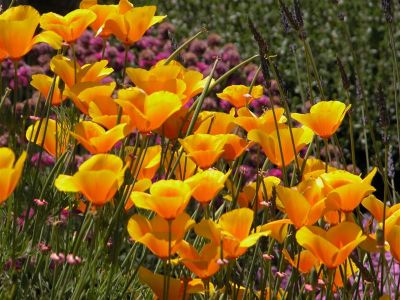
Location: the plants prefer light and warmth but can tolerate frosts down to -4-5°C.
Soil: undemanding; they grow well on dry sandy soils. Do not tolerate excess moisture or fresh organic fertilizers.
Propagation: by seeds, which are sown in April or October directly in their permanent location. Flowering begins 40–45 days after sowing. Self-seeds. Seedlings are thinned to maintain a distance of 20–25 cm between plants. Do not tolerate transplanting.